

There's little question that artificial intelligence (AI) has been Wall Street's premier catalyst over the last three years. But it's not the only hyped trend that's excited investors. Euphoria surrounding stock splits has played an equally important role in fueling optimism.
This year, five blockbuster stock splits have taken place:
- Netflix (NFLX +1.43%): 10-for-1 split in November 2025
- O'Reilly Automotive (ORLY 0.45%): 15-for-1 split in June 2025
- Interactive Brokers Group (IBKR 2.16%): 4-for-1 split in June 2025
- Fastenal (FAST 0.62%): 2-for-1 split in May 2025
- Lucid Group (LCID 7.70%): 1-for-10 split in September 2025

Image source: Getty Images.
A stock split is an event that allows a publicly traded company to alter its share price and outstanding share count by the same factor. However, these changes are purely cosmetic and don't alter a company's market cap or impact its operating performance in any way.
Despite the relatively benign nature of stock splits, investors tend to flock to companies announcing and completing forward splits. This type of split reduces a company's share price to make it more nominally affordable for investors who can't purchase fractional shares with their broker. Typically, a company that has to lower its share price has been firing on all cylinders from an operating and innovative standpoint. In other words, it's just the type of business investors want to buy and hold over the long term.
Unfortunately, not all stock-split stocks are created equally. One of the five aforementioned stock-split stocks stands out as a no-brainer buy before the end of the year, while another might as well be wrapped in yellow caution tape.
This historic stock-split stock can drive substantial long-term gains
Although streaming service Netflix is the highest-profile stock split of 2025, it's not the company that offers the safest path to long-term profits. Instead, this title belongs to auto parts chain O'Reilly Automotive, whose 15-for-1 forward split in June was its largest since going public in April 1993.
Macro themes and company-specific advantages drive the bull case for O'Reilly Automotive.

NASDAQ: ORLY
Key Data Points
To begin with, consumers are keeping their vehicles longer than ever before. In May, S&P Global Mobility, a division of the more familiar S&P Global, released its latest annual report that examines the average age of vehicles (defined as cars and light trucks) on U.S. roadways. Using vehicle registration data, S&P Global Mobility reports the average age of U.S. vehicles rose to an all-time high of 12.8 years in 2025, up from an average of 11.1 years in 2012. Even though newer vehicles are built to last longer, this dynamic points to mechanics and drivers relying on auto parts stores like O'Reilly to keep their vehicles in good working order.
O'Reilly Automotive also benefits from the nonlinear ebbs and flows of the U.S. and global economy. Although some aspects of its operations aren't cyclical, the fact that economic expansions last substantially longer than recessions encourages consumers to spend on discretionary items in its stores.
On a more company-specific basis, O'Reilly's hub-and-spoke distribution model has helped differentiate it. The company entered 2025 with 31 regional distribution centers, close to 400 hub stores, and more than 6,000 retail locations. These hub stores are strategically located to provide other retail locations (the "spokes") with more than 153,000 stock-keeping units (SKUs) on a same-day or overnight basis.
Furthermore, O'Reilly Automotive has one of the most enviable share purchase programs on Wall Street. Since initiating this program in January 2011, approximately $26.9 billion has been spent to repurchase 1.46 billion shares of stock, which represents about 60% of its outstanding shares. For businesses with steady or growing net income (such as O'Reilly), buybacks can have a decisively positive impact on earnings per share.
Though O'Reilly Automotive stock may not appear cheap at 30 times forward-year earnings, the company's persistent buyback program, coupled with its long-winded macro tailwinds, supports additional long-term upside.
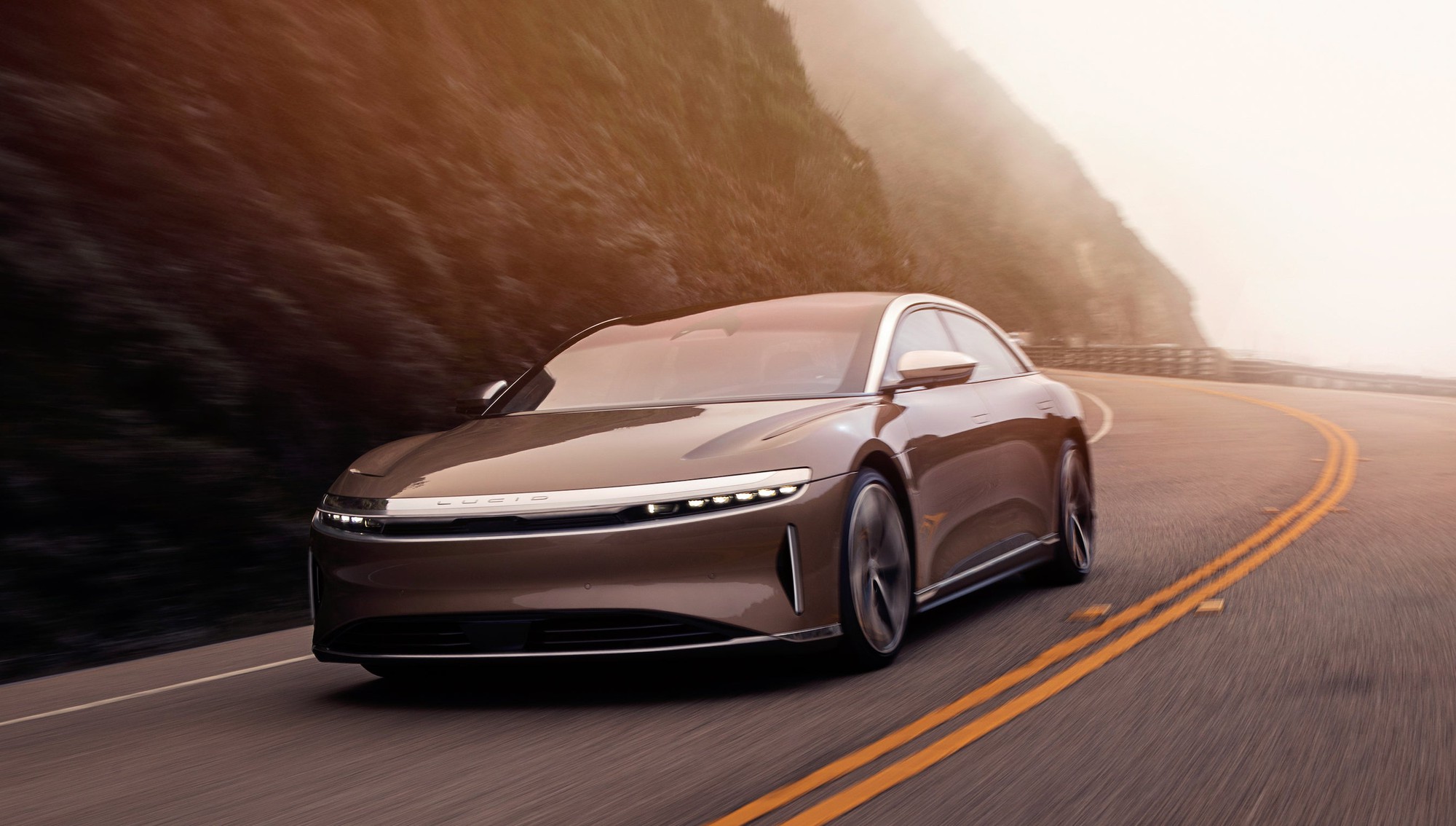
Image source: Lucid.
This stock-split stock appears headed for a further breakdown
You might have noticed earlier that there's an anomaly among this year's highest-profile stock-split stocks. Putting aside that Netflix is considerably larger than the other companies listed, it, along with O'Reilly, Interactive Brokers, and Fastenal, were all forward splits. Meanwhile, electric vehicle (EV) maker Lucid Group was the most-anticipated reverse stock split of 2025.
Whereas investors tend to gravitate toward companies announcing and completing forward splits, reverse splits often have the opposite effect on the investing populace. Splits designed to increase a company's share price are usually undertaken from a position of operating weakness, with the ultimate goal to avoid delisting from a major stock exchange.
Lucid's 1-for-10 reverse split serves as a warning that investors should keep their distance.

NASDAQ: LCID
Key Data Points
Lucid Group's biggest issue is that it's repeatedly fumbled the bag from an operational standpoint. With Tesla choosing to shift away from its luxury Model S to mass-produce the more affordable Model 3, Lucid's Air had an opportunity to become the undisputed leader in the luxury EV space. But management's projection for 2021, which initially called for 90,000 units of production in 2024, was ultimately whittled down to a forecast of just 9,000 EVs by the time 2024 rolled around. Persistent supply chain issues and tepid demand for luxury EVs have haunted Lucid Group and its shareholders.
To make matters worse, Lucid missed the mark with its Gravity SUV. This new addition to its lineup was initially expected to make its debut in 2024, but had its broad commercial rollout delayed by a year. Missed opportunities have been a common theme for Lucid Group.
The company's income statement and balance sheet raise additional red flags. Despite a $1.25 billion increase to Lucid's delayed draw term loan credit facility during the third quarter, its future remains uncertain. It's burned through more than $2 billion in cash from its operating activities during the first nine months of 2025, and the company's accumulated losses since inception are nearing $14.8 billion, as of Sept. 30, 2025.
Building an EV company from the ground up to mass production is a costly, competitive, and time-consuming process. Lucid's inability to stand out, along with its laundry list of operational disappointments, points to continued struggles in the quarters ahead.
