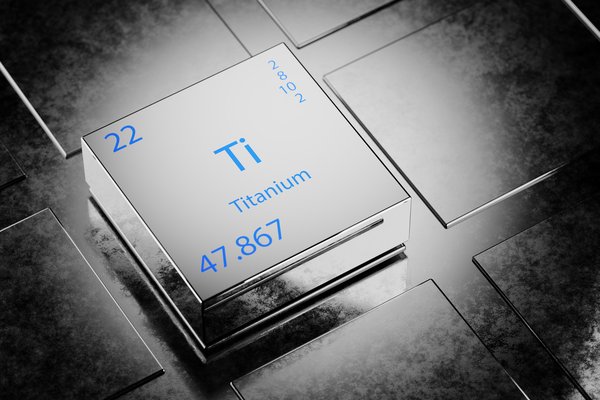
Whether used in its pure form or as titanium dioxide, titanium is a metal vital to various businesses. From the healthcare industry, which uses the metal in the manufacturing of prosthetic limbs, to the aerospace and defense industries, which use titanium in aircraft and weapons, titanium is found in a wide swath of industrial applications. But that's not all. Everyday products, from cosmetics to house paints, also rely on titanium dioxide.
Undeniably, titanium is used in a broad number of capacities, making it a metal stock worthy of consideration for investors -- especially in light of its increasing demand. A market research firm, Fact.MR, estimates the global titanium market to be valued at $28 billion as of 2023 and forecasts it to rise at a compound annual growth rate of 6.5% over the next 10 years.

4 Top Titanium Stocks to Buy in 2024
There's no one way to strengthen one's portfolio with exposure to titanium. Investors can choose from a myriad of options, including diversified chemicals companies that produce various materials to those that are singularly focused on the metal.
| Company | Market Cap | Description |
|---|---|---|
| ATI (NYSE:ATI) | $5.54 billion | A manufacturer of specialty materials, including titanium and titanium-based alloys. |
| Chemours (NYSE:CC) | $4.6 billion | A diversified chemicals company that specializes in titanium dioxide production. |
| Kronos Worldwide (NYSE:KRO) | $1.08 billion | Produces titanium dioxide pigments for use in various products such as paper, cars, and cosmetics. |
| Tronox (NYSE:TROX) | $2.07 billion | A vertically integrated mining and chemical business that manufactures titanium dioxide pigments. |
1. ATI
Dividing its business into two operating segments, ATI produces various high-performance materials, components, and advanced metallic powder alloys in its High Performance Materials and Components segment, while its Advanced Alloy and Solutions segment provides flat products to energy, aerospace, and defense industry customers. In both segments, though, titanium is present.
In 2022, sales of titanium and titanium-based alloys accounted for 11% of the company's revenue. This is notably less than the nickel-based alloys and specialty alloys business that represented 52% of the company's 2022 sales, but this shouldn't disqualify titanium investors from considering shares of ATI. Rather, it should appeal to investors who want to strengthen their portfolios with titanium exposure but who are similarly interested in mitigating the risk of a downturn in the titanium market.
Although ATI provides materials to multiple industries, aerospace and defense represent the company's largest customer, accounting for about 50% of the company's total 2022 sales. For people considering a position in ATI, it's important to recognize that the aerospace industry is cyclical, and investors should be prepared to experience the occasional turbulence in the industry's ups and downs.
2. Chemours
Although Chemours provides thermal management solutions and several performance materials, titanium figures prominently in the company's identity. Since 1949, Chemours has operated a titanium mine in Florida, and it added to its asset portfolio in 2019 with the acquisition of a titanium mine in Georgia. While the company's mines contribute about 10% of its ore feedstock requirements, Chemours acknowledges that it has the option to expand operations to increase the ore feedstock.
Through its titanium technologies segment, Chemours serves about 500 customers worldwide with more than 20 different grades of titanium dioxide pigment, customized for various applications, including house paint, coated paper, and plastic packaging. Chemours manufactures its titanium dioxide pigments at four production facilities located in the United States, Mexico, and Taiwan.
Demonstrating the impact of the titanium technologies business on the company's financials, the segment accounted for about 50% of consolidated revenue and 44% of adjusted earnings before interest, taxes, depreciation, and amortization (EBITDA) in 2022.
In addition to its position as a leading titanium dioxide producer, investors interested in growing their passive income streams will also be attracted to Chemours. Currently, Chemours offers a dividend with a forward yield of 3.3%.
3. Kronos Worldwide
True to its name, Kronos Worldwide is a titanium dioxide producer with a considerable global presence that's demonstrated in several ways. For one, Kronos Worldwide has titanium dioxide production facilities in several countries, including Germany, Belgium, Norway, Canada, and the United States.
Additionally, the company attributes the majority of its sales to North America, Europe, and the Asia Pacific region, although it has about 4,000 customers overall in more than 100 countries. This leading position didn't occur overnight. Kronos Worldwide can trace its history back to 1916, when it claims to have developed the first commercial process for titanium dioxide production.
Unlike diversified companies that produce various materials, Kronos Worldwide is narrowly focused on its titanium dioxide business. In 2022, titanium dioxide accounted for approximately 92% of the company's net sales -- something that should appeal to people looking for greater titanium exposure in a single investment.
Along with Chemours, Kronos Worldwide is a titanium stock that will appeal to income investors. Shares currently offer a mouthwatering forward yield of 8.2%. Granted, such a high yield may have some people reaching for a warning flag, but the company has averaged a payout ratio of 78.8% over the past five years, suggesting management isn't jeopardizing the company's financial health to satisfy dividend-hungry investors.
Related investing topics
4. Tronox
Brandishing itself as "the world’s leading vertically integrated manufacturer of titanium dioxide pigment," Tronox is another company that should be on the radar of people seeking a titanium stock. Although the company sells zircon and other products, such as high-quality pig iron and monazite, titanium dioxide represents the lion's share of the company's revenue -- about 78% in 2022.
With six mines in operation, Tronox is looking to further strengthen its vertical integration, helping to reduce the cost of its titanium dioxide production. In Australia, the company is developing a new mine, Atlas Campaspe, which will provide high-quality ilmenite, an ore from which titanium dioxide is produced. The company is also expanding operations at two mines in South Africa.
In terms of the company's financials, management foresees growth in the next few years. From $847 million in 2022, management forecasts that adjusted EBITDA will rise to between $1.3 billion and $1.5 billion in 2025. Similarly, management expects improvements on the cash flow statement, projecting free cash flow to rise from $122 million in 2022 to between $750 million and $850 million in 2025. The company is also committed to shoring up its balance sheet. At the end of 2022, Tronox had a net debt-to-EBITDA ratio of 2.8; however, management forecasts reducing the ratio to between 1 and 1.5 by 2025. The stock currently offers an attractive forward yield of 3.7%.
Are titanium stocks right for you?
For people looking to fortify their portfolios with a conservative investment, titanium stocks are a wise approach. The metal serves a critical need for a variety of uses, from airplane wings to paper laminates. For people especially seeking exposure to the aerospace industry, ATI is a worthy consideration. Income investors, on the other hand, will want to dig in deeper to titanium dioxide stocks Chemours, Kronos Worldwide, and Tronox as possible ways to strengthen their passive income streams.