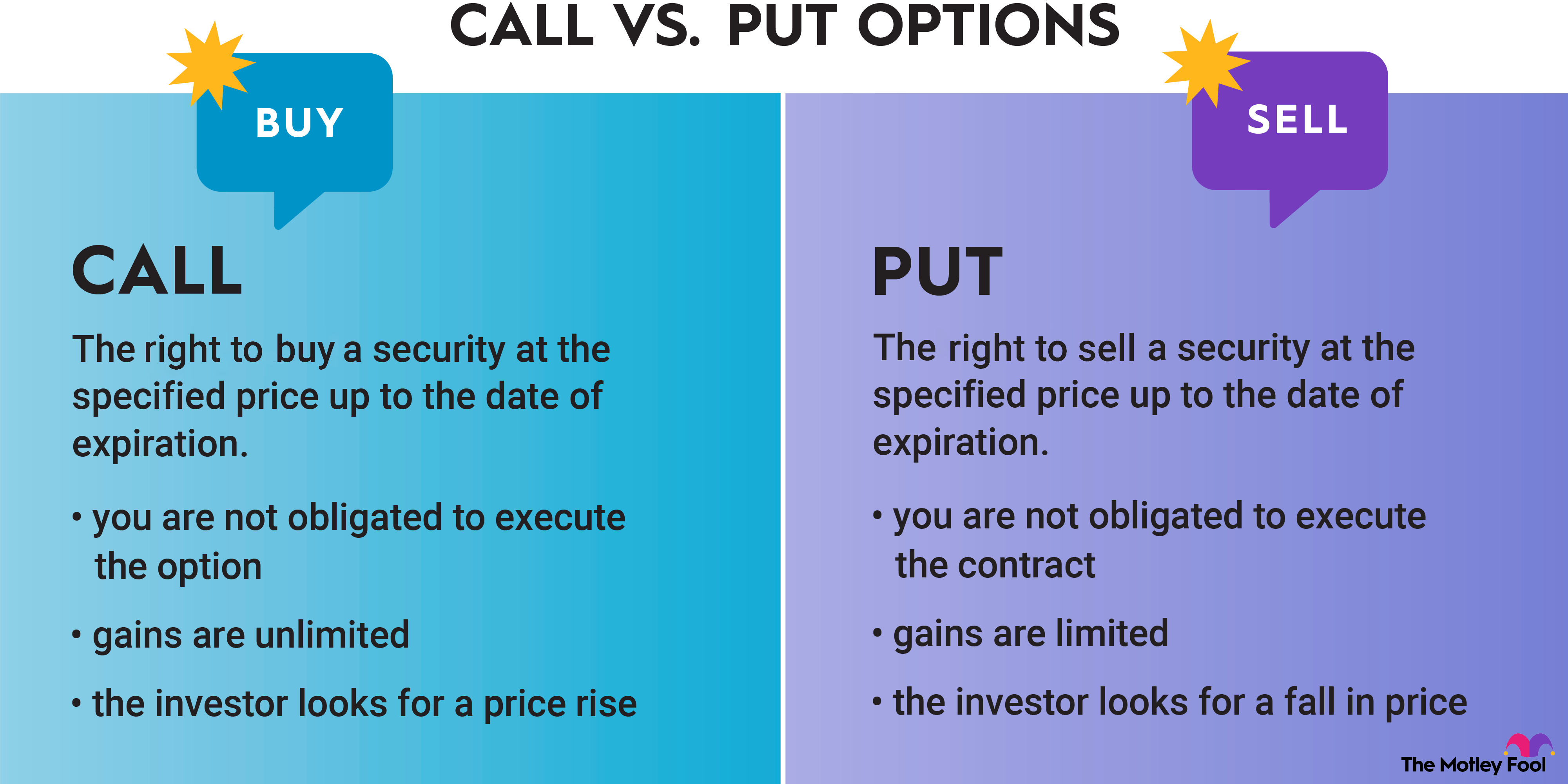
You're not obligated to execute the option. If the stock price increases enough, you can exercise it or sell the contract for a profit. If it doesn't, then you can let the contract expire and only lose the premium you paid. You could also sell before expiration for a lower price than what you paid.
The breakeven point on a call option is the sum of the strike price and the premium. When you have a call option, you can calculate your profit or loss at any point by subtracting the current price from the breakeven point.
Example of a call option
Let's say you're bullish on a stock that's trading at $150 per share. You buy a call option with a strike price of $170 that expires in six months, and it costs a premium of $15 per share. Since options contracts cover 100 shares, the total cost would be $1,500.
The breakeven point would be $185 (the $170 strike price plus the $15 premium). If the share price increases to $195, your profit would be $10 per share, totaling $1,000.
How does a put option work?
A put option is a contract tied to a stock. You pay a premium for the contract, giving you the right to sell 100 shares of the stock at the strike price. You can execute the contract at any time until its expiration date.
If the price of the stock decreases enough, then you can sell your put option for a profit. You're not obligated to execute the contract, so if the asset's price doesn't drop enough, you can let it expire.
The breakeven point on a put option is the difference between the strike price and the premium. When you have a put option, you can calculate your profit or loss at any point by subtracting the breakeven point from the current price.
Example of a put option
Imagine a stock trades at $500 per share, and you think it's overvalued. You buy a put option with a strike price of $450 and an expiration date 12 months away. The premium is $10 per share, for a total of $1,000 for the put option.
The breakeven point would be $440, the difference between the $450 strike price and the $10 premium. If the stock plummets to $400, then you're up $40 per share ($4,000 total) on your put option. If it doesn't drop below $450 at all, you'd either need to sell at a loss before the option expires or let it expire and eat the premium.