Advertiser Disclosure
Many of the offers that appear on this site are from companies from which The Motley Fool receives compensation. This compensation may impact how and where products appear on this site (including, for example, the order in which they appear) and may influence which products we write about, but our product ratings are not influenced by compensation. We do not include all companies or offers available in the marketplace. Websites may earn compensation when a customer clicks on a link, when an application is approved, or when an account is opened.
Brooklyn Sprunger is a full-time Content Manager and Personal Finance Writer at Motley Fool Money, where she oversees product reviews and ratings while also writing about credit cards, bank accounts, investing, auto insurance, and other personal finance topics. She has worked in financial content since 2018, including more than four years at The Motley Fool. When she’s not writing or editing, Brooklyn is likely hiking and watching the Tennessee Vols.
Many or all of the products here are from our partners that compensate us. It’s how we make money. But our editorial integrity ensures that our product ratings are not influenced by compensation.
I like to think of my credit score as my financial reputation. A higher score can save you hundreds (or even thousands) on interest, get you better credit cards, and make big purchases like a car or a house much easier.
I didn't have a credit score until my early 20s. I had to do a lot of heavy lifting to build it up before I was ready to buy a car, rent an apartment, and eventually buy a house. But now I can proudly say that I have an Excellent credit score, and you can too.
Unfortunately, increasing your score is like growing a garden -- it takes patience, consistency, and most importantly, time. But if I can do it, you can too. Let's look at the most sure-fire ways to get your score up.
Know what's affecting your score
Before you can improve my credit, you have to understand it. That's one of the big mistakes I made in my first few years.
Payment history (35%) -- Are you paying bills on time? Even one late payment can ding your score.
Credit utilization (30%) -- How much of your available credit you're using. Keeping it below 30% helps.
Length of credit history (15%) -- Older accounts help your score. I kept my first credit card open, even when I barely used it.
Credit mix (10%) -- Having different types of credit, like a credit card and a loan, can be beneficial.
New credit (10%) -- Opening too many accounts too quickly can hurt.
What worked for me:
My first-ever card was from studying abroad in college with a $1,000 limit. I still keep it open to this day. It gave me a foundation to build on, and it's still quietly helping my score today.
Credit card comparison
We recommend comparing options to ensure the card you're selecting is the best fit for you. To make your search easier, here's a short list of standout credit cards.
5.00/5
Our ratings are based on a 5 star scale.
5 stars equals Best.
4 stars equals Excellent.
3 stars equals Good.
2 stars equals Fair.
1 star equals Poor.
We want your money to work harder for you. Which is why our ratings are biased toward offers that deliver versatility while cutting out-of-pocket costs.
= Best
= Excellent
= Good
= Fair
= Poor
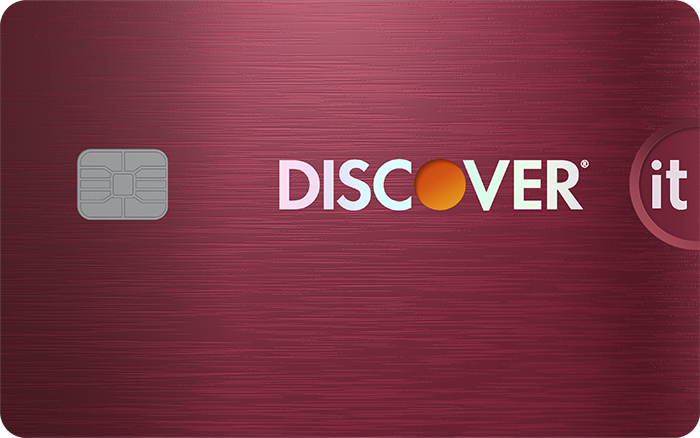
Best for cash back on rotating categories
Discover will match all the cash back you’ve earned at the end of your first year.
INTRO OFFER: Unlimited Cashback Match for all new cardmembers. Discover will automatically match all the cash back you’ve earned at the end of your first year! There’s no minimum spending or maximum rewards. You could turn $150 cash back into $300.
1% - 5% Cashback
Earn 5% cash back on everyday purchases at different places you shop each quarter like grocery stores, restaurants, gas stations, and more, up to the quarterly maximum when you activate. Plus, earn unlimited 1% cash back on all other purchases.
5.00/5
Our ratings are based on a 5 star scale.
5 stars equals Best.
4 stars equals Excellent.
3 stars equals Good.
2 stars equals Fair.
1 star equals Poor.
We want your money to work harder for you. Which is why our ratings are biased toward offers that deliver versatility while cutting out-of-pocket costs.
= Best
= Excellent
= Good
= Fair
= Poor
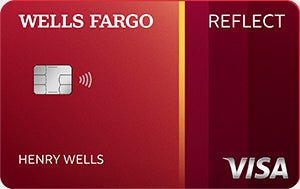
Best for long 0% intro APR
N/A
N/A
Intro:
0% intro APR for 21 months from account opening on purchases and qualifying balance transfers
Purchases: 0% intro APR for 21 months from account opening on purchases
Balance Transfers: 0% intro APR for 21 months from account opening on qualifying balance transfers
4.70/5
Our ratings are based on a 5 star scale.
5 stars equals Best.
4 stars equals Excellent.
3 stars equals Good.
2 stars equals Fair.
1 star equals Poor.
We want your money to work harder for you. Which is why our ratings are biased toward offers that deliver versatility while cutting out-of-pocket costs.
= Best
= Excellent
= Good
= Fair
= Poor
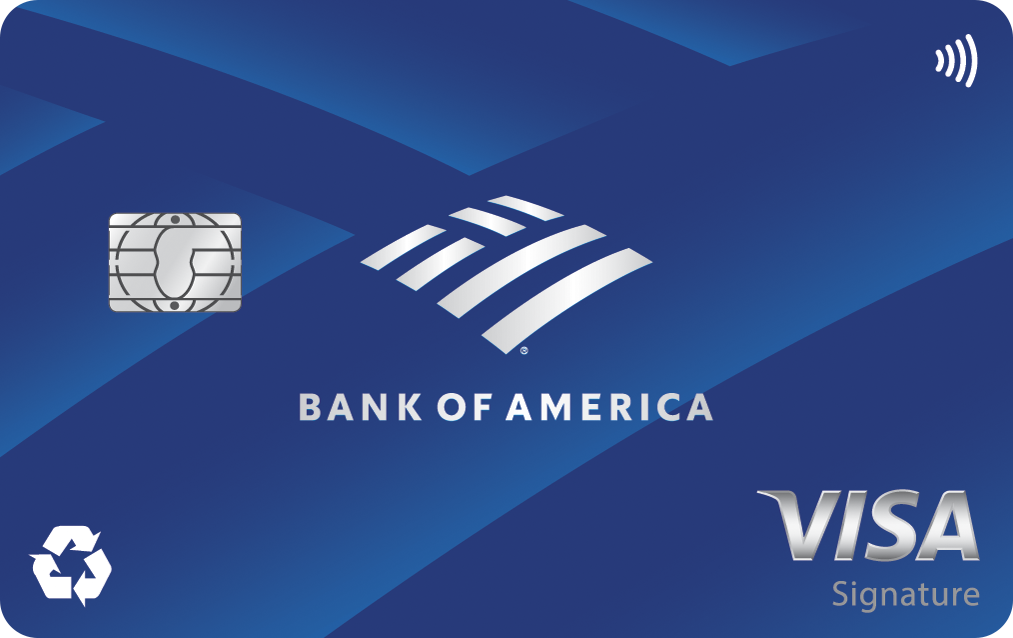
Best for unlimited rewards on purchases
25,000 points (worth $250)
25,000 online bonus points after you make at least $1,000 in purchases in the first 90 days of account opening - that can be a $250 statement credit toward travel purchases
1.5-3 points per dollar
Earn unlimited 1.5 points per $1 spent on all purchases, with no annual fee and no foreign transaction fees, and your points don't expire as long as your account remains open. Earn 3 points per $1 spent on travel purchases booked through the Bank of America Travel Center.
Intro:
0% Intro APR for 15 billing cycles for purchases, and for any balance transfers made in the first 60 days. After the Intro APR offer ends, a Variable APR that’s currently 17.49% - 27.49% will apply. A 3% Intro balance transfer fee will apply for the first 60 days your account is open. After the Intro balance transfer fee offer ends, the fee for future balance transfers is 4%. Balance transfers may not be used to pay any account provided by Bank of America.
Purchases: 0% Intro APR for 15 billing cycles for purchases
Balance Transfers: 0% Intro APR for 15 billing cycles for any balance transfers made in the first 60 days
Late payments can tank your score, so I set up reminders and autopay for every bill I could. Even small recurring bills count if they're reported to the credit bureaus, so I made consistency a priority.
Keep credit utilization low
Here's the simplest way to think about it: your credit utilization is your balance ÷ your total credit limit. For example, if I had a $1,000 card and a $500 balance, my utilization would be 50%. That's high. You should aim to keep it below 30%, and I ideally stay around 5%-10%.
To do that, I pay my statements about once a week instead of waiting for the due date. That way, my utilization stays low whenever the bank reports it to the credit bureaus.
Don't close old accounts
Your oldest accounts are like financial roots -- they anchor your history. My first card with its tiny $1,000 limit has been open for years. I barely use it, but keeping it active helps my average account age stay strong.
Be strategic with new credit
Opening new credit gave my score a temporary dip, so I applied only when necessary, like when I needed a card with better rewards or a higher limit. Spacing out applications prevented multiple hard inquiries from hurting me all at once. And I avoid applying for new cards around times I know my score will be checked, like applying for a rental apartment or buying a house.
Monitor your credit regularly
I check my credit reports to catch mistakes that could drag me down. Errors happen, and disputing them can give your score a quick boost. I get my free report from each bureau at AnnualCreditReport.com once a year.
Be patient and consistent
This is the hardest part. Just like that garden you're tending, it takes time to see real results with your credit score.
But paying bills on time, keeping balances low, and avoiding unnecessary credit applications DO add up. Even small wins, like paying off a card or reducing utilization, can move the needle in a meaningful way.
Bottom line
Building an excellent credit score from scratch was a lot of work, but it was worth it. By focusing on consistent habits and strategic moves, I went from zero credit to a score that made big purchases and financial opportunities possible.
If you're starting from nothing, or trying to recover from mistakes, remember this: progress doesn't happen overnight, but it does happen. Keep your habits steady, and your score will follow.
If you're ready to put these habits into action, the right credit card can make it even easier. A card with no annual fee, manageable limits, and on-time payments reported to the bureaus can help you steadily build your history and boost your score over time. Check out our list of the best credit cards to find options that fit your goals and set you up for success.
FAQs
Nope. Pulling your own score is considered a "soft inquiry," which doesn't affect your credit at all. In fact, regularly checking can help you spot mistakes or unusual activity early.
Paying in full is always best. Minimum payments keep your account current, but interest charges pile up and high balances hurt your utilization ratio. Paying in full shows lenders you're reliable and helps your credit score.
File a dispute directly with the credit bureau reporting the error (Experian, Equifax, or TransUnion). They're required to investigate, usually within 30 days. Correcting errors can give your score an instant boost.
Share This Page
We're firm believers in the Golden Rule, which is why editorial opinions are ours alone and have not been previously reviewed, approved, or endorsed by included advertisers. Motley Fool Money does not cover all offers on the market. Motley Fool Money is 100% owned and operated by The Motley Fool. Our knowledgeable team of personal finance editors and analysts are employed by The Motley Fool and held to the same set of publishing standards and editorial integrity while maintaining professional separation from the analysts and editors on other Motley Fool brands.
Terms may apply to offers listed on this page.