|
You might -- particularly if you retired before you became eligible for Social
Security payments. As you recall, that check can't come until you are at
least age 62. Even if you're already drawing Social Security, you may decide
to resume work simply because you enjoy the personal contact with others.
Maybe you want to feel more productive, desire some "mad" money, or just
want to have time away from your life's partner. Many retirees do. Further,
they work because they want to, not because they have to. They just enjoy
it. But what does it mean financially when they return to work?
The financial impact of a second career depends largely on the age at which
you resume work. For those younger than age 62, a job serves to increase
the ultimate benefit they will receive when they take Social Security. In
computing that benefit, the system looks at a person's entire working life.
The computations are complicated, and use the best 35 of the 40 highest years'
earnings. If you have a lot of zero-income years, that will lessen your ultimate
benefit. Retire early, and you're bound to have a lot of those zero-income
years. They will cause your Social Security check to be smaller than it could
be. Resume work, and you'll pay into the Social Security system again, thus
offsetting those zero-income years and increasing your benefit.
Is that a reason to go back to work? It might be. Then again, it might not.
It's entirely up to you. If you've done a Foolish job in planning for retirement,
increasing your ultimate Social Security payment may not be an important
factor to you. But be aware that an early retirement may come at a higher
cost than you might have otherwise thought.
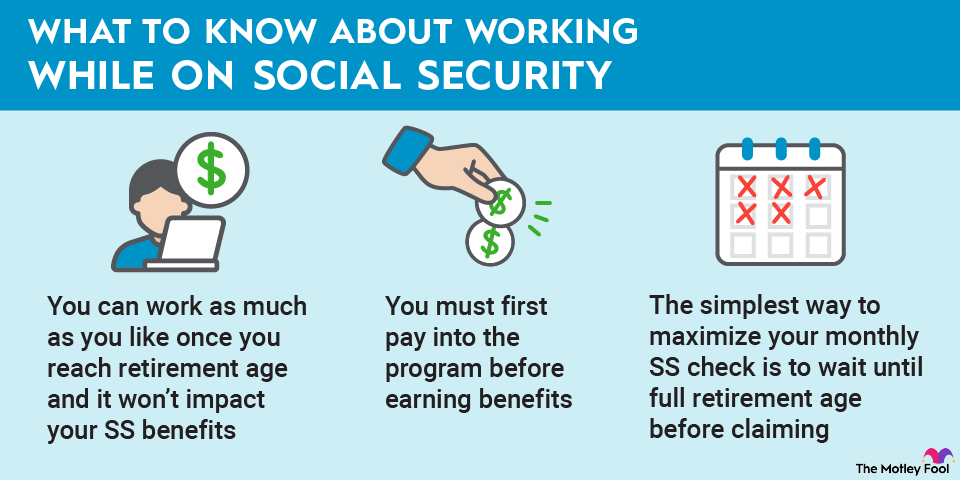
For those who do go back to work, at ages 65 and older there is no worry.
Younger retirees, though, may see a reduction in their Social Security
checks, depending on how much they earn in wages during the year. From ages
62 through 64, if you receive a Social Security check, you must forfeit one
dollar of that check for every two dollars you earn above a certain maximum
earnings limit. That limit moves upward each year with inflation. In 2001,
the limit is $10,680. Thus, a Social Security recipient who was age 63 and
who receives $11,680 in wages in 2001 will be over the maximum earnings limit
by $1,000. That excess will cause a $500 reduction in the Social Security
benefits that person receives in 2001.
If you are under age 65 and return to work after you begin receiving your
Social Security benefit, estimate what you will earn for the year and compare
that amount to that year's maximum earnings limit. If you see you will exceed
that limit, tell Social Security immediately. The agency will reduce your
monthly check accordingly. Fail to do so, and those earnings will be reported
to Social Security anyway when you file your income tax return for the year.
The Social Security Administration (SSA) will then notify you of an overpayment
because of excess earnings. It will recoup that overpayment from the following
year's checks. You might not be working that year and may need your full
Social Security payment.
What if your estimate was wrong and you didn't earn as much as you thought
you would? In that instance, the SSA will restore the previously withheld
benefit. You won't have lost a penny, but you will have avoided an overpayment.
Working after retirement has its good points and its bad points. Each of
us must evaluate both. The Foolish point to remember here is to recognize
the impact such work has on our Social Security benefits. Our endeavors may
increase what we get from the system and -- possibly at the same time --
reduce the check we currently receive.
To close, consider the words of Oscar Wilde: Work is the curse of the
drinking classes.
Fool on, and have a Mai Tai for me. Now, what to do with one of your biggest
assets -- your home.
Next: Your House »
|
|