If you've read this far, you may be raring to invest in a self-selected lineup of individual stocks ... but wondering whether you have enough money to start. Too many would-be investors assume that playing the stock market is solely for the rich -- or at least, folks with a few thousand bucks of spare cash -- and never get started.
Happily for Fools like us, that's not the case. If you have even $20 or $30 per month to invest in stocks, you can start investing.
Most people know about the most common way to investing in stocks: buying a bunch of shares all at once. For example, if you'd like to own 100 shares of Coca-Cola (NYSE: KO), and it's selling for $45 per share, you'd cough up $4,500 to buy the shares, paying your broker what should be a modest commission of roughly $20 or less.
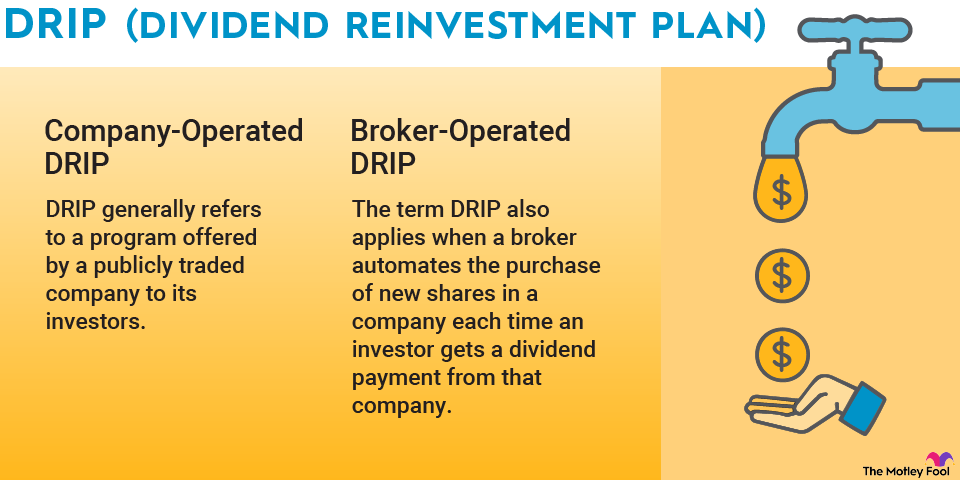
But there's a little-known and even more affordable alternative to such lump-sum purchases. A dividend reinvestment program, often called a "Drip," will let you spend as little as $10 a month to buy shares directly from a given company, without paying any brokerage commissions.
"Drip" isn't a very appealing name, but it does get the point across. You're reinvesting the dividends you receive into additional shares of stock (or fractions thereof), but you're also "dripping" additional money into your holdings every month. And all those little drips can add up over time.
Dividend reinvestment plans and direct stock purchase plans
Plans like these are becoming increasingly popular, with more than 1,000 major corporations now offering them. With dividend reinvestment plans, the company usually requires that you already own at least one share of its stock, in your name, before you enroll. If you're not already a shareholder, you'll have to buy at least one share through a broker or a Drip service.
If you use a broker, you'll need to pay a commission on any initial purchase. (You'll learn more about choosing a broker in Step 6.) In addition, you'll have to specify that you want the share or shares registered in your name, not "street name."
When you buy stock through a broker, it's usually registered in their name. Nothing sinister here, Fools -- your broker's simply holding the certificates for you. That makes it easier for you to sell quickly, without having to mail in certificates. If you already own some shares of the stock held in street name, you can pay a few dollars to have one or more of them transferred to your name.
Once you own a share or more in your own name, you can open a Drip account with the company, buying new shares directly from that company (or its agent). Direct stock purchase plans (DSPs) operate similarly, but don't require you to own at least one share before you enroll.
Many Drips and DSPs vary slightly from one another. Some charge you a few pennies per share when you buy, but most others (the ones we like best) charge nothing. Some also permit automatic regular purchases, taking money directly from your bank account.
While many of these plans are great bargains, others might not be worth it, depending on your circumstances and their fees and policies. You should examine the particulars of each plan you're interested in before deciding to enroll.
Advantages of Drips
Clearly, these programs are a blessing for investors who lack big chunks of cash to spare. As an added plus, they'll reinvest any dividends you receive to buy more shares. Dividend reinvestment is a little-appreciated but extremely powerful way to improve your long-term returns.
For example, if you'd held shares of Coca-Cola for the 18 years between 1981 through 1998, they would have appreciated a total of 4,718% -- an impressive annualized gain of 24% per year. But if you'd reinvested all the dividends Coke paid you into additional shares, your total gain would have been 56% greater, at 7,364%. Annualized, that's 27% per year.
A $5,000 investment in Coke in 1981 would have grown to about $240,000 without reinvested dividends. With dividends reinvested, it would have become roughly $373,000. Impressive, eh?
Another advantage to these plans is that they permit you to slowly build up positions in stocks over a long period of time -- a practice known as "dollar-cost averaging." Imagine that you want to invest in Wal-Mart (NYSE: WMT), but think its shares are a bit too pricey at the moment. If you wait for the shares to fall, you might get in at a better price. But if they just keep going up, you'll be out of luck.
By investing small, regular amounts of money in Wal-Mart, fluctuations in the company's share price work in your favor. If the stock falls, your same investment amount buys you more shares. If the stock keeps rising, the shares you've already bought increase in value.
And since Drip or DSP plans don't limit you to small contributions, you can also use them to make relatively large lump-sum investments without forking over a hefty commission fee. You'll still enjoy the power of dividend reinvestment, but you'll pay less for the privilege. (Many online brokers now offer dividend reinvestment, too; you can ask your broker whether it's available for you.)
Drippy disadvantages
Every silver lining has a cloud; in these plans' case, it's the paperwork involved. Each plan will send you a separate statement every time you invest, and you'll have to hang onto all of them for tax purposes. If you lose them, or fail to keep good records, paying taxes on your investments can get really hairy. Fear not, Fool -- there's good software on the market to help you avoid many of the record-keeping headaches.
Another disadvantage probably won't affect most Fools. Unlike brokerage accounts, Drips don't let you buy on short notice. If a stock's value drops on a certain day, and you want to take advantage of the low price to scoop up more shares, an online broker can help you make the purchase in minutes. With most Drips and DSPs, however, you'll have to mail in a form and a check. By the time that paperwork gets processed, your buying opportunity may have evaporated.
Many plans make all their purchases and sales just once a month, creating further delays. Sometimes that means you'll pay even less than you planned for your shares -- but sometimes you'll pay more. Selling shares through these plans can be equally slow, taking as long as a few weeks. Fools who just want to make steady, regular investments likely won't be plagued by either of these issues, but they're still worth knowing about.
More information
There's plenty more to learn about dividend reinvestment plans and direct stock purchase plans. If you want to invest in multiple companies' Drips through a single source, consider The National Association of Investors Corp. (NAIC), the country's authority on investment clubs. Its "Low Cost Investment Plan" will enroll you in the Drip of your choice, all for just the price of one share of stock in any of the participating companies, and a small additional fee. You can then add to your shares regularly at little or no additional charge. This service is only open to NAIC members, though; to join the organization, you'll have to pay an annual fee.
The Moneypaper website lists information on more than 1,100 companies that offer Drips. The site also offers the Temper of the Times enrollment service, which will purchase initial shares and enroll investors in Drips for a nominal fee.
You might also want to check out our Motley Fool Income Investor newsletter, which seeks out the market's best dividend-paying stocks. With their hefty payouts and strong performance, Income Investor's picks could make prime candidates for Drip investing.
To see the rest of the 13 Steps, follow the links at the bottom of this article.