Understanding ETF taxes
If you buy ETFs in a standard brokerage account (i.e., not a retirement account), you should know that they could result in taxable income. Any gains you make from selling an ETF will be taxed according to capital gains tax rules, and any dividends you receive will likely be taxable as well.
Of course, if you invest in ETFs through an individual retirement account (IRA), you won't have to worry about capital gains or dividend taxes. In a traditional IRA, money in the account is considered taxable income only after it is withdrawn, while Roth IRA investments aren't taxable at all in most cases.
Pros and cons of ETFs
Let's examine the pros and cons of investing in ETFs.
Pros:
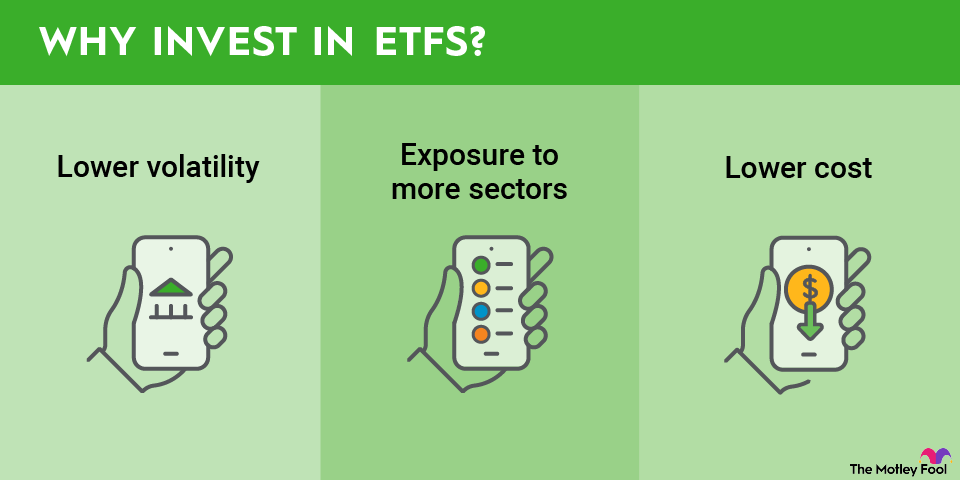
- ETFs offer exposure to a diverse range of stocks, bonds, and other assets, typically at a low expense.
- ETFs eliminate the guesswork from stock investing. Many ETFs are index funds, which enable investors to track the performance of a specific benchmark index over time.
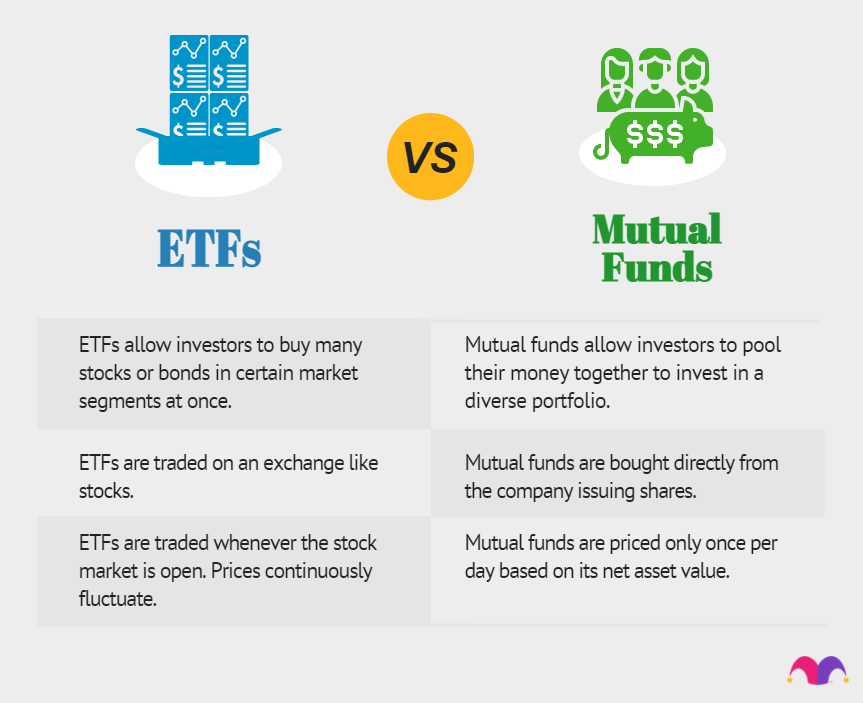
- ETFs are more liquid (i.e., easy to buy and sell) than mutual funds. Online brokers make it easy to buy or sell ETFs instantly with a simple click of the mouse.
- It can be extremely complicated to invest in individual bonds on your own, but a bond ETF can make the fixed-income portion of your portfolio very easy.
Cons:
- Since ETFs own a diverse assortment of stocks, they don't have quite as much total return potential as individual stocks.
- ETFs are often low-cost, but they aren't free. If you buy a portfolio of individual stocks on your own, you won't have to pay any management fees.
Common ETF investing mistakes
When you invest in ETFs, there are some big mistakes to avoid. Just to name the most common:
- Over-trading: The average stock fund investor underperforms the S&P 500 over time. The biggest reason is over-trading. ETFs work best as long-term buy-and-hold investments. Moving in and out of ETFs tends to result in subpar performance.
- Following the crowd: Don't buy an ETF just because everyone else is. Buy ETFs that best fit your investing goals.
- Ignore fees: Shop around to find lower-cost ETFs that meet your specific objectives. A seemingly small difference in expense ratios can make a big difference, especially if you hold the ETF for many years.
Criteria to choose an ETF
There are literally thousands of ETFs available for investment right now. In fact, the number of ETFs recently surpassed the number of publicly traded stocks for the first time ever. So, how do you find the right ETFs for you?
Here are some things to consider:
- Investment objective: This is the most important consideration. Do you simply want passive exposure to the entire stock market? Do you want exposure to a certain sector? Do you want to invest in a specific trend such as artificial intelligence?
- Active versus passive: Do you want to simply track an index's performance over time, or do you want fund managers who try to beat a benchmark index?
- Fees: You can find a basic S&P 500 ETF with a 0.03% expense ratio or a large-cap ETF with a similar portfolio that charges 1%. There are some good reasons to choose a higher-cost ETF, such as if you want to invest in a highly specialized stock index. But if you find an ETF that meets your needs, it's worth checking whether there's another that does essentially the same thing at a lower cost.
- Gross expense ratio: Some ETFs have temporarily lower fees, but you might see a different (and higher) gross expense ratio listed. This is important to know, as it's the fee you would pay if there were no temporary discounts in place.
- Issuer: Be sure your ETFs are operated by a respected issuer with a long history in the industry. Vanguard, Schwab, and BlackRock (BLK -0.46%) are just a few examples of top-notch ETF issuers.
- Fund assets: There are ETFs with hundreds of billions in assets, and at the other end of the spectrum, some with just a few million. A fund's assets tell you how much money other investors are entrusting with that specific ETF.