Exchange-Traded Funds

A 60-Second Guide

Recs

52

The "It" equity -- the exchange-traded mutual fund -- is no spring chicken. It's been around since the early 1990s. But ETFs are still turning heads. It's no wonder: The combination of index investing with the handiness --- and lower costs -- of individual stock ownership is irresistible. Are ETFs a good match for your portfolio? Read on...

0:60 Consult your investing dictionary.

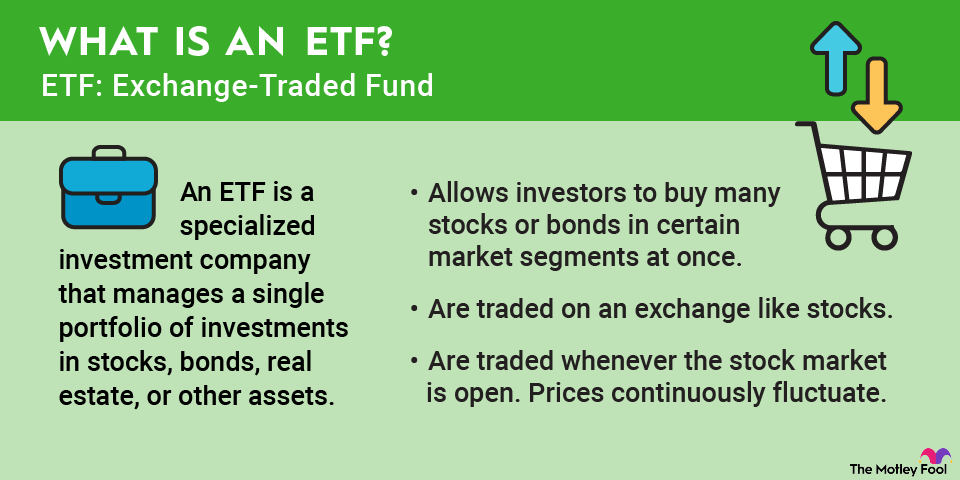
What exactly is an exchange-traded fund (ETF)? "Exchange-traded" refers to shares that trade all day long on the major stock market exchanges (just like regular stocks, although ETFs are found mainly on the American Stock Exchange). "Funds" are investing vehicles that hold dozens, hundreds, or even thousands of companies under one umbrella unified by a particular investing theme (such as companies that comprise the Dow or ones whose main business is in the biotech industry). Like any other publicly traded company, ETFs have ticker symbols (snappy ones, in fact, like Cubes, Spiders, and Diamonds). But instead of typing "MSFT" to buy Microsoft, for example, you enter "DIA" for the Dow Jones Industrial Trust, or "Diamond" ETF. Do you need diamonds in your portfolio?

0:54 Poke holes in your portfolio.

Do you crave exposure to foreign indexes? Are your holdings a little heavy in large American companies? Do you think biotechnology is a boom industry, but aren't comfortable committing money to one particular company? There are ETFs to represent virtually any segment of the market -- both here and abroad -- nearly any way you slice it. There are ones tracking everything from bonds, REITs, and the utility sector to the pedestrian Fool favorite S&P 500. If that sounds a lot like the index mutual fund market's offerings, it is. For some investors, though, ETFs are a better fit for their investment dollars.

0:47 Get a little Zen.

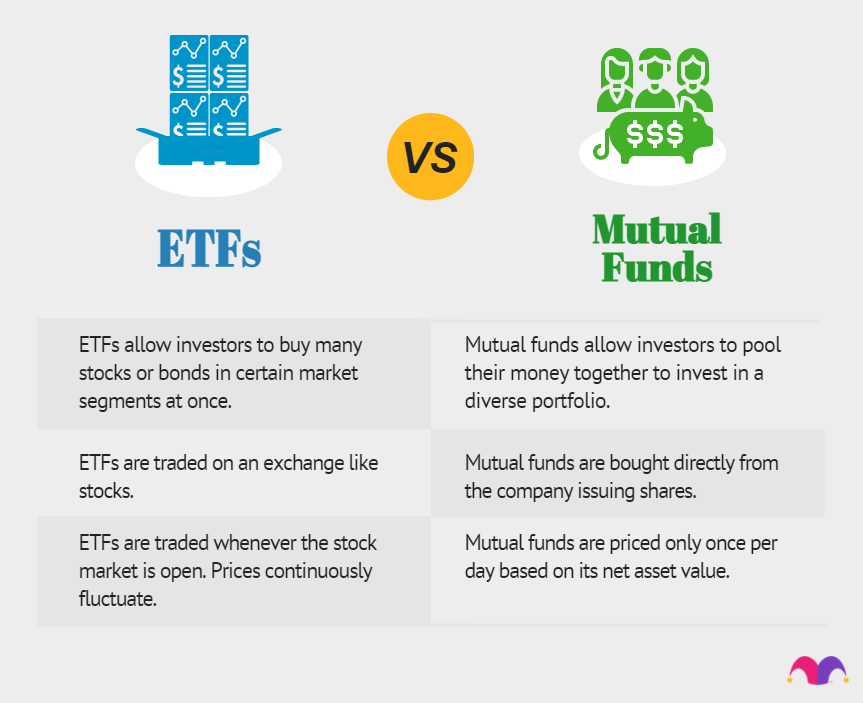
Time for some soul-searching. Don't worry -- not the touchy-feely kind. Are you a "feet first" kind of investor, or do you prefer to build your portfolio slowly? If you'd like to add an indexing element to your portfolio and are prepared to invest a lump sum, ETFs provide some flexibility you might find useful. Like regular stocks, they can be bought or sold anytime the market is open via your brokerage account. (Traditional index funds, on the other hand, can only be redeemed at the closing price of each day.)

If you plan to dollar-cost average (adding small, systematic amounts to build a portfolio), ETFs aren't ideal. They don't offer direct investment programs, so dollar-cost averaging would rack up trading costs that far outweigh any cost benefit over a traditional index fund. For you, a more efficient route would be a no-load, low-expense index fund.

The mutual fund-ETF face-off isn't over quite yet, Grasshopper. Before you click "buy"...

0:34 Check out the competition.

They may track the same stocks and offer easy diversification -- but subtle differences between index funds and exchange-traded funds can affect your long-term returns:

  • Taxes: The big buzz about ETFs is their tax efficiency. The big "tax event" for ETF shareholders happens when you sell your shares, hopefully at a profit, after which you'll pay capital gains taxes.
  • Expense ratios: By construction, ETF investors have less exposure to capital gains taxes than mutual fund shareholders. That's because fund managers frequently buy and sell the fund's holdings -- and ask investors to pick up the tab. ETFs occasionally shift shares, too, although much less than most mutual funds. Annual expenses for ETFs range between 0.1% and 0.65% and are deducted from dividends. Index mutual funds charge anywhere from 0.1% to more than 3%.
  • Minimum investment requirement: For investors with limited funds (say, less than $1,000) who want to get started in the stock market, ETFs offer a cheap entrée. Through your discount brokerage account, you can buy one single measly share if you choose. In comparison, many index mutual funds have high initial balance requirements. (Those with lower requirements often charge higher fees.)
  • Ease of use: Here's the double-edged sword of ETF investing. They are easy to buy -- you simply need a discount brokerage account (and that's easy to get -- and cheap). Consequently, they're easy to trade. And trade and trade and trade.

Don't be blinded by love based on low expense ratios and minimum investment requirements. There's still a price to pay to invest in ETFs -- mainly brokerage fees. And there's the rub...

0:19 Keep fees in check.

As a stock, ETFs can be optioned, shorted, hedged, and bundled. We don't like the idea of investors trading in and out of ETFs repeatedly, or going on margin to the hilt to buy them, any more than we do any other stocks. Like traditional index funds, ETFs are best used as a long-term investment tool. The best investing strategies for most investors are the simplest ones -- filling asset allocation gaps and replacing higher-fee mutual funds.

If you want to get fancier than that, ETFs can accommodate more advanced investing tactics (we go into in more detail here). But tread lightly: Don't rack up trading commissions or capital gains taxes by actively trading.

0:08 Do a background check.

And finally, as with any investment, make sure you get what you're paying for: means scrutinizing an ETF's holdings as you would those of any mutual fund before you buy. It's not only individual investors enamored with this newfangled investing vehicle -- the industry's keen on them, too, and getting a little loosey-goosey with labels. So make sure the ETF label matches the underlying securities you want to buy before heading off into the sunset, hand in hand.

Got another minute?

  • How ETFs Became the "It" Equity: Exchange-traded funds have attracted trillions of investing dollars. Here's how they snuck onto the scene and why the fund world is on notice.
  • Mutual Funds vs. ETFs: In a side-by-side taste test, which comes out ahead? It depends on who's doing the math.
  • Investing Strategies: They're nimble and can accommodate an array of investing techniques. But the best strategy is probably the simplest.
  • Potential Pitfalls: Don't be tricked into buying an ETF impostor. Here's how to avoid this and other potential trip wires.

Next: ETFs: The "It" Equity? »

Comments from our Foolish Readers

Help us keep this a respectfully Foolish area! This is a place for our readers to discuss, debate, and learn more about the Foolish investing topic you read about above. Help us keep it clean and safe. If you believe a comment is abusive or otherwise violates our Fool's Rules, please report it via the Report this Comment Report this Comment icon found on every comment.

  • Report this Comment On September 28, 2009, at 4:35 AM, wrkdiver wrote:

    Does anyone know how I can find an ETF with Brazilian Bonds?

  • Report this Comment On November 20, 2009, at 9:15 PM, themoneyladder99 wrote:

    Having lived through a horrific financial crisis brought on by fancy-sounding financial products like CDOs and subprime mortgages, you have every right to be wary of something that sounds new and complex. ETFs however have been around for the last sixteen years but have only recently started to become popular amongst individual investors.

    Over the years, ETFs have proven their value to investors by the tax, cost-saving and diversification advantages they provide. Here are some of the advantages of investing in ETFs, especially when compared to mutual funds:

    1) Tax Advantages: If you own mutual funds, it is unlikely you have escaped the bite of the Capital Gains Distribution Tax. This is a tax that you are paying because the mutual fund manager decided to sell stock and incur a capital gains tax that they then passed on to fund investors. There are two problems with this: (a)You may not want to be selling at that moment but are forced to accept the mutual fund’s decision and cough up the tax that goes with a sale. Had you invested in ETFs instead, you alone would decide when to sell for a profit and incur a tax. (b) If many other fund unit holders want to sell their mutual fund units, the mutual fund may be prompted to sell the underlying stocks to make their cash payments. This is especially a problem in a market such as the one we have today, where stock values are recovering from their deep discounts prompting many mutual fund unit holders to cash out. Again, you’re paying a tax penalty for a sale that you didn’t even want to make! If you had purchased an ETF instead, the only tax you would pay would be when you sell the ETF unit for a profit, much like an individual stock trade profit.

    2) Management and Marketing Fees: Actively managed mutual funds charge a premium for their (supposedly) superior stock-picking. ETFs, which simply track an index or a subset of an index, make no such charges. Mutual funds also tend to run aggressive marketing departments whose sole aim is to sell the fund to more and more investors. Other than keeping the portfolio manager in finer suits, this type of marketing has no benefits, particularly to the fund investor. Having worked at a major investment management firm that managed mutual fund portfolios, I noticed firsthand the value of minimizing management costs. ETFs do not have these marketing charges because they are “commodity” products. Two ETFs that track the same index have little reason to try to differentiate themselves so they focus on cost-cutting, a direct benefit to the ETF investor.

    3) Minimum Investment: Mutual funds often have a minimum dollar amount you need to invest in order to buy units. ETFs have no such minimum. For example, let’s say you’re feeling optimistic about the energy industry and want to invest in shares of energy companies. The Vanguard Energy Fund Investor (VGENX) will let you do just that…at a minimum investment of $25,000! In contrast, the iShares S&P Global Energy (IXC) ETF will allow you to buy a single share at about $36 and win exposure to the energy industry.

    4) Easy To Trade: ETFs are much easier to trade than mutual funds. You can buy and sell them in your brokerage account just like an individual stock. You can place stop-loss and limit orders on them. You can even short ETFs. In contrast, mutual funds require you to place in your order and then wait until the end of the trading day to get your fund units at a price determined by the mutual fund’s total value (Net Asset Value or NAV). Unlike an ETF, you don’t know exactly what you will be paying when you place an order. Needless to say, you can’t bet against a mutual fund by shorting it.

    5) Modularity: Like Lego bricks, you can use ETFs as building blocks of a broadly-diversified portfolio even if you only have a couple thousand to invest. This is much more expensive with mutual funds.

    Visit my website: http://www.themoneyladder.com

    "Smart money advice for smart young people"

  • Report this Comment On November 20, 2009, at 9:16 PM, themoneyladder99 wrote:

    Having lived through a horrific financial crisis brought on by fancy-sounding financial products like CDOs and subprime mortgages, you have every right to be wary of something that sounds new and complex. ETFs however have been around for the last sixteen years but have only recently started to become popular amongst individual investors.

    Over the years, ETFs have proven their value to investors by the tax, cost-saving and diversification advantages they provide. Here are some of the advantages of investing in ETFs, especially when compared to mutual funds:

    1) Tax Advantages: If you own mutual funds, it is unlikely you have escaped the bite of the Capital Gains Distribution Tax. This is a tax that you are paying because the mutual fund manager decided to sell stock and incur a capital gains tax that they then passed on to fund investors. There are two problems with this: (a)You may not want to be selling at that moment but are forced to accept the mutual fund’s decision and cough up the tax that goes with a sale. Had you invested in ETFs instead, you alone would decide when to sell for a profit and incur a tax. (b) If many other fund unit holders want to sell their mutual fund units, the mutual fund may be prompted to sell the underlying stocks to make their cash payments. This is especially a problem in a market such as the one we have today, where stock values are recovering from their deep discounts prompting many mutual fund unit holders to cash out. Again, you’re paying a tax penalty for a sale that you didn’t even want to make! If you had purchased an ETF instead, the only tax you would pay would be when you sell the ETF unit for a profit, much like an individual stock trade profit.

    2) Management and Marketing Fees: Actively managed mutual funds charge a premium for their (supposedly) superior stock-picking. ETFs, which simply track an index or a subset of an index, make no such charges. Mutual funds also tend to run aggressive marketing departments whose sole aim is to sell the fund to more and more investors. Other than keeping the portfolio manager in finer suits, this type of marketing has no benefits, particularly to the fund investor. Having worked at a major investment management firm that managed mutual fund portfolios, I noticed firsthand the value of minimizing management costs. ETFs do not have these marketing charges because they are “commodity” products. Two ETFs that track the same index have little reason to try to differentiate themselves so they focus on cost-cutting, a direct benefit to the ETF investor.

    3) Minimum Investment: Mutual funds often have a minimum dollar amount you need to invest in order to buy units. ETFs have no such minimum. For example, let’s say you’re feeling optimistic about the energy industry and want to invest in shares of energy companies. The Vanguard Energy Fund Investor (VGENX) will let you do just that…at a minimum investment of $25,000! In contrast, the iShares S&P Global Energy (IXC) ETF will allow you to buy a single share at about $36 and win exposure to the energy industry.

    4) Easy To Trade: ETFs are much easier to trade than mutual funds. You can buy and sell them in your brokerage account just like an individual stock. You can place stop-loss and limit orders on them. You can even short ETFs. In contrast, mutual funds require you to place in your order and then wait until the end of the trading day to get your fund units at a price determined by the mutual fund’s total value (Net Asset Value or NAV). Unlike an ETF, you don’t know exactly what you will be paying when you place an order. Needless to say, you can’t bet against a mutual fund by shorting it.

    5) Modularity: Like Lego bricks, you can use ETFs as building blocks of a broadly-diversified portfolio even if you only have a couple thousand to invest. This is much more expensive with mutual funds.

    Visit my website: http://www.themoneyladder.com

    "Smart money advice for smart young people"

Add your comment.

Compare Brokers

TD AMERITRADE
more info
ShareBuilder
more info
Power E*Trade

more info
Scottrade
more info
Fool Disclosure

DocumentId: 983970, ~/Articles/ArticleHandler.aspx, 11/22/2009 8:17:56 AM

The Must-Read Story on Fool.com
An Open Letter to the Federal Reserve

Related Tickers

11/20/2009 4:00 PM
DIA $103.25 Down -0.06 -0.06%
Diamonds Trust, Se… CAPS Rating: **
SPY $109.43 Down -0.39 -0.36%
S&P DEP RECEIPTS CAPS Rating: No stars
QQQQ $43.44 Down -0.22 -0.50%
PowerShares QQQ Tr… CAPS Rating: ***

Community: Investing Wiki

Term Of The Hour

Uncertainty: Uncertainty is an inability to ascertain the true current state or to determine or predict future outcomes.

Want to learn more or edit this definition?
Click here to read more!