Unions: Good or Bad?

Recs

44

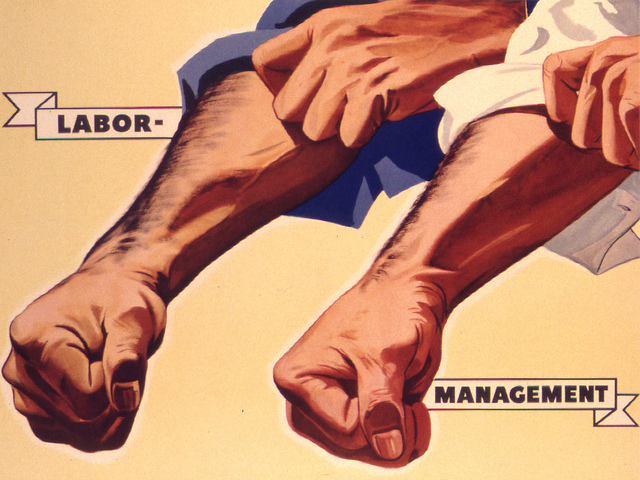
I've long supported unions. I've even belonged to two -- when I was a high school teacher and when I was a university administrative worker. (For the record, the Harvard Union of Clerical and Technical Workers had some great songs.) But in recent years, I've come to doubt my pro-union convictions. Permit me to share some of my thoughts and then to solicit your thoughts. I suspect that many who read my words are much more informed about and experienced with unions than I am.

Why unions are good
In much of industrial America, workers toiled under very unsafe conditions, earning extremely low pay and enjoying little to no legal protection. Unions were successful in bringing about many improvements for such workers, such as more reasonable working hours. They have generally served workers well by helping them avoid being exploited by employers. Even in these days, unions have a strong impact. According to the Bureau of Labor Statistics, union members in 1999 had median weekly earnings of $672 (that's $34,944 per year) while non-union workers had median weekly earnings of only $516 ($26,832) (source).

Why unions are problematic
Much as I'd rather not accept it, while unions have done a lot of good and have helped workers avoid exploitation, they also seem to have helped workers exploit employers. Perhaps it has been a gradual shift over time, with unions slowly accumulating more and more power. (Perhaps not -- again, I welcome your thoughts.)

Unions can have the power to impede a company's ability to compete and thrive. A firm might be in desperate trouble, yet its unions may be unwilling to bend or compromise in order to help the company survive. Many employers find themselves left very inflexible when they have union contracts to abide by.

Some more problems with unions:

  • Anti-competitiveness. The Socialstudieshelp.com website suggests that, "unions. are victims of their own success. Unions raised their wages substantially above the wages paid to nonunion workers. Therefore, many union-made products have become so expensive that sales were lost to less expensive foreign competitors and nonunion producers."
  • A decline in the value of merit. In many union settings, workers can't advance much or at all on their merits, but must generally progress within the limits defined by union contracts. Employers may have trouble weeding out ineffective employees if they belong to unions. In theory, at least, unionized workers might become so comfortable and protected that they lose the incentive to work hard for their employer. And outstanding employees might lose their get-up-and-go if there's no incentive to excel -- or worse, if they're pressured by the union to not go the extra mile.

Here's a webpage detailing some other union drawbacks.

Is there a problem?
So there's both good and bad associated with unions. I suspect that most businesses, and even many or most investors in said businesses, would prefer that the businesses be union-free. But that's easier said than done.

Is ownership an answer?
One strategy for companies to avoid unions taking hold on their premises might be to ensure that as many of their workers as possible are as satisfied as possible. That's simple and makes sense, but it can become mighty difficult to maintain as a company grows huge. Another option is to convert employees into owners -- via stock ownership or profit-sharing, for example. If workers have a real stake in a firm's bottom line, they may be more sympathetic to management's point of view and more eager to work extra hard to help the firm succeed.

That's not a perfect solution, though. Starbucks (NYSE: SBUX), for example, is known for awarding stock options. Yet some of its workers in the U.S. and Canada have organized into unions, while others would like to.

Consider also Southwest Airlines (NYSE: LUV), which has long made employees part-owners via profit-sharing and stock options. It hasn't escaped having unions in its midst. Yet, as this Foundation for Enterprise Development case study notes, "A few years ago the pilots' union at Southwest struck an extraordinary deal with the airline to freeze wage increases for 10 years in exchange for an increased proportional allocation of stock options. The flight attendants' union has since also signed a similar agreement that is unprecedented in the industry." And Southwest has continued to thrive in its notoriously tough industry.

American Airlines, whose parent company is AMR (NYSE: AMR), also decided to issue stock options to its employees, making the announcement in April -- and just a week or so ago it reported a long-elusive (though tiny) profit. Are the two items related? Perhaps, at least to some degree. Though it's worth pointing out that stock options aren't necessarily always attractive. If they're for stock of a shaky company in a wobbly industry, they may not be worth much at all. (Bill Mann noted earlier this year why investors might want to walk away from American Airlines.)

The healthcare crisis
If ownership isn't the best answer, perhaps healthcare coverage might be. Along with compensation issues, healthcare is a major factor in the recent strike of grocery workers in California. The unions don't want to lose ground on the healthcare package workers currently receive. The grocery chains are crying that they're being pinched as they fight the threat of Wal-Mart (NYSE: WMT) -- yet some have been recording increases in sales and earnings lately. Kroger (NYSE: KR), for example, posted a 3% increase in sales and a 16% increase in earnings between fiscal 2001 and 2002.

What's really going on? I suspect that both sides fear a slippery slope: Workers fear that if they give in a bit on healthcare, they'll eventually lose it all. (And with healthcare costs skyrocketing lately, that's a valid concern.) Employers fear that they're already on a slippery slope as they fight the encroaching behemoth that is Wal-Mart.

The Wal-Mart situation
Wal-Mart itself is interesting, when you consider unionization. Thus far, in its not-that-short history, it has escaped having most of its workers belong to unions. But a passionate fight is being waged right now, as workers struggle to establish a union.

This raises interesting questions for us investors: Should we root for the union, as it might lead to more livable wages for employees and might keep more of Wal-Mart's million-plus employees enjoying healthcare benefits? Or should we root for Wal-Mart, figuring that a union will almost certainly put pressure on profits and might threaten the company's ability to sustain its track record of formidable global growth?

I'd like to tell you what I think of the Wal-Mart situation, but I can't. I'm torn. I see both sides of the issue. I wouldn't want to see Wal-Mart unduly restricted by union stipulations. I recognize that although it's enormous, its net profit margins aren't that hefty, at around 4%. That doesn't leave lots of room for adding expenses (though of course there is some room). But at the same time, I wouldn't want employees to be taken advantage of simply because Wal-Mart is big enough to do so. I admire generous companies, ones that treat their workers well. I'd want Wal-Mart to be, as many folks would argue it currently is, fair or even generous to workers. I suppose what I'd like to see is a more perfect solution than a traditional union or successful union-busting.

Questions that remain
So after this brief foray into union considerations, I'm left with more questions than answers. Once more, I invite your thoughts. Please share them on our discussion board for this column -- or pop in to see what others are saying. (We're offering a painless free trial of our boards right now.) I hope to revisit this topic soon, to share some of the most compelling responses of yours that I read. Some food for thought:

  • If unions are no longer so critical, should they disappear, and if so, how? They enjoy many protections by law. By what process might we become a union-free nation?
  • If unions are indeed still vital, how worried should we be that less than 15% of our workforce belongs to unions, and that this figure has been dropping?
  • If a company wants to avoid unionization, what is its best strategy?
  • How might unions and employers/managements better coexist, without one side exploiting the other?
  • How should investors view companies that have unionized workers?

Fool coverage of unions
If you're interested in other Fool articles that have touched on unions, look no further. Whitney Tilson recently explained how JetBlueAirways (Nasdaq: JBLU) is "JetBlue is ALPA's (the militant and powerful Air Line Pilots Association) worst nightmare, and they will do anything to unionize JetBlue." And earlier this year, I questioned whether Wal-Mart (NYSE: WMT) was exploiting employees and received many responses from readers.

I know that this brief article only covers the tip of the iceberg, but it's a fascinating iceberg, isn't it? Share your perspective with your fellow Fools!

Selena Maranjian is smarter than a speeding bullet and faster than a tall building. For more about her, view her bio and her profile. You might also be interested in books she has written or co-written: The Motley Fool Money Guide and The Motley Fool Investment Guide for Teens . The Motley Fool is Fools writing for Fools.

Comments from our Foolish Readers

Help us keep this a respectfully Foolish area! This is a place for our readers to discuss, debate, and learn more about the Foolish investing topic you read about above. Help us keep it clean and safe. If you believe a comment is abusive or otherwise violates our Fool's Rules, please report it via the Report this Comment Report this Comment icon found on every comment.

  • Report this Comment On September 10, 2009, at 7:00 PM, dkeck wrote:

    What I think?

    I think that unions have become victims of their own success, taking companies such as GM and running them into the ground demanding more money and more benefits. In a lot of ways, I think unions are outdated, and should probably be abandoned for the sake of a growing economy. However, I don't want to look like I'm simply bashing unions so I'll explain myself.

    Minimum wage and social security should probably have brought the end to unions. Why? Minimum wage was supposed to insure that companies paid employees at least enough to live on. Social Security was supposed to lessen the burden on retired Americans who could no longer work. These programs along with government laws that protect workers and ensure safe working conditions should take care of most of the needs of the workers. Also, the government started Medicare and Medicaid, which should have further lessened problems.

    Away from government, most responsible companies that are large enough should provide some health insurance for their workers, not only because it's good for the workers, but also because it attracts better employees to work for the company.

    It seems to me that unions have brought more problems that they have done good in recent years, and I'd also like to point out that unions make up a good share of the major lobbyists in Washington today, and in many ways undermine what needs to be done for the nation.

    Sorry if I seem bitter, and let me know if I'm wrong about any of what I've said.

  • Report this Comment On September 15, 2009, at 3:47 PM, FurgoodLentz wrote:

    Unions did not run GM into the ground. Could it be that GM sold less cars?

    Start naming companies that failed because of unionization. Put up or shut up.

    Look at Walmart. Do they offer high wages and benefits to attract "better people" . The Walton heirs have more money than they could possibly spend and they did not work one day for it.

    Give me facts and figures not vague ideas that fit your prejudices.

    If you must work for a living you are a laborer. Thank the unions for what you have.

  • Report this Comment On September 27, 2009, at 6:50 PM, Unionnotsogood wrote:

    Unions DID serve an essential role when they first started. However, the Industrial Revolution is over now and there are regulations set on any industry. Unions now create, or rather protect lazy workers.

    Plus, companies don't fail because of unions, they just create worse products/services.

    Let us look at teachers specifically in NYC public schools. Teachers get tenure, even if they, as my kids say, "suck." My children are doing much better at a private school. Their grades are up, their teachers care about their students, and most importantly, THEY ARE LEARNING!. This, some may say, has to do with money allotted to the school. I say it has nothing to do with that. Why?.. Simple:

    During a PTA meeting, my daughter's English teacher had no idea who my girl was? When I asked why she received such low grades, she gave me one essay that she wrote and said she did poorly on it. And I asked what about other assignments. There were no other assignments. Little did I know, they read two books in class and that's it. I am not saying all teachers are like this, but unions protect lazy money grabbing people quite often. Not only that, unions are always lobbying in Washington to get more money to do nothing.

    However, we should not bypass the fact that unions at some point, did protect workers from "evil" companies. However, it seems that now, once in the political scene, they have completely forgotten what their origin job was.

  • Report this Comment On October 25, 2009, at 11:24 AM, KSPILOT607 wrote:

    "Minimum wage and social security should probably have brought the end to unions. Why? Minimum wage was supposed to insure that companies paid employees at least enough to live on. "

    XXXXXXXXXXXXXXXXXXXXXXXXXXXXXXXXXXXXXXXXXXX

    dkeck..I have a question for you,can you live on minimum wage which is 7.35 an hour now?

    I think not..my union contract bought me my first home and new car..if I were to work for a non-union company I would NEVER achieve this,if unions are allowed to be dismantled...the middle class will come EVEN closer to extinction!

    Here is the question..I would ask of employees..do you want MUCH better wages,do you want health care,do you want good working conditions,do you want sick leave,if you at some time need to stay home with a sick child and not have the threat of being fired,then....VOTE UNION...if you do not want any of this(you would be an idiot if you didn't)...go non-union!

  • Report this Comment On October 29, 2009, at 11:44 PM, justhear2 wrote:

    Dear Mr. Un-informed, aka KSPiLot607

    I never really had an opinion of unions in tell i worked for a major non union truck company which delvd loads to some of the large car makers like GM and Ford motor company. I remenber getting to the dock on time, waiting to load, ( the load was a JIT /just in time?)

    i had to stand at the back of the trl while they loaded.

    i was picking up car motors to be delvrd the next day.

    to my dismay it took 4 hours to load the trk. and there were 4 union workers doing the loading process. # 1 would remove the engine from the assembly line and drive it 5 feet towards my trk. # 2 fork lift would pick it up and take it another 5 feet to the staging desk. where worker#3 would get out of there chair (while reading a Book) walk over to the engine crate and scan the bar code. then go back to their desk and continue reading. Then the forklift would take it to the tailgate of my trk sit it down and worker #4 would check off their paperwork and also i would check off my paper work (that they gave me)

    then the forklift would load it on my trk. Not one of those union works spoke with me in a nice way, (gee maybe because i was not a teamster? or maybe they were all just having a bad day!) From that point on i had a bad taste in my mouth for the union. Now lets fast forward 15 years. I am now a Lead in r shop, we work for a contractor who is a sub-contractor to the main contract. we are non-union and the main contract has all union employees in there shops. (teamsters) Our Boss has seen fit to follow the CBA (collective bargaining agreement) that the union and the main contractor agreed too, with a few differences', the union employees when hired are hired on at 80% of the max pay rate, we start at 100%, we both get the 4% pay increase each year, we both get the sick time and vacation time the same, we get the ($900 dollars a month in are pay for health care, the union takes the $900 to cover there members health care, and the members pay $70 dollars a month. we have company health care which we can use our H/C $ for. the insurance is comparable to that of the union. we have 401k, the company gives us a matching 4% the union is @ 3%. Let talk overtime, each of out employees is on a rotating list for overtime if they sign up and it comes to there turn, the overtime is theirs. the union gives there over time only to those who have seniority. Our advancement is based on job performance. I could go on and on.

    Now lets talk about your comment on Sick Leave! Lets talk about a little thing called, FMLA i am sure you have heard of it? or maybe not! It stands for Family Medical Leave Act. The FMLA is a labor law allowing an employee to take JOB-PROTECTED unpaid leave due to a serious health condition that makes the employee unable to perform his or her job, to care for a sick family member, or to care for a new child (including by birth, adoption or foster care). You may notice the Large lettering that says Job Protected!

    We have had the union try to come in promising more pay and better working conditions, but we follow their CBA and we don't pay the union dues and are not under there subjection! Oh Did i mention that in their CBA they are not aloud to Strike? Yes your heard it correct! so why do i need to join a union and pay dues when i have it better the the poor union folks next door? One may say "You have Job Security with a Union membership!" If the contract ends the job ends! Look at the Union employees that worked for General Motors! Bam! I rest my case, your witness! Have a Great Day!

  • Report this Comment On November 01, 2009, at 3:41 PM, TexasLineman wrote:

    Well to speak on unions I have found that most of the time your only paying someone to represent you lawfully. Here is the problem you run into. To many people have their hands tied with union representation and unions can leave at anytime due to employees removing their representation. That causes the employers retaliation to become relevant at the time. You cant expect to ever move up if you recieve help from a union representative because its like spitting at the integrity of your bosses. Another thing is that it is a proven fact that unions only last as long as the company. Another is that unions do not save your jobs only the loop holes that they find do. Here is another way to look at union pride. Listed below are 3 of the major problems Americans are faced with during crucial times in debt. Be open minded.

    $150.00 mnth dues for Union Rep.

    x 12 mnths

    $1800.00 a year then

    x 30 years left to retirement

    = $54000.00

    In this time period you could do these things:

    3 kids Associate Degrees for lifetime

    10,000 x 3 = 30,000 for College

    Prescription deductibles every year for the family

    400.00 x 30 years =12000

    Replacement roof and paneling for my house

    $10,000 for a lasting 30 year period

    ALL THIS EQUALS = $52,000.00

    or just look at this.

    $52000.00 x 150 employees for 30 years till retirement

    =$7,800,00.00

    for what? Saying some words and arguments for having a job! Your life could be worse!

Add your comment.

Compare Brokers

TD AMERITRADE
more info
ShareBuilder
more info
Power E*Trade

more info
Scottrade
more info
Fool Disclosure

DocumentId: 493294, ~/Articles/ArticleHandler.aspx, 11/22/2009 5:16:34 AM

Report This Comment

Use this area to report a comment that you believe is in violation of the community guidelines. Our team will review the entry and take any appropriate action.

Sending report...

The Must-Read Story on Fool.com
An Open Letter to the Federal Reserve

Related Tickers

11/20/2009 4:00 PM
AMR $5.47 Down -0.08 -1.44%
AMR Corp CAPS Rating: *
KR $22.86 Up +0.04 +0.18%
The Kroger Co. CAPS Rating: ****
LUV $9.00 Up +0.09 +1.01%
Southwest Airlines… CAPS Rating: ***
WMT $54.28 Down -0.26 -0.48%
Wal-Mart Stores, I… CAPS Rating: ****
JBLU $5.20 Down -0.01 -0.26%
JetBlue Airways Co… CAPS Rating: ***

Community: Investing Wiki

Term Of The Hour

Put: A put is an options contract that gives the holder the right, but not the obligation, to sell the underlying asset at a specified price on or before a specified date.

Want to learn more or edit this definition?
Click here to read more!