If you're like most investors, your stocks are listed by a major index such as the New York Stock Exchange (NYSE) or the Nasdaq, which is both a stock exchange and a stock market index. In order to be listed on a stock exchange, a company must stay in compliance with certain rules set by the exchange. When they don't, they get delisted, or removed from the exchange. While delisting can be voluntary or involuntary, generally when investors talk about stocks delisting, they're referring to the involuntary kind initiated by an exchange.
Here's what happens when a stock is delisted. A company receives a warning from an exchange for being out of compliance. That warning comes with a deadline, and if the company has not remedied the issue by then, it is removed from the exchange and instead trades over the counter (OTC), meaning through a dealer network. The mechanics of trading the stock remain the same, as do the business's fundamentals. You don't automatically lose money as an investor, but being delisted carries a stigma and is generally a sign that a company is bankrupt, near-bankrupt, or can't meet the exchange's minimum financial requirements for other reasons. Delisting also tends to prompt institutional investors to not continue to invest.
Bankruptcy
When does a stock get delisted?
There are a number of reasons that can cause a stock to be delisted. The Nasdaq has three primary requirements to stay in compliance:
- Share price of at least $1.
- A total of at least 400 shareholders.
- Shareholders' equity valued at $10 million or a market value of at least $50 million or total assets and total revenue of at least $50 million each.
In addition, companies are required to promptly disclose to the Securities and Exchange Commission (SEC) all material news, file quarterly and annual reports in a timely manner, and meet several ongoing corporate governance requirements. Failure to meet any of the requirements can potentially cause the company's stock to be delisted from the exchange.
Companies can also delist themselves. That happens when they are taken private or merge with another publicly traded company. The company may move its stock to a different exchange or even dissolve, liquidating its own assets and paying out the proceeds to shareholders.
Can a delisted stock be relisted?
A delisted stock can theoretically be relisted on a major exchange, but it's rare. The delisted company would have to avoid bankruptcy, solve the issue that forced the delisting, and again become compliant with the exchange's standards.
What's more common than a relisting is that a delisted company goes bankrupt and the delisted stock becomes worthless. The company may be acquired by a private owner out of bankruptcy or be forced to liquidate. The company may also restructure and eventually go public through an initial public offering (IPO), issuing new shares to new shareholders. While the company is the same, the original shareholders generally have their investment wiped out in the bankruptcy.
How to sell a delisted stock
If you are aware of the possibility that a company may be delisted, choosing to sell your stock is probably a wise move. Involuntary delisting and the events leading up to it lower a company's value, and, if bankruptcy occurs, there's a good chance of losing your entire investment. When a stock is delisted as part of a merger or due to the company being taken private, you have limited time to sell your shares before they are converted into cash or exchanged for the acquiring company's stock at a predetermined conversion rate.
While you can still sell your shares when a company trades over the counter, the bid/ask spreads may be relatively wide, meaning that buyers willing to pay your desired price are scarce. Although some brokerages restrict such OTC transactions, you generally can sell a delisted stock just as you would a stock that trades on an exchange. A delisted stock can continue to trade over the counter for years, even if the company files for bankruptcy.
In case you think that buying delisted stocks represents a bargain, this pitfall is best avoided. These companies are often in the process of bankruptcy or are severely financially challenged and tend to trade like penny stocks.
Examples of delisted stocks
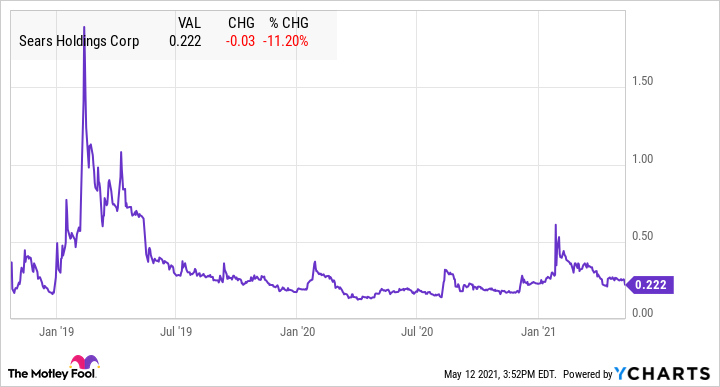
Tickers for companies that have gone bankrupt, many of which are delisted, are identified with a "Q" at the end. Sears Holdings declared bankruptcy in 2018 and now trades under the ticker (OTC:SHLDQ). Sears was delisted from the Nasdaq on Oct. 24, 2018, but the stock has continued to trade over the counter. The stock has traded for around $0.25 a share for most of the time since, as the chart below shows.
To give one unique example, an executive order from former President Trump led to the delisting of a number of Chinese companies. These enterprises are suspected of having ties to the Chinese military or refuse to allow audits, among other violations.
Understanding the delisting process is helpful for gaining greater knowledge of stock market mechanics, but remember that most investors are better off avoiding delisted stocks since they risk losing everything in the event of a company declaring bankruptcy.
Related investing topics
About the Author