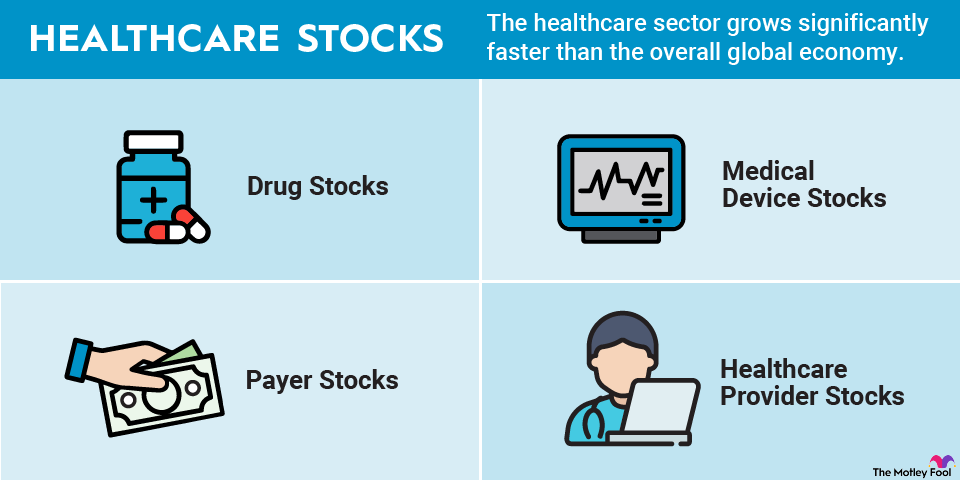
Everybody needs healthcare -- or will, at some point. And, when there’s something everyone needs, there’s a huge opportunity for investors. Healthcare stocks are shares of publicly traded companies that provide healthcare products or services.
About $10 trillion is spent on healthcare globally. More than half -- around $5.3 trillion -- is spent in the U.S. With the healthcare sector growing significantly faster than the overall economy, the numbers will almost certainly be much larger by the end of the decade.

How can investors profit from this growth? Here’s what you need to know about investing in healthcare stocks.
Top healthcare stocks to buy in 2026
Strong companies can be found within each type of healthcare stock. Here are some top healthcare stocks to buy that represent each type:
| Name and ticker | Current price | Market cap | Industry |
|---|---|---|---|
| Vertex Pharmaceuticals (NASDAQ:VRTX) | $446.58 | $112.6 billion | Biotechnology |
| Intuitive Surgical (NASDAQ:ISRG) | $460.99 | $160.8 billion | Healthcare Equipment and Supplies |
| TransMedics Group (NASDAQ:TMDX) | $99.46 | $3.2 billion | Healthcare Equipment and Supplies |
| UnitedHealth Group (NYSE:UNH) | $270.59 | $237.6 billion | Healthcare Providers and Services |
| HCA Healthcare (NYSE:HCA) | $472.64 | $104.6 billion | Healthcare Providers and Services |
| Cardinal Health (NYSE:CAH) | $211.23 | $48.5 billion | Healthcare Providers and Services |
1. Vertex Pharmaceuticals

NASDAQ: VRTX
Key Data Points
2. Intuitive Surgical

NASDAQ: ISRG
Key Data Points

NASDAQ: TMDX
Key Data Points

NYSE: UNH
Key Data Points

NYSE: HCA
Key Data Points

NYSE: CAH
Key Data Points
Your dollars and mine, our capital, is helping shape the world.
3. Valuation
- Determine the value of a healthcare stock before buying to make sure you're paying a fair price.
- The price-to-earnings (P/E) ratio is the most popular valuation metric. It measures a stock's price relative to its earnings per share, or what you get in earnings for every dollar you invest.
- Forward P/E ratios, which use earnings estimates for the next year, can be more helpful in assessing the valuation of fast-growing healthcare stocks. Comparing P/E ratios with other stocks in the same industry will help you determine if the stock is relatively cheap or relatively expensive.
- Take growth prospects into consideration by checking out the stock’s price-to-earnings-to-growth (PEG) ratio, which incorporates projected earnings growth rates (typically over five years). Stocks with lower PEG ratios (especially when the ratios are less than 1) are more attractively valued than those with higher PEG ratios.
4. Dividends
- Some of the best healthcare stocks pay dividends -- a portion of earnings that the company returns to shareholders. Dividends can boost the overall return you receive from owning a stock.
- The dividend yield tells you how large a stock’s annual dividend payments are as a percentage of the current share price.
- Consider the stock’s payout ratio, which measures dividends as a percentage of earnings and indicates how much of the company’s cash is being used to cover the dividend. The lower the payout ratio, the greater the likelihood that the company will be able to keep paying dividends in the future.
What are the risks of investing in healthcare stocks?
Investing in any kind of stock comes with risks, including the possibility that competitors will develop more successful products and services. Healthcare stocks face these risks, as well as others unique to the sector.
Healthcare is highly regulated. Drugmakers and medical device makers can fail to secure the necessary regulatory approvals to market new products. Regulatory changes can drastically alter a healthcare stock’s growth prospects. In the U.S., the Food and Drug Administration (FDA) oversees the regulation of drugs and medical devices. It’s smart to pay attention to any FDA action related to medical stocks you’re watching.
Many healthcare stocks also face significant litigation risk. For example, biopharmaceutical companies, medical device makers, and healthcare providers can be sued if patients believe their products or services harmed them.
In addition, drugmakers and medical device makers must convince payers, including health insurers, PBMs, and government agencies, to buy their products. If companies aren’t successful in obtaining reimbursement approvals, their growth prospects can be reduced.
Many healthcare companies are also highly dependent on Medicare reimbursement levels. Recent changes to Medicare allow the program to negotiate prices for some high-cost drugs with pharmaceutical companies. Some drugmakers' revenues and profits could be negatively affected since Medicare pays less for certain drugs.
Benefits of investing in healthcare stocks
The key benefits of investing in healthcare stocks include:
- Many healthcare stocks have strong long-term growth prospects driven by aging demographics.
- Healthcare stocks tend to perform well during economic downturns.
- These stocks provide diversification in one of the most important sectors.
- Many healthcare stocks offer attractive dividends.
How to invest in healthcare stocks
Follow these steps to invest in healthcare stocks:
- Open your brokerage app: Log in to your brokerage account where you handle your investments.
- Search for the stock: Enter the ticker or company name into the search bar to bring up the stock's trading page.
- Decide how many shares to buy: Consider your investment goals and how much of your portfolio you want to allocate to this stock.
- Select order type: Choose between a market order to buy at the current price or a limit order to specify the maximum price you're willing to pay.
- Submit your order: Confirm the details and submit your buy order.
- Review your purchase: Check your portfolio to ensure your order was filled as expected and adjust your investment strategy accordingly.
Market trends & outlook
Current trends affecting healthcare stocks include:
- Adoption of artificial intelligence (AI)
- Transition to more outpatient care (for example, ambulatory surgical centers)
- Mergers and acquisitions
- The impact of GLP-1 drugs
- Expiring Affordable Care Act subsidies
Despite some challenges, the future outlook for healthcare stocks is promising overall, with aging demographics in the U.S. and other countries.
The bottom line
Despite these risks, the long-term outlook for healthcare stocks appears very good. Aging demographic trends worldwide, combined with advances in technology, should open up tremendous opportunities for healthcare stocks -- and deliver healthy returns for patient investors.

Related investing topics
FAQ
Investing in healthcare stocks FAQ
About the Author
Keith Speights has positions in Intuitive Surgical and Vertex Pharmaceuticals. The Motley Fool has positions in and recommends Intuitive Surgical, TransMedics Group, and Vertex Pharmaceuticals. The Motley Fool recommends HCA Healthcare and UnitedHealth Group and recommends the following options: long January 2028 $520 calls on Intuitive Surgical and short January 2028 $530 calls on Intuitive Surgical. The Motley Fool has a disclosure policy.