Track the companies that matter to you. It's FREE! Click one of these fan favorites to get started: Apple; Google; Ford.

Recs

207

Options: A Foolish Introduction

Historically, the Fool has shied away from options as an investment vehicle, for reasons best stated by people smarter than us. Peter Lynch, a Foolish favorite around here, was not a fan of small individual investors using options. And we're ever mindful of Warren Buffett's first rule: "Don't lose money." Options, by their very nature, can significantly amplify losses. Then again, as leveraging instruments, they can also amplify gains.

Options have enjoyed a much higher profile in recent years, as trading volumes increased, curious investors dipped their toes into untested waters, and new specialized brokers entered the market. Late-night infomercials feature alluring red-and-green-flashing software and testimonials from ordinary people who, with little to no training, claim to have made fortunes in the option markets.

That last point is why we're here. This series is not intended for traders or sophisticated professionals employing complex arbitrage strategies or looking to trade volatility. Instead, we're hoping to give ordinary Fools a firm knowledge of what options are, and how we recommend using them in hopes of improving returns.

Options are something else
The best place to start would be to define exactly what options are. Options are derivatives -- they derive their value from an underlying "something else." Before you start using options, it's Foolish to make sure you understand exactly what that "something" is.

For years, Warren Buffett has warned investors about the potential dire consequences of unchecked and growing derivatives use in capital markets. Then again, the Oracle of Omaha himself has used derivatives when he feels the market's offering him a value opportunity. So we can understand why Fools might be confused by this seemingly contradictory behavior.

To state this emphatically, we Fools believe that 99% of individual retail investors -- that's you, folks -- can happily go through life without ever buying or selling an option. But derivatives themselves (of which options are only one part) aren't inherently bad. The real problems stem from their wide proliferation, and the crazy accounting with which they're associated.

Options are just tools, and they're only as good as the people using them. Shrewd use by well-educated investors can greatly enhance a portfolio's returns. Reckless, ill-informed use of options, however, can badly damage your holdings. To use options well, you've got to have a healthy understanding of the intrinsic value of the business involved. Without that most Foolish of principles, how safe do you feel in using options to leverage returns?

A few Foolish caveats
You won't find descriptions here of option trading for trading's sake. If you're interested in day trading or "black box" software, look elsewhere. Most of those programs should come with warning labels, and some should be illegal.

Don't look here for an option-only trading approach, either. We believe that options derive their value from real businesses, whose real worth can be estimated and employed as a sturdy foundation for a Foolish options strategy.

Many people, including plenty of folks in our Foolish community, have done very well by treating options as trading instruments. If you'd like to try to follow in their footsteps, we'll point you toward some resources that might help. For the rest of you, sit back and relax. If you finish this series with a better understanding of the mechanics, risks, and potential rewards of options, we'll have done our job.

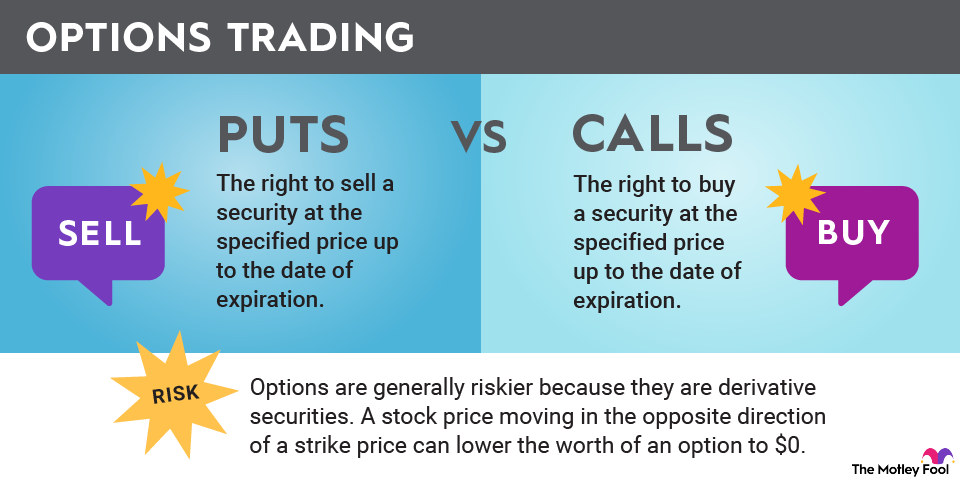
Now, for those Fools who can’t tell the difference between a put, a call, and a lemon meringue pie, get started here:

And, for those of us who are already familiar with the fundamentals of the options world, check out these more intermediate-level how-tos:

If you are interested in receiving more information from The Motley Fool about investing in options, please click here.

Jeff Fischer and team have demystified options. And they can rack up income like $1,030... $2,626... and $3,228 on a schedule you can set your watch by!
That's why we're glad to announce every single one of their closely guarded strategies is available to YOU during May and June – 100% FREE, no strings attached! Just enter your email address in the box below...

Fool contributor Jim Gillies owns no shares of any company mentioned. The Fool has a disclosure policy.


Read/Post Comments (35) | Recommend This Article (207)

Comments from our Foolish Readers

Help us keep this a respectfully Foolish area! This is a place for our readers to discuss, debate, and learn more about the Foolish investing topic you read about above. Help us keep it clean and safe. If you believe a comment is abusive or otherwise violates our Fool's Rules, please report it via the Report this Comment Report this Comment icon found on every comment.

  • Report this Comment On August 25, 2009, at 1:56 AM, semones100 wrote:

    Interesting article. A continuing reminder to me to understand more about options.

    I still need help understanding how I can lose money (not opportunity) by selling covered calls

    At this point I do not recall any time MFPRO recommended Buying an option except to close an almost expired put. I would like more background in these Options articles about these strategies. Are these Buying options where the hazards occur, etc

    I'm watching the 8/18 online videos and reading the emailed narratives, but think all these "option lessons" should point out some of the things your broker does like "withholding your cash from withdrawl to cover the possible call on your put obligations- proper, but originally leaves the novice wondering why some of his cash is being withheld. I would like to see some of these issues covered on the ONLINE Q & A sessions

    semones100

    George Kent

  • Report this Comment On October 09, 2009, at 5:45 PM, llorenz wrote:

    I am relatively new to options trading and have allocated about 10 % of my total portfolio to an options trading account. Typically, I would trade 100 to 200 shares of a stock in my stock portfolio account. My question is, based on this, would I then typically trade 1 or 2 options contracts in my options portfolio account?

  • Report this Comment On October 10, 2009, at 1:25 AM, irmat wrote:

    I am not relatively new with options, I have never done this in the past. I believe I am up to the risk, and hope I will make money when I become comfortable with the information herein.

    What's next?

  • Report this Comment On December 22, 2009, at 2:41 PM, STAN2G wrote:

    How do options move in relation to the various market indices? Are options more useful during a sideways market, such as we've been experiencing for the past month or so?

  • Report this Comment On December 28, 2009, at 12:35 PM, patterson51490 wrote:

    I know nothing about options, but I have a question. If you don't own the stock how are you going to make money writing puts? Help me I need an answer.

  • Report this Comment On December 28, 2009, at 1:04 PM, tkell31 wrote:

    Patterson, you collect a premium for writing the put. In exchange for the premium you have to buy the stock (or buy back the option) if it is at or below the strike price when the option expires. I suggest reading the links above to familiarize yourself with options prior to trying to trade them.

  • Report this Comment On February 03, 2010, at 4:39 PM, xjp83x wrote:

    A writing put example:

    For the buyer, it gives the buyer the right to sell the stock at a strike price. The buyer usually does this when he/she predicts the underlying stock price to go down in the future.

    So the current price of GE is 16.68. The buyer of a put may think that it's going to go down in 6 months. In 6 months, GE is at 10 dollars. If he bought a put at a strike price of 15, he can buy the GE for 10 dollars and gets the right to sell GE at 15 dollars.

    The writer has to buy the stock at the strike price of 15 when he could have bought it at 10 dollars.

    However, if GE went up istead of down, the writer receives the premium and got nothing to lose. The writer usually writes a put when the market is neutral/bull.

  • Report this Comment On February 12, 2010, at 12:14 AM, binaryoptions wrote:

    I have honestly had far greater success trading options than any other security. Investors with low capital who are very patient and selective with their option purchases can do very well if willing to take the risk.

  • Report this Comment On February 27, 2010, at 8:33 PM, rmtonkavich wrote:

    The Options Clearing Corporation has a very good website at "www.optionsclearing.com". The site offers a great set of tools to help learn and understand the various attributes to investing with Options. I would highly recommend to anybody that is looking for helpful and relevent information about how to use Options to enhance your Portfolio would peruse their site and take advanatage of some of the training tools offered.

  • Report this Comment On March 16, 2010, at 12:03 AM, redkat103 wrote:

    Optionetcs .com is another wealth of information site.

  • Report this Comment On May 21, 2010, at 11:10 AM, mdspe wrote:

    I am very green at options... I bought my 1st INTC . Price $20.27

    Strike$23.00

    Sell to Open

    October Closing date

    1 contract

    Out of Pocket $110.00

    Did I do it right? and should I have purchased more contracts since my out of pocket is only $110.00?

    I have $20,000 set aside for options.

    thanks

  • Report this Comment On June 20, 2010, at 2:04 PM, billybobp wrote:

    I have no experience with options, but I just finished reading the basics and advanced tips. So, let me see if I got all this straight:

    Right now, I own 300 shares of XYZ stock that is currently trading around $15.75 per share. Now XYZ pays a modest dividend, which is why I hanging on to this stock, but I’d be willing to sell it and reinvest the proceeds in something else if I could get a decent price for my shares. For example, I’d be will to sell at $19 per share. On the other hand, the dividend is decent enough so that I’d be willing to buy more shares of XYZ if the price was right – say $14 per share.

    So I could write a limit order to sell my existing shares at $19 per share at no cost to me. Or, as I understand this options business, I could write a call option for three contracts on my shares for 19 at some future date. I’d have to pay a trading fee, but I would get some cash in return. If the cash I can earn exceeds the options trading fee, then I should write the call and collect the cash instead of writing a sell at limit order. Is this correct?

    And since I’m also interested in buying more shares if the price drops, I could write (sell) a put option at 14 at some future date. Again, so long as what I receive for the put option exceeds the transaction fee, I should write the put and collect some cash instead of writing a buy at limit order. Is this correct?

    That is, I can use options to earn money to do what I planned on doing anyway?

  • Report this Comment On June 29, 2010, at 3:35 PM, Puckplayr4 wrote:

    Billybobp...sounds like you and I are about in the same area of understanding. I bought some lower priced stocks in excess of 100 shares just to be able to sell some covered calls, but I think the brokerage transaction fees are more than I can earn on writing the option. In general, if you feel confident a stock won't rise well past the strike price you perceive as a good selling point, then writing the covered calls is a good way to go (assuming the transaction costs don't eat in to the profit too much). That's where I seem to be stuck...Apparently I need a more valuable stock or thousands of shares, not hundreds.

    I've been trading USD/EUR currency options for the past year (successfully) at an insane profit rate, but then Greece collapsed just as we were becoming 50% more risky with our investment and lost it all... That is all about managing risk, which is apparently much easier to do with Currency than stock options...I am not advocating anyone else do this, thankfully I have great mentor who has been learning this game from the inside out for the past 10 years, and we know where we went wrong (aside from being too greedy)...but we easily doubled our money in 6 months before we lost it all. Starting over sucks...and we won't shoot for the moon this time, but doubling our money every 8-12 months works for me too. You'd think I'd know more about options than I do...I just know we make all of our money (as do most regulars) from WRITING options...not speculating (buying). If you take 100 swings at a possible homerun, you might hit it every once in awhile, but at a cost. But if you're the one selling the options, banking smaller, but safer profits, weekly...the money flows in if you can keep from over-leveraging yourself before the options expire. Everyone that swings for the fences is my customer..and I am playing both sides of the fence, just like a sports bookie. Its all about managing the risk...just like a moving line in sports betting (which I REALLY don't recommend!). In currency, you sell calls and you sell puts. Then when the price gets too close to the strike you sold at (either way), you buy/sell in combinations that increase profits AND manage that risk until the options expire. We went from 2 months to 3, (increasing our period of risk 33%). We just couldn't manage that risk during the Greece Euro debacle. Even now we are on the GPB/USD instead of the Euro, and back to a shorter period, just to lessen the risk. We're starting slow, sticking to the plan, and in 8-9 years, I should be able to afford that Ferrari! This as a "infomercial" would be worth millions...I just don't know what sort of certification you need to sell a program like this...and its not mine to sell, Thankfully a great friend is showing me the ropes and I am sure will help me retire 20 years early. Again, I am not advocating this for anyone else. The cost to figure this out on your own would bankrupt you, and even after doing this for 10 years my partner is still learning lessons and picking himself up by his boot-straps.

  • Report this Comment On November 08, 2010, at 9:23 PM, noslen wrote:

    IIorenz:

    One option contract = 100 shares of stock.

    If you have a stock, that has options, and you consider buying shares, DON"T instead but a call DITM option (DeepInTheMoney) that has a delta close to 100 and at least 90 days until expiration or even longer. Set a stop loss order at 30% of the option premium. DO NOT keep the call when expiration is just 30 days to expiration - sell it.

    Noslen

  • Report this Comment On December 16, 2010, at 1:52 PM, oneilda wrote:

    Before recommending a site it might be wise to be sure that there are no negatives. Although we can't know everything about everyone. Here is a snipet about Optionetcs.com:

    "Overall Optionetics, is a costly program, that takes some real investment skill to succeed with.

    When you meet with the Optionetics rep he will not be trying to explain to you how the system works, but will be more concerned with selling their seminar. It is a two day seminar with the steep price tag of $2,995.

    This price is also a little deceptive, because you are going to end up paying well over $3,000 to get started with Optionetics. You will have to pay hidden setup fees. And then on top of that you need more money to invest and start trading with them.

    On top of that Optionetics founder George Fontanills is being sued by FIMAT USA in the New York Federal Court for not complying with margin calls. I would recommend taking caution before jumping in to a program like Optionetics."

    ...Just sayin - be careful.

  • Report this Comment On March 04, 2011, at 11:52 PM, LuckyJohn57 wrote:

    I think the big message here is that options, like any other instrument, can be used successfully as part of an overall strategy. The real question is more one of what, when and how much to invest. I have been using a covered call strategy for years that has been conservative but ultimately profitable. The real trick is to not get too enamoured with a particular stock so that if it's called, you can just move on. BTW does anyone know if options transactions can be tracked on the scorecard?

  • Report this Comment On March 11, 2011, at 5:30 PM, nullah wrote:

    I was wondering if anyone knew where one could access historical options data

  • Report this Comment On April 09, 2011, at 12:48 AM, sjn1234 wrote:

    What about commodities option. It's not as easy finding a Scottrade or Schwab to buy a call on gold, silver or oil. Has anyone seen any articles reviewing futures/options brokers?

  • Report this Comment On June 21, 2011, at 4:10 PM, ZZyzxZZ wrote:

    I didn't read all the subtopics so maybe the most important thing was covered and maybe not. That thing is:

    Options trading is a Zero-sum game. Unlike the stock market where companies can create value by being successful in their business, options are bets at a poker table. People bet: some win and some lose, and the money won equals the money lost.

    Think about this: Do you play Texas Holdem now that it's a craze? If you do, next time you sit down to play poker, try to access the other players at the table. See any pros? See any fish? If you don't see any fish at the table, then you're the fish.

  • Report this Comment On July 19, 2011, at 4:21 PM, kmacattack wrote:

    I've been investing for about 30 years, and wrote my first covered call about 25 years ago and I've been fortunate in that I've always made money with the strategy, and only 3 times in 25 years did I get called away. I've been with the same full commission broker for the entire 30 years. He's a little over 70 and still working full time and I turned 60 recently and 95 percent of the time he's tended to advise me to invest pretty conservatively and only once advised me to buy an investment that turned sour. He was branch manager at Smith Barney in 2000 and advised me to buy two funds which were being sold as Smith Barney branded funds, one was a moderate risk growth fund, the other was an agressive growth fund. The agressive growth fund tripled in about 2 years, but two of the companies that were included in the twenty or so in the fund were Enron and World Com. When the "ship hit the sand" I lost (on paper) $80,000. Eventually, the fund recovered and I got out with a nice profit. My broker was so embarrassed about pushing the fund, he told me, "I'll never ask you to buy another of their recommended funds."

    About two years ago, he taught me a little about puts, and I was scared to death at first, but have made some great money over the last year by writing puts ON STOCKS THAT I already own and am familiar with. I dig into the financials and look at the trends and long term prospects. I've only been "burned" one time on a put, and I still am ahead because instead of buying the put back before expiration, I took the stock, Clean Energy, which has made a very nice comeback in the last week and increased more than 25 percent in 2 days. I bought Sirius XM about 18 mos ago, and the stock has more than doubled, plus I've made a very nice profit by writing puts 4 times on it, buying the options back twice when the price made a nice run up, then when it pulled back, I've written puts again. I just bought a Chinese beverege company, Sky People, a couple of weeks ago and wrote a put on it today, picking up $1,500. The stock's growth is phenominal, the profit margins are excellent, and they are expanding internationally. I look for this stock to move to about $8.00 within 18 months, (it's about $3.10 now, bought my first 1,000 shares at $2.70 about 10 days ago, and added another 1,000 later in the week, then another 1,000 today and wrote a put on the entire 3,000. I would like to add another 2,000 shares in the next 30 days, and if the budget situation is resolved, I'll do so immediately. I think, like Sirius, this will be an excellent stock for writing puts. Tata Motors is my only other foreign holding, and I've made some good money on a covered call when I first bought the stock, but was called away when TATA went up to about $27.50 from the $25 where purchased it. But, I made $2,000 on the call option in a couple of months. TATA pulled back when the market was dropping over the last few weeks to around $21, and I wrote a put yesterday on it, picking up $1,500. I didn't buy the stock this time, but if it drops below $21, I'll still be happy to purchase it rather than buying the put back at a loss. Long term, I think this stock is going to be a big winner. I placed protective stops under some of my big gainer stocks about a month ago, and a few of them dropped below my stops, so I ended up with a higher cash balance than I would like, but, It's my "insurance policy" to cover the puts. I've never done "straddles" or other more complex options, and haven't bought any calls either. But, I'm learning as I go, not getting too greedy (I'm not writing puts on anything that I can't afford to cover and more importantly that I don't feel comfortable owning long term) I also wrote a put on Ford this morning. I'm down about $2 per share on Ford, but I think it's a terrific buy at the current $12.80 level. There are a lot of great things happening with Ford, top notch management, the best light to heavy pickup truck line in the world, and a great line up of smaller, fuel effecient cars including the Focus, the new Fiesta, the Fusion, which is available as a hybrid, the Taurus, etc. I own a Taurus, a Ford cargo van and two Ford Pickups. My trucks are all older models, but they are truly built "Ford Tough."

  • Report this Comment On July 19, 2011, at 4:35 PM, kmacattack wrote:

    I didn't menton that I know little or nothing about "charts", 50 day averages, etc. I've relied on my brokers knowledge on those trends, but I've bought many "big winner stocks" that according to the charts were headed down. If you can dig into the financials, Profit and Loss TRENDS for the past 3 years or so, Balance sheets (do they have positive shareholder value, or ARE THEY MOVING RAPIDLY TOWARD a positive balance sheet, Does the company have enough CASH on hand to weather the storm if they've been in trouble, and another indicator I look at is that IF they have been in trouble (As Sirius XM was) how are they managing their debt obligations? Sirius, rather than paying dividends, is paying down debt as their profits increase. Ford has been paying off debt at a rapid pace, and in the first quarter this year, improved their cash position WHILE PAYING OFF DEBT AS WELL, by $3 BILLION. Insider trading information can be helpful, but isn't always a good indicator. Some insider trades are "pre programmed" and can give a false impression. I've pretty much designated about 10 percent of my portfolio to higher risk issues, such as Sirius when I buy, but Sirius is no longer a high risk company. Just do a little homework before you "leap."

  • Report this Comment On August 15, 2011, at 10:48 PM, readytogo37 wrote:

    Went through Optionsetics in 2003 - they do sell their programs ... but the seminars can be gone to forever "Free" - anyway, the main thing for me was to learn that all the programs, and the Greeks and the wave program's and such all boil down to 1 thing ... whether the stock is going up or down or nowhere - hence I am waiting with baited breath for the opening of the Pro ... reading a chart can be done with a 12" ruler ... its picking the company ... Optionetics believes that covered calls are the most dangerous of all ... unlimited down side risk ... however, we currently have one on SLV ... and remeber DONOT BUY STOCKS JUST TO do covered calls with ... leg in with your broker and save a commission fee ... Thanks

  • Report this Comment On November 11, 2011, at 5:35 PM, cluesow wrote:

    Wondering if anyone thinks it's possible my broker is using my shares to cover his call options, (ones he sold and kept the premium for and is now being exercised on). Sems he's got me "taking profits" sometimes when the stock is rising nicely.

    Thanks,

  • Report this Comment On December 04, 2011, at 7:36 PM, trendfriendpa wrote:

    yes he is probably using your shares to hedge and earn income for his firm. If the chart doesn't say to sell, then don't sell. The chart tells you what to do.

  • Report this Comment On December 04, 2011, at 7:37 PM, trendfriendpa wrote:

    for those that would like a quick chart to visually explains selling/buying puts/calls send email to trendfirendpa@yahoo.com - subject line - motley fool - options explanation chart

  • Report this Comment On December 05, 2011, at 1:39 PM, TacticalOptions wrote:

    Very good article. Options can also be used to manage stock portfolios and reduce risk. It's important to understand how they work.

    http://sellacalloption.com/

  • Report this Comment On March 29, 2012, at 4:56 PM, EP130 wrote:

    great article, i was just studying up for a summer analyst internship interview for a sales and trading firm and this information helped a lot. for anyone interested i also read a great book that goes a little more in detail. I came across The Power Curve by author Scott Kyle on a recommendation from a teacher and found the examples used to be of great help

  • Report this Comment On July 24, 2012, at 8:42 AM, kdbutler1999 wrote:

    Good article, and it links to good information for those who do want to get started trading options.

    Another good site for those who want to learn more about options trading is www.olmsteadoptions.com.

    New site with excellent info on how to get started with options, founded by Dr. Edward Olmstead, professor of Applied Mathematics at Northwestern University and author of Options for the Beginner and Beyond.

    A free trial is available, too.

  • Report this Comment On September 18, 2012, at 12:10 AM, title1ted wrote:

    Is anyone familiar with binary options or digital options? How are these different from options? (Note: I am not well versed in options to begin with.)

  • Report this Comment On October 03, 2012, at 9:43 PM, MrMrr wrote:

    is this a good small company ..still learning about options

    Search form

    Search

    Home

    Trading Ideas

    Newsletters

    Free Sign Up

    .

    This Unloved Stock Could Deliver an 80%-Plus Short-Term Gain

    September 27, 2012By: Amber Hestla-BarnhartPrint

    1

    While value investing and short-term trading seem to be at opposite ends of the investment spectrum, there are ways short-term traders can use long-term value investing principles to profit. Value investors look for cheap stocks and buy in the hope that over the long term there will be a very large move in the stock. When a short-term trader finds a value stock with a chart that is indicating that it's a buy, they can trade it for a short-term gain as the value investors are accumulating their positions. And through the use of options they could leverage a relatively small price move into a large gain.

    Looking at unloved sectors in the stock market, the hunting ground for many value investors, airlines stand out as dismal performers besieged by bad news. Some of the major airlines may not make it -- bankruptcy seems to be part of the business plan for major carriers. Regional airlines, on the other hand, seem to have business plans based on profitable operations. Among the regional airlines, Southwest Airlines (NYSE: LUV) stands out as a potential trade.

    The weekly chart shows that LUV is trading near support. The pattern could be thought of as an extended cup-and-handle with the handle currently being formed and defining the support level.

    The 52-week high is slightly above $10 a share and there is every reason for a value investor to believe that the stock will eventually return to that level.

    Earnings are steady and growing. The company reported earnings of 43 cents a share in 2011, and it is expected to report 65 cents a share this year and 96 cents in 2013. Based on next year's expected earnings, LUV is trading at a price-to-earnings (P/E) ratio of less than 10, which is less than a third of the five-year average P/E ratio of 35. LUV is also trading below its book value and has enough cash on its books to pay off all the company's debt obligations. These are additional factors that value investors like to see.

    LUV is scheduled to report earnings for this quarter in mid-October. The company has beaten analysts' expectations in each of the past four quarters, and if it beats expectations again, the stock price could move higher. This is the type of company that could make a great options trade since there is probably already buyers interested in the stock and we have an event (the earnings release) that could be a catalyst to move the stock price.

    In looking at LUV options, there is not much of a difference in the price of options expiring in December compared with those expiring in October or November. For about 15 cents more, we can add 60 days to the option's life and increase our chances of success with this trade. December $8 call options on LUV are trading at about $1.10, which is the ask price. Traders can use a limit order to enter the trade and should be able to buy at a slightly lower price.

    With LUV currently trading at $8.86, the option trade will be profitable if the stock increases by 24 cents. The chart pattern shows that a target of $10 is possible. The option would be worth at least $2 if LUV trades at $10, offering a gain of more than 80% for those who buy the option at $1.10 or below.

    Value stocks can offer trading opportunities for those willing to take positions ahead of an earnings report that may confirm the buy decision of long-term investors. LUV is an example of this kind of trade and the profit potential is significant relative to the low price of the options.

    Recommended Trade Setup:

    -- Buy LUV Dec 8 Calls at $1.33 or less

    -- Do not use a stop-loss

    -- Set initial price target at $2 for a potential 50%-plus gain by expiration

    Market Summary

    October 3, 2012 - 9:41 PM

    S&P 500

    0.00

    -6.69 (0.00%)

    NASD

    0.00

    0.00 (0.00%)

    Most Popular Trades

    Avoid Serious Losses By Following the Rules

    Think Like a Trader to Limit Your Risks and Pocket 28% Weekly Gains

    Profit from New Methods of Visualizing Sentiment

    [+] View More

    This Breakout Stock is a Strong 'Buy' Today

    Sell These 4 Bank Stocks Immediately

    WARNING: Sell These 3 Stocks Now

    A Rounding Top Pattern Could be Pointing to a 750% Trading Gain

    If History Repeats, These Two Trades Should be Winners

    Indicators Are Bullish for This Bad News Stock

    Market Outlook: If You Could Only Choose One Investment, This Would be It

    A 27% 'Instant Dividend' From Amazon

    Indicator With 82% Accuracy Signaling Possible Market Surprise

    You Could Double Your Money If Shares Break This Barrier

    Don't Count This Tech Giant Out Yet - It Could Double Your Money

    2 Small-Caps With Huge Potential Signaling 'Buys'

    Market Outlook: This 'Sure Thing' Indicator is Saying 'Buy, Buy, Buy'

    This 100% Gainer is an Immediate Sell or Short

    Indicator With 70% Accuracy Says This Stock Could be a Bottom Fisher's Dream

    5 Stocks Sounding the 'Sell' Alarm

    3 Small Caps That Could Deliver Big Gains by Year-End

    Proven 'Buy' Signal Says 2 Oversold Stocks Are About to Take Off

    Earn Instant Income on a Once-Mighty Stock Trading at 9-Year Lows

    This Beaten-Down Tech Stock Could Double Your Money

    Capture a 10% Dividend in a Low-Yield Market

    Indicator on Verge of Signaling a Sell-off - Get Positioned Now

    It's Not Too Late to Short This Collapsing Sector

    Breakout Stock Could Make You 38% Before Hitting Resistance

    Gold is a Good Investment, But These Miners are a Better Bet

    Stock On the Brink of a Technical Breakout That Could Return 60%-Plus

    Ignore the Crowd - This Trade Could Double

    3 Ways You Could Profit From Apple Without Paying $700 a Share

    Indicator Warns Traders to Prepare for a Market Drop

    An Easy Way to Make Twice as Much Money as Shareholders

    Chart Pattern Signaling Big Potential in This Small Company

    Get This Triple-Digit Gainer for a Bargain-Basement Price

    Volatility Signaling a Major Move Ahead That Could Make You 63%

    This Retail Stock's Nosedive Could Deliver...

    Hang On To Your Income Investments... Don't...

    Which of These Surging Stocks has Even More...

    More from Street Authority...

    New Banking Rules Could Double Price Of Gold...

    These 7 Stocks Haven’t Missed A Dividend...

    The Easiest Way to Make $1 Million in the Stock...

    More from TopStock Analysts...

    This Credit Giant Must Pay Cardholders $85M...

    This Fail-Safe Trick Can Spare Your Home From...

    These 7 Dividend Champions Are Consistent...

    More from Investing Answers...

    This Recent IPO's Market Could Grow by 17,000%

    Make a Fortune the Warren Buffett Way: Using...

    Insiders Are Staking a FORTUNE on These Companies

    More from Small Stocks...

    Hang On To Your Income Investments... Don't...

    These 7 Stocks Haven't Missed A Dividend Payment...

    Forget Facebook: These Newly Listed Stocks...

    More from Global Dividends...

    Home | Commentary | Free Sign Up | Special Offers | About Us| Contact Us

    Terms of Use | Privacy Policy | Disclaimer | Advertise

    Copyright 2001 - 2012. StreetAuthority, LLC All Rights Reserved.

    LEGAL DISCLAIMER: TradingAuthority.com and its parent company, StreetAuthority, LLC, are publishers of financial news and opinions and NOT securities brokers/dealers or investment advisors. You are responsible for your own investment decisions. All information contained in our newsletters or on our web site(s) should be independently verified with the companies mentioned, and readers should always conduct their own research and due diligence and consider obtaining professional advice before making any investment decision. As a condition to accessing our materials and web sites, you agree to our Terms and Conditions of Use, available here, including without limitation all disclaimers of warranties and limitations on liability contained therein. Owners, employees and writers may hold positions in the securities that are discussed in our newsletters or on our web site.

  • Report this Comment On February 17, 2013, at 8:53 AM, KenMcG6150 wrote:

    I believe that options, like any other tool, can be quite useful when properly used by someone who understands how to use them and the dangers to which one can be exposed through careless handling of them.

    When properly applied, I think options can reduce risk and increase returns as opposed to simply buying and selling stocks at current market prices. However, like almost anything worthwhile. using options effectively within one's portfolio requires time, study and effort and my experience has been that is not what most people are looking for when they are considering options.

    In short, I believe the reason most people lose money in options is the same reason most people lose money investing in stocks period, they do not put forth the time and effort to truly understand the transactions in which they are engaging and the businesses underlying those same transactions.

    It takes a great deal of time and hard work that I just don't find most people willing to dedicate to the process.

  • Report this Comment On March 22, 2013, at 8:09 AM, NICKTHEGREEK1986 wrote:

    PSX

  • Report this Comment On April 21, 2013, at 11:26 PM, smalldogInvestor wrote:

    i don't particularly care for the tone of this article. i'd be surprised if any new self-directed investor read past the first paragraph. options should be the first thing a self-directed investor should learn because it provides a tool to combat random walk.

    these days it is utterly foolish not to be involved with options!

    the truth is that options run the stock market. much equity volume is due to the creation and conclusion of option contracts. even if you never trade an option, option volume and pricing can tell you information about where the price of an equity is likely to go.

    there are many advantages of options, some of which are:

    one can continually lower the cost basis in an equity.

    one can define the risk of a trade without resorting to stoploss orders.

    one can participate in high quality equities that one might never consider because the price of the underlying stock is too high a number to purchase a meaningful number of shares. (would you buy 1 share of goog!?)

    one can benefit from a decline in a stock without requiring the dreaded margin account in order to short stock.

    options provide a way to profit from a non-trending (60% of the time) market.

  • Report this Comment On April 22, 2013, at 9:42 PM, scs660 wrote:

    If you want to buy a stock at the current price, and you are a long term investor, sell a put. You will get the stock for a discount from current market or you will make money when someone pays you the premium.

  • Report this Comment On May 12, 2013, at 2:40 PM, LuckyS13 wrote:

    Ive never seen a smarphone iphone ipad or any of this stuff where are they and what are they for?

Add your comment.

Compare Brokers

Fool Disclosure

DocumentId: 950862, ~/Articles/ArticleHandler.aspx, 5/20/2013 8:56:47 PM

Report This Comment

Use this area to report a comment that you believe is in violation of the community guidelines. Our team will review the entry and take any appropriate action.

Sending report...

Today's Market

updated Moments ago Sponsored by:
DOW 15,335.28 -19.12 -0.12%
S&P 500 1,666.29 -1.18 -0.07%
NASD 3,496.43 -2.54 -0.07%

Create My Watchlist

Go to My Watchlist

You don't seem to be following any stocks yet!

Better investing starts with a watchlist. Now you can create a personalized watchlist and get immediate access to the personalized information you need to make successful investing decisions.

Data delayed up to 5 minutes


Advertisement