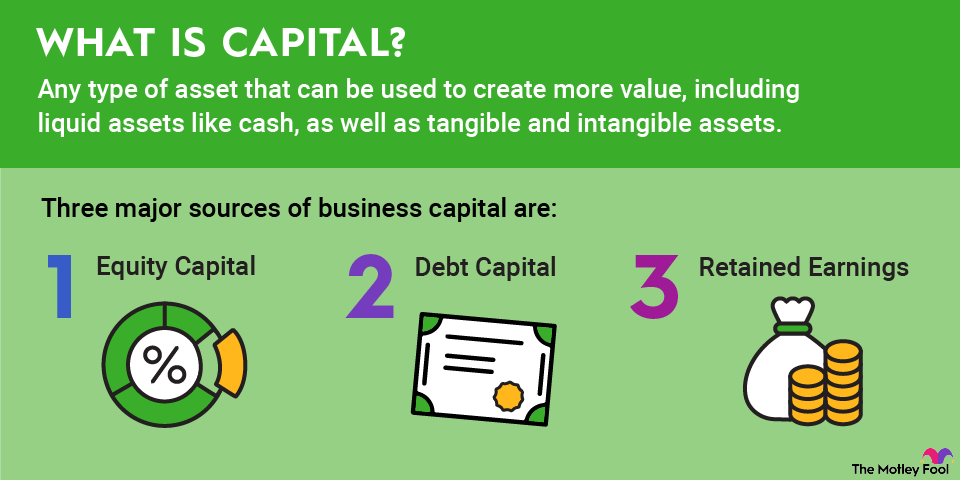
When companies decide to raise money, they generally have two choices. They can work with outside investors to raise equity, or they can borrow money in the form of debt. Companies financed with equity trade a specified ownership percentage for new money, while companies using debt financing have to pay a particular rate of interest for the money they borrow.
Here, we'll discuss what the cost of debt is and how you might see it applied in the real world.
What is the cost of debt?
The cost of debt refers to the average cost of borrowing for a business. In other words, when companies borrow money, they're obligated to pay a certain interest rate over the course of the loan term, much like an individual loan. Companies with outstanding bonds and loans pay ongoing interest to various lenders, and that interest expense translates to the dollar cost of debt over a particular time period.
Another way to think about the cost of debt is to think about it as a "rent" charge for borrowed money. Since interest is considered to be the cost of borrowing, interest expense is simply the ongoing expense associated with rented money.
To find a company's cost of borrowing, take all of their outstanding debts on their balance sheet and add them up. Then, find interest expense on the company's most recent annual income statement to find the dollar cost of debt over the period in question.
Finally, put the interest expense number over the total outstanding debt to find an approximation for the company's average cost of debt. This percentage should give a good sense as to how much the company pays to borrow money and should also shed some light as to whether the company is structuring its capital stack in a cost-effective manner.
For simplicity, understanding the average cost of debt and how to derive it is a good place to get started. If you want to get more specific, you can multiply the average cost of debt by (1 – effective tax rate) to find the after-tax cost of debt.
Why does the cost of debt matter?
Companies that use debt financing benefit in a central way: The interest expense associated with borrowing money is often tax-deductible as a cost of doing business. This means that a company's actual cost of borrowing may be a fair amount lower than its average cost of borrowing before taxes. This can make debt financing more attractive than equity financing, at least from a tax standpoint.
The reality is that companies pay extremely close attention to their tax liabilities and are willing to consider debt as a valuable tax shield. At the same time, companies with too much debt may run into a creditworthiness issue if their cash flow can't keep up with the ongoing interest expense.
Like it or not, interest is a fact of life when it comes to taking on debt. As such, businesses face an ongoing cost of debt, much like any individual or family does with a mortgage, student loan, or car note. This is due to the time value of money and the potential risk of default; the lender needs to be properly compensated for handing out their money, and this compensation comes in the form of interest expense.
What increases the cost of debt?
Naturally, rising interest rates will make borrowing more expensive across the board. Over the past year-plus, the Federal Reserve has raised the overnight federal funds rate at its fastest pace in history, leading to substantially higher borrowing costs for almost all forms of debt. In other words, loan origination (and the forthcoming interest expense) just got much more expensive, especially because interest compounds exponentially.
As companies add new debt to their balance sheets, their average cost of debt increases; in dollar terms, they'll see a higher interest expense on their income statement. Further, if the company has debts with long payback periods (or longer terms), it will pay more to borrow over time than if it had taken a shorter loan with higher periodic payments.
These are all decisions a company has to make when considering its entire financial picture, but primarily with regard to its ability to service its obligations on a consistent basis. Higher rates, unfortunately, typically mean a greater reluctance to invest in new projects since the cost of failure is so much higher.
Think about how the cost of debt might rear its head in everyday life. A family that buys a new home with a large mortgage in 2023 will pay substantially more than if the family bought the same house at the same price in 2020. The family's cost of debt is undeniably higher than it would have been had they acted when interest rates were lower -- but of course, there are other considerations that would make a family buy a home beyond just their cost of borrowing.
Related investing topics
Final considerations around the cost of debt
Debt financing can be a way to raise money relatively quickly, but it won't come without a substantial ongoing cost in the form of interest expense. A company must also have the credit capacity to add new borrowing to its balance sheet without experiencing a hit to its creditworthiness.
That said, if a company can take on more debt effectively, it will also benefit from a generous tax shield. Most CEOs would agree that a lower tax liability is a desirable outcome for their respective companies.
Debt is a double-edged sword. Borrowed money can help companies and individuals reach financial goals, but it can also cause tremendous financial stress if not managed accordingly. As with any decision to take on new debt or to restructure, companies and individuals alike would be wise to take a big-picture view and proceed with caution in the face of new borrowing.