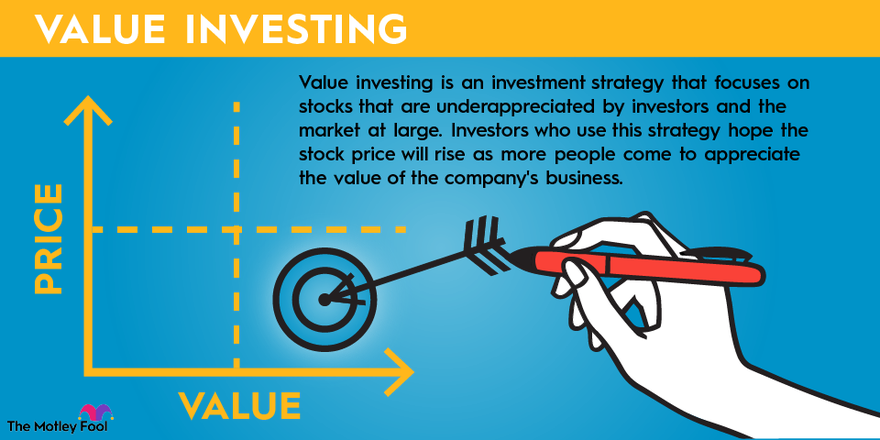
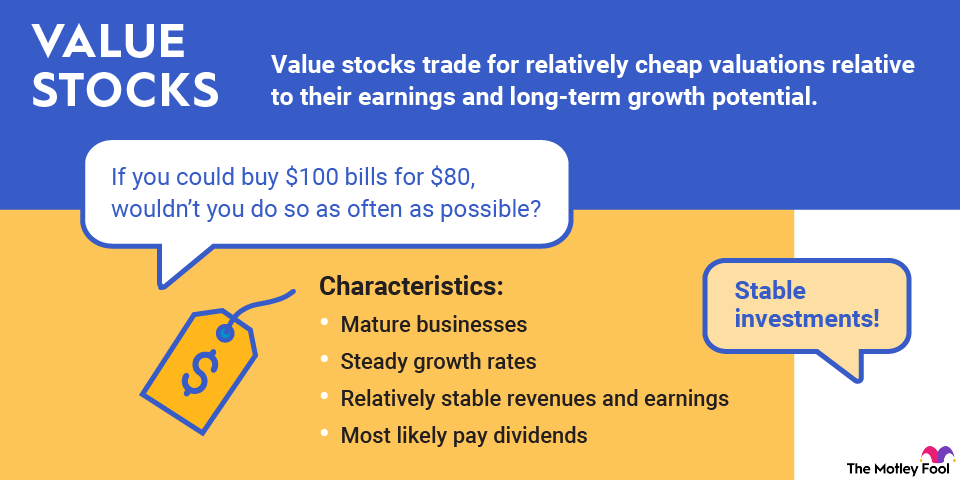
Value investors want to buy stocks for less than they're worth. If you could buy $100 bills for $80, wouldn't you do so as often as possible? Even high-quality companies with strong fundamentals see share prices fall when the overall stock market drops. Plus, value stock companies tend to be well established and less volatile than growth stock companies.
Here's an overview, including some excellent beginner-friendly value stocks and key concepts and metrics that value investors should know.
Four best value stocks for beginners
Value stocks are generally publicly traded companies trading at cheap valuations relative to their earnings and long-term growth potential. Let's look at four excellent value stocks: Berkshire Hathaway (BRK.A +0.96%) (BRK.B +1.35%), Target (TGT +3.85%), General Motors (GM +0.24%), and Signet Jewelers (SIG +2.70%). Then, we'll dive into some metrics that can help you find the best value stock investments.
| Name and ticker | Market cap | Dividend yield | Industry |
|---|---|---|---|
| Berkshire Hathaway (NYSE:BRK.B) | $1.0 trillion | 0.00% | Diversified Financial Services |
| Target (NYSE:TGT) | $47.8 billion | 4.29% | Food and Staples Retailing |
| General Motors (NYSE:GM) | $75.9 billion | 0.68% | Automobiles |
| Signet Jewelers (NYSE:SIG) | $3.8 billion | 1.39% | Specialty Retail |
1. Berkshire Hathaway

NYSE: BRK.B
Key Data Points
Berkshire Hathaway (BRK.A +0.96%) (BRK.B +1.35%) is a unique company on the stock market and has long been a top choice for value investors. That's largely because longtime CEO Warren Buffett, who stepped down at the end of 2025, is the world's most admired value investor, and his investing acumen is the biggest reason for the company's success.
Since Buffett took over in 1964, Berkshire Hathaway has grown into a conglomerate with more than 60 wholly owned businesses and a massive stock portfolio of more than 30 different holdings. Berkshire has steadily increased its book value and earnings power over time.
It operates under the same business model that has led the stock to almost double the annualized return of the S&P 500 index for more than 55 years. That track record is unmatched and will probably never be beaten.
As part of their value investing strategy, Buffett and his late business partner Charlie Munger kept large cash reserves to deploy when they spotted an opportunity. Buffett's also been content to own companies outright that can generate profit and don't need to grow, using those profits to fund stock purchases and new acquisitions, a unique strategy in the stock market.
Wholly owned subsidiaries, such as See's Candies, Dairy Queen, and Brooks running shoes, are all good examples of cash-flowing stable businesses that don't need to grow to contribute to Berkshire's business model. Buffett's value investing approach also explains why he favors sectors like insurance, which provide a "float" in the form of premiums that he can reinvest.
Buffett announced at Berkshire's annual shareholder meeting in May 2025 that he would step down by the end of the year. He will be passing the reins to Greg Abel, who is currently CEO of Berkshire Hathaway Energy.
As of the end of the third quarter, Berkshire had more than $375 billion in cash and equivalents on its balance sheet, putting it in a good position to make an acquisition if it finds one attractive. Additionally, the company could pay a dividend. Abel is expected to run the business with a value-oriented mindset similar to Buffett's, though the Buffett imprint is likely to change over time.
One sign that even value stocks are getting expensive is that Berkshire was a net seller of stocks in 2024, signaling that Buffett may believe the market is overvalued. Stocking up on dry powder is another smart strategy of value investors like Buffett, and it will likely pay off if stocks pull back again as they did at the beginning of 2025.
2. Target

NYSE: TGT
Key Data Points
Target (TGT +3.85%) is one of the largest retailers in the U.S. and one of only a handful of national multicategory retailers, along with Walmart (NYSE:WMT), Costco (COST +2.99%), and Amazon (AMZN +1.60%). The company has been a steady engine of growth throughout most of its history. It has a wide reach for a brick-and-mortar retailer -- operating in urban, suburban, and rural locations -- and stores in all 50 states.
However, Target (has struggled in recent years due to weak consumer discretionary spending, inventory fluctuations, and internal issues such as theft. It's also faced customer backlash due to changes in its diversity, equity, and inclusion (DEI) policies, which may have contributed to weak results in 2025. As a result, the stock traded at a price-to-earnings (P/E) ratio of 12 in January 2026.
That's a great price to pay for a retailer with differentiated positioning and one that's still opening new stores despite its recent struggles. Target is also a Dividend King with a dividend yield of 4.5%, offering a reward to income investors.
Target still has a long-term growth opportunity in retail, both through new stores and e-commerce. This includes its range of same-day fulfillment options, such as curbside pickup, known as Drive Up, and same-day delivery through Shipt.
Target's stock has fallen for a number of reasons, but its challenges are fixable. The company expects to grow sales by a total of 15% over the next five years, and at its current valuation, the stock looks like it should be a winner if it can accomplish that goal.
While its recent results have been disappointing, Target is the kind of value stock that offers value because of its turnaround potential. A change in leadership could also help drive a recovery when Chief Operating Officer Michael Fiddelke becomes CEO in February.
3. General Motors

NYSE: GM
Key Data Points
Valuation is arguably the most important test of a value stock, as a value investor is ultimately looking to buy a stock worth more than its price. As Buffett has said, "Price is what you pay. Value is what you get."
By that yardstick, General Motors (GM) (GM +0.24%) may be one of the best value stocks around. GM has been a leading player in the auto industry for a century and remains one of the world's largest automakers.
Based on its adjusted earnings per share (EPS), GM trades at a P/E ratio of 8.3 as of January 2026. This is a reflection of investors' low growth expectations and uncertainty around tariffs and trade. However, forward expectations have improved due to policy changes under the Trump administration, as well as the company's own moves to scale back on money-losing ventures.
The company has started to benefit from slowing growth in electric vehicles (EVs), though it has a number of them on the market, as the transition will support sales of its combustion vehicles. GM also announced in late 2024 that it would shut down its Cruise autonomous vehicle business, which had cost it an estimated $10 billion. Investors responded positively to the move because it will help GM's cash flow.
Concerns about tariffs have weighed on the stock at times, but it's unclear how the import taxes will affect the business since higher car prices could be good for GM, or at least for its American-made inventory. A recent hike in steel tariffs to 50%, however, is expected to be a hardship for GM and its peers.
The company estimates the gross tariff impact for the year to be $3.5 billion to $4.5 billion. However, the company will benefit from a new government MSRP offset program that lowers the tariff impact, as well as relaxed fuel economy standards.
As a value stock, GM is also able to aggressively repurchase stock to lift its EPS. It has reduced shares outstanding by almost one-third over the last 18 months. That's one way value stocks can grow profits even without growing revenue.
4. Signet Jewelers

NYSE: SIG
Key Data Points
Signet Jewelers (SIG +2.70%) is the world's largest diamond jewelry retailer. With a market cap of just $3.6 billion, it's much smaller than any of the other stocks on this list, but value stocks come in all sizes.
Signet operates in a mature industry, and the stock has historically traded at a discount because investors regard it as a low- or no-growth company. There also seems to be some concerns about disruption from lab-grown diamonds.
However, Signet is benefiting from that segment as well since it's driving up average unit retail prices and giving the company new ways of serving a broader range of price points. It's also driving higher demand in the fashion category, which is the non-bridal segment of the business.
The company has made some smart moves, including reducing its real estate footprint, investing in higher-margin service businesses, like repair and warranties, and focusing on driving returns for its largest brands, including Kay, Jared, and Zales.
Based on adjusted EPS, Signet trades at a P/E ratio of just 10, and the company has taken advantage of that discount to buy back stock. Over its last four quarters, it repurchased 8% of shares outstanding after shares fell sharply, and its shares outstanding have fallen by roughly half over the last decade.
What are value stocks?
Most stocks are classified as either value stocks or growth stocks. Generally, a value stock trades for a lower price than its financial performance and fundamentals suggest it's worth. A growth stock is a company expected to deliver above-average growth compared to its industry peers or the overall stock market.
Growth Stock
Some stocks have both attributes or fit in with average valuations or growth rates, so whether they are value stocks depends on the number of pertinent characteristics they possess. Value stocks generally have the following characteristics:
- They are typically mature businesses.
- They have steady (but not spectacular) growth rates.
- They report relatively stable revenues and earnings.
- Most pay dividends, although this isn't a set-in-stone rule.
Some stocks easily fit into one category or the other. For example, package delivery giant FedEx (FDX +4.05%) is clearly a value stock that's fallen out of favor with Wall Street due to some short-term challenges. Conversely, fast-moving Tesla (TSLA -1.85%) is an obvious example of a growth stock.
On the other hand, some stocks can fit into either category. For example, there's a case to be made either way for tech giants Apple (AAPL +4.12%) and Microsoft (MSFT -1.52%), though their valuations may be a little too stretched currently to be seen as value plays.
Regardless of a stock's category, economic downturns present an opportunity for value investors. The goal of value investing is to scoop up shares at a discount, and the best time to do so is when the entire stock market is on sale; for instance, during a recession.
How to find value stocks
The point of value investing is to find companies trading at a discount to their intrinsic value, with the idea that they'll likely outperform the overall stock market over time. However, finding undervalued stocks is easier said than done. That said, here are three of the best metrics to keep in your toolkit as you search for a bargain:
- P/E ratio: This is the best-known stock valuation metric -- and for good reason. The P/E ratio can be a very useful tool for comparing the valuations of companies in the same industry. To calculate it, simply divide a company's price per share by its past 12 months of earnings per share.
- Price/earnings-to-growth (PEG) ratio: This is similar to the P/E ratio, but the PEG ratio adjusts to level the playing field between companies that might be growing at slightly different rates. By dividing a company's P/E ratio by its annualized earnings growth rate, you get a more apples-to-apples comparison between different businesses.
- Price-to-book value (P/B) ratio: Think of the book value as what would theoretically be left over if a company stopped operations and listed all its assets for sale. Calculating a company's share price as a multiple of its book value can help identify undervalued opportunities, and many value investors specifically look for opportunities to buy stocks trading for less than their book value. This is sometimes known as an asset play.
Why invest in value stocks?
There are a number of reasons why investing in value stocks can be a good strategy.
- Value investing tends to be more methodical than growth investing. It's typically easier to identify a stock that is a good value than to predict a business's long-term growth rate.
- Value stocks typically have less downside than growth stocks. Since their valuations are already low, they have less room to fall than growth stocks.
- Value stocks often pay dividends. Their yields can be high, as dividend yields are inversely correlated with valuations.
- Value investing can pay off when the market is expensive. When the market gets frothy, value stocks tend to be better long-term bets.
How to choose value stocks
Choosing a value stock involves considering many of the same factors you would with any other stock. You'll want to invest in well-run companies with strong business models and a sustainable competitive advantage.
For value stocks, it's especially important to consider valuation. To help you determine whether a stock offers a good value, you can use a discounted cash flow model to see how much a stock is worth based on projected future cash flows.
Dividend yields and share buybacks are also worth considering. While value stocks tend to offer modest growth rates, they can deliver strong returns through returning capital to shareholders with dividends and share buybacks.
How to invest in value stocks
- Open your brokerage app: Log in to your brokerage account where you handle your investments.
- Search for the stock: Enter the ticker or company name into the search bar to bring up the stock's trading page.
- Decide how many shares to buy: Consider your investment goals and how much of your portfolio you want to allocate to this stock.
- Select order type: Choose between a market order to buy at the current price or a limit order to specify the maximum price you're willing to pay.
- Submit your order: Confirm the details and submit your buy order.
- Review your purchase: Check your portfolio to ensure your order was filled as expected and adjust your investment strategy accordingly.
Value investors
Long-term investors can generally be classified into one of three groups:
- Value investors try to find stocks trading for less than their intrinsic value by applying fundamental analysis.
- Growth investors try to find stocks with the best long-term growth potential relative to their current valuations.
- Some investors take a blended approach and do a little of each.
Buffett is perhaps the best-known value investor of all time. From the time he took control of Berkshire Hathaway in 1964 to the end of 2024, the S&P 500 generated a total return of 31,223%. Berkshire's total return during the same period has been a staggering 5,502,284% (that's not a typo).
Although he isn't as well-known as Buffett, Benjamin Graham is often referred to as the father of modern value investing. His books, The Intelligent Investor and Securities Analysis, are must-reads for serious value investors. Graham was also Buffett's mentor.
Reasons for undervaluing a stock
There are a lot of reasons why investors might undervalue a stock. Let's take a look at a few of them.
- Recency bias: Stocks can plunge on a single bad earnings report, even though it might be just a result of one-time issues. Investors tend to pay more attention to recent events, meaning one piece of bad news can cause a stock to be oversold. Of course, a stock plunging isn't necessarily a signal that it's undervalued. You have to investigate it to see why it fell and whether it's still healthy.
- Short-term bias: Investors also have a tendency to pay more attention to what they can see in the short term. For example, the sell-off in April 2025 was arguably a result of short-term bias. Investors feared that tariffs would crush the economy. After some negotiations and adjustments, stocks quickly recovered to all-time highs.
- Cyclicality: Cyclical stocks rise and fall based on macro factors in the economy. Value investors can do well picking up these stocks when they're at a low point in the economic cycle. Currently, some consumer discretionary stocks, like fast-casual restaurants, have fallen sharply on weak consumer spending, and there could be some opportunities in this sector.
- Turnarounds: Turnarounds don't always turn as some investors say, but sometimes they do pay off. If there's evidence that a turnaround is starting to work, that can be a good opportunity to buy a value stock. Nike (NKE +0.65%), for example, has shown some early evidence that its turnaround is working, and the stock has responded.
- Transitional business models: Sometimes, companies change their business models, and the stock plunges when the results initially tumble. For example, Netflix (NFLX -0.84%) stock tumbled in the early stages of its streaming launch before going on to deliver huge returns. Similarly, RH (RH -1.86%), formerly Restoration Hardware, plummeted when it switched to a membership-based business model, though the stock surged after that move paid off.
- Temporary headwinds: Sometimes, business conditions are challenging, but they are temporary. Netflix reported two straight quarters of subscriber declines after the COVID-19 pandemic, but that was because consumers were reverting to pre-pandemic norms for how they spent their time. That headwind proved to be temporary.
Value stocks vs. growth stocks
There are several differences between value stocks and growth stocks. These are the most important ones to know.
- Value stocks tend to trade at a low P/E ratio. Growth stocks generally trade at a high P/E ratio.
- Value stocks tend to be characterized by slow growth. Growth stocks are high-growth stocks.
- Value stocks typically pay dividends. Growth stocks usually do not.
- Growth stocks are usually riskier than value stocks.
- Growth stocks are more volatile.
- Growth stocks tend to outperform in bull markets, while value stocks generally outperform growth stocks in bear markets.
Tax considerations for value investors
The tax implications for value investors are similar to what they are for any stock investor. You'll have to be mindful of short-term and long-term capital gains, investing in a retirement account vs. a taxable account, and paying taxes on dividends.
As a value investor, you're more likely to hold stocks for the long term, which will help save money on taxes since you need to hold a stock for at least a year to pay the lower, long-term rate. Additionally, since most value stocks pay dividends and dividends are part of value-investing strategy, it's typically smart to keep value stocks in a retirement account so you don't have to pay taxes on the dividends.
Related investing topics
Don't underestimate the power of value stocks
While they may not be quite as thrilling as their growth stock counterparts, it's important to realize that value stocks can have just as much long-term potential, if not more. After all, a $1,000 investment in Berkshire Hathaway at the beginning of 1965 would be worth more than $28 million today.
Finding companies that trade for less than they are truly worth is a time-tested investment style that can pay off tremendously.
FAQ
Investing in value stocks FAQ
About the Author