Return on Equity: An Introduction

Recs

63

Disarmingly simple to calculate, return on equity is a critical weapon in the investor's arsenal, as long as it's properly understood for what it is. ROE encompasses the three pillars of corporate management -- profitability, asset management, and financial leverage. By seeing how well the executive team balances these components, investors can not only get an excellent sense of whether they will receive a decent return on equity but can also assess management's ability to get the job done.

Return on equity is calculated by taking a year's worth of earnings and dividing them by the average shareholder equity for that year. The earnings number can come directly from the Consolidated Statement of Earnings in the company's most recent annual filing with the SEC. It can also be figured as the sum of the past four quarters' worth of earnings, or as the average of the past five or 10 years' earnings, or it can even be an annualized figure based on the previous quarter's results. However, investors should be careful not to annualize the results of a seasonal business, in which all of the profit is booked in one or two quarters.

The shareholder-equity number is located on the balance sheet. Simply the difference between total assets and total liabilities, shareholder equity is an accounting convention that represents the assets that the business has generated. It's assumed that assets without corresponding liabilities are the direct creation of the shareholder capital that got the business started in the first place.

The usual way investors will see shareholder equity displayed is as "book value" -- the amount of shareholder equity per share, or the accounting book value of the business beyond its market value or intrinsic economic value. A business that creates a lot of shareholder equity is a sound investment, because the original investors will be repaid with the proceeds that come from the business operations. Businesses that generate high returns relative to their shareholder equity pay their shareholders handsomely and create substantial assets for every dollar invested. These businesses are typically self-funding and require no additional debt or equity investments.

To quickly gauge whether a company is an asset creator or a cash consumer, look at the ROE it generates. By relating the earnings to the shareholder equity, an investor can quickly see how much cash comes from existing assets. If the ROE is 20%, for instance, then 20 cents of assets are created for every dollar originally invested. As additional cash investments increase on the asset side of the balance sheet, the ROE number shows whether additional dollars invested are dollars of return from previous investments.

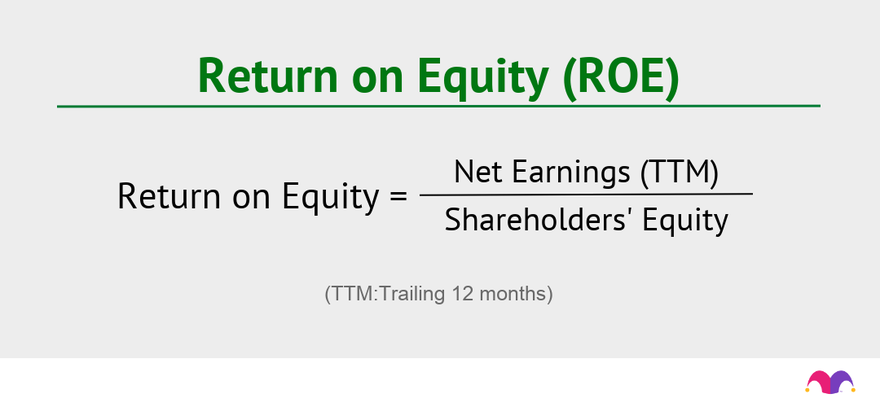
If return on equity is simply:

ROE = one year's earnings / shareholder equity

… then how is it that we can see the profit margin, asset management, and financial leverage through this one calculation? If we expand the equation, we can start to take into account other variables. (We apologize if this gives you a flashback to high school algebra.)

ROE = (one year's earnings / one year's sales) x (one year's sales / assets) x (assets / shareholder equity)    

Because the sales and the assets are both in the numerator and the denominator of the entire equation, they cancel one another out. When we break the equation apart in this manner, the three component parts of ROE come to light. Earnings over sales is profit margin, sales over assets is asset turnover, and assets over equity is the amount of leverage the company has. We'll discuss each one, and after we complete our analysis, we'll come back to ROE and how this composite number can be used to evaluate companies. We'll also explore its limitations as an analytical tool.

More on return on equity:

Comments from our Foolish Readers

Help us keep this a respectfully Foolish area! This is a place for our readers to discuss, debate, and learn more about the Foolish investing topic you read about above. Help us keep it clean and safe. If you believe a comment is abusive or otherwise violates our Fool's Rules, please report it via the Report this Comment Report this Comment icon found on every comment.

  • Report this Comment On January 14, 2009, at 2:56 PM, dogmoon1 wrote:

    Need help applying ROE for CLNE. Balance sheet quotes Stockholder equity at 230.93 but there was an additional paid in capital of 297.87 plus other equity adjustments of 2.15 -- is this issuance of more stock? Also, retained earnings are -69.09. Do the math and you get 230.97, However, is the equity all new cash with no gains not considering prior equity.

    I'm just getting started in the investment bus. and want to develop careful habits from the start, so, could someone answer this accounting valuation of ROE? Mike

Add your comment.

Compare Brokers

TD AMERITRADE
more info
ShareBuilder
more info
Power E*Trade

more info
Scottrade
more info
Fool Disclosure

DocumentId: 652411, ~/Articles/ArticleHandler.aspx, 11/21/2009 5:04:25 AM

The Must-Read Story on Fool.com
An Open Letter to the Federal Reserve

Community: Investing Wiki

Term Of The Hour

Power of attorney: Power of attorney is a legal document that gives an individual the right to act on behalf of the one signing the document.

Want to learn more or edit this definition?
Click here to read more!