Average American Household Debt in 2026: Facts and Figures

KEY POINTS
- Total Consumer Debt: U.S. consumer debt reaches $18.771 trillion by Q2 2026.
- Average Household Debt: The typical U.S. household carries $105,444 in debt as of 2025.
- Credit Card Balances: Average credit card debt stands at $6,610 in Q2 2026.
How much debt do households carry in the U.S., and how much does the average person carry? Across mortgages, credit cards, auto loans, and other borrowing, total consumer debt in the U.S. stands at $18.771 trillion as of the second quarter of 2026, per the Federal Reserve Bank of New York, and the average debt in America is $105,444 per household, according to Experian.
Drawing on data from Experian, the Federal Reserve, TransUnion, and the Census Bureau, Motley Fool Money breaks down debt by type, updated each quarter as new data is released.
Key household debt statistics
| Figure | Amount |
|---|---|
| Total household debt, Q2 2026 | $18.771 trillion |
| Average household debt, 2025 | $105,444 |
| Total credit card debt, Q2 2026 | $1.263 trillion |
| Average credit card debt, Q2 2026 | $6,610 |
| Total mortgage debt, Q2 2026 | $13.117 trillion |
| Average mortgage debt, Q2 2026 | $272,628 |
| Average mortgage payment, Q1 2026 | $2,023 |
| Total home equity revolving debt, Q2 2026 | $459 billion |
| Average HELOC value, 2025 | $49,517 |
| Total auto loan debt, Q2 2026 | $1.713 trillion |
| Average auto loan debt, Q2 2026 | $25,219 |
| Average monthly new car payment, 2026 | $770 |
| Average monthly used car payment, 2026 | $531 |
| Average personal loan debt, Q2 2026 | $11,694 |
| Total student loan debt, Q2 2026 | $1.651 trillion |
| Other debt, Q2 2026 | $0.568 trillion |
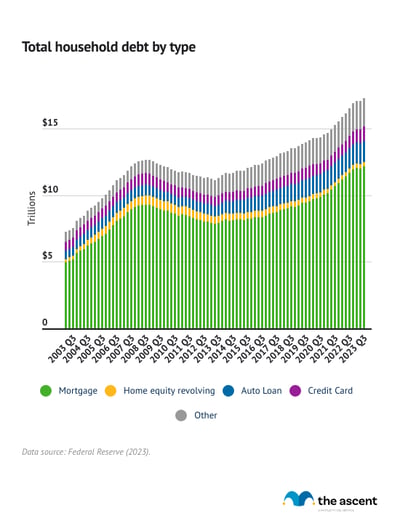
Average consumer household debt: $105,444
| Debt Type | Total, Q2 2026, unless otherwise specified |
|---|---|
| Total consumer debt (including types not listed below) | $18.771 trillion |
| Average household debt, 2025 | $105,444 |
| Total mortgage debt | $13.117 trillion |
| Total revolving home equity debt | $459 billion |
| Total auto loan debt | $1.713 trillion |
| Total credit card debt | $1.263 trillion |
| Total student loan debt | $1.651 trillion |
| Other debt | $0.568 trillion |
The New York Fed's quarterly Household Debt and Credit Survey (HHDC) shows that total consumer debt stands at $18.771 trillion as of the second quarter of 2026, down slightly from $18.784 trillion in the first quarter.
How much debt does the average American have?
The average American carries $105,444 in total debt as of September 2025, according to Experian. Excluding mortgage debt, the average balance is $21,603, down 3.3% from the prior year, suggesting consumers are paying down non-housing debt faster than they're adding it.
Credit cards, auto loans, and personal loans account for the bulk of non-mortgage debt.
Average debt by age
Debt balances vary significantly by generation, driven largely by where each cohort is in its financial life cycle, according to Experian data from September 2025.
| Generation | Auto Loan | Credit Card | Mortgage | Non-Mortgage Balance |
|---|---|---|---|---|
| Gen Z (18–28) | $21,027 | $3,553 | $267,157 | $14,987 |
| Millennials (29–44) | $25,471 | $7,068 | $324,272 | $26,304 |
| Gen X (45–60) | $27,956 | $9,684 | $287,928 | $30,069 |
| Baby boomers (61–79) | $22,734 | $6,766 | $197,090 | $18,044 |
| Silent Generation (80+) | $17,276 | $3,400 | $149,458 | $6,663 |
Gen X carries the highest average balance across auto loans, credit cards, and total non-mortgage debt. Gen X credit card balances are at least 24% higher than millennials' and 35% higher than baby boomers', per Experian. Millennials carry the largest average mortgage balance at $324,272, reflecting peak homebuying years at today's elevated home prices.
Average credit card debt: $6,610
| Figure | Amount |
|---|---|
| Total credit card debt, Q2 2026 | $1.263 trillion |
| Average credit card debt, Q2 2026 | $6,610 |
| Delinquency rate of all credit card loans from commercial banks, Q1 2026 | 2.92% |
| Flow into early delinquency, Q2 2026 | 8.69% |
| Flow into serious delinquency, Q2 2026 | 6.97% |
Americans owe $1.263 trillion in credit card debt as of the second quarter of 2026, according to the Federal Reserve. The average credit card balance was $6,610 in the second quarter of 2026, down from $6,715 at the end of 2025, even as total outstanding balances rose, according to TransUnion. The split points to more cardholders carrying a balance, not existing cardholders carrying more.
Based on Experian data from the second quarter of 2025, Gen X has the highest average credit card balance, $9,600, while Gen Z has the lowest, $3,493.
Credit card balance by generation
| Generation | 2023 | 2024 | 2025 |
|---|---|---|---|
| Generation Z (18-25) | $3,148 | $3,266 | $3,493 |
| Millennials (26-41) | $6,274 | $6,642 | $6,961 |
| Generation X (42-57) | $8,870 | $9,255 | $9,600 |
| Baby boomers (58-76) | $6,601 | $6,648 | $6,795 |
| Silent generation (77+) | $3,434 | $3,375 | $3,445 |
Credit card delinquency rate: 8.7%
In the second quarter of 2026, 8.69% of credit card balances had become delinquent by 30 days or more over the past year, up from 8.61% the prior quarter.
Flows into serious delinquency (90 days or more past due) fell to 6.97% from 7.1% a year prior.
Average mortgage debt: $272,628
| Figure | Amount |
|---|---|
| Total mortgage debt, Q2 2026 | $13.117 trillion |
| Average mortgage debt, Q2 2026 | $272,628 |
| Median mortgage payment, Q1 2026 | $2,023 |
| Average mortgage rate, Q2 2026 (30-year fixed) | 6.41% |
| Total home equity revolving debt, Q2 2026 | $459 billion |
| Average HELOC value, 2025 | $49,517 |
Mortgages make up about 70% of American consumer debt. Total mortgage debt stands at $13.117 trillion as of the second quarter of 2026, down slightly from $13.191 trillion the prior quarter, according to the Federal Reserve.
How much mortgage debt does the average American have? The average mortgage debt among Americans is $272,628, per TransUnion, up from $269,562 a quarter ago.
How much mortgage debt does the average American have?
The average mortgage debt among Americans is $272,628, per TransUnion, up from $269,56 a quarter ago.
The average 30-year fixed mortgage rate for the second quarter of 2026 is 6.41%, up from 6.11% in the first quarter, reversing a slight decline seen through late 2025.
Mortgage rates rose through 2023 after hitting lows in 2020 and 2021. They started to decline in the second half of 2024.
Average mortgage payment: $2,023
The average mortgage payment in the first quarter of 2026 was $2,023, according to the Federal Housing Finance Agency's National Mortgage Database.
Average HELOC amount: $49,517
Based on data from Experian, the average value of a home equity line of credit in 2025 was $49,517.
Average auto loan debt: $25,219
| Figure | Amount |
|---|---|
| Total auto loan debt, Q2 2026 | $1.713 trillion |
| Average auto loan debt, Q2 2026 | $25,219 |
| Average monthly new car payment, 2026 | $770 |
| Average monthly used car payment, 2026 | $531 |
Auto loan debt increased to $1.713 trillion in the second quarter of 2026 from $1.685 trillion in the previous quarter. The average auto loan debt is $25,219 as of the second quarter of 2026, up from $24,822 the previous quarter.
The average car payment for both new and used vehicles has roughly held steady, according to Experian data.
Average new car payment: $770
The average monthly payment on a new-car loan is $770 in 2026, according to Experian. Monthly payments on loans for new cars, by credit score, are as follows:
- Deep subprime (300-500): $763
- Subprime (501-600): $792
- Nonprime (601-660): $811
- Prime (661-780): $774
- Super prime (781-850): $753
Average used car payment: $531
The average monthly payment on a used-car loan was $531 in 2026, according to Experian. Monthly payments on loans for used cars, by credit score, are as follows:
- Deep subprime (300-500): $558
- Subprime (501-600): $551
- Nonprime (601-660): $539
- Prime (661-780): $516
- Super prime (781-850): $529
Auto loans in delinquency: 1.5%
According to TransUnion, 1.51% of auto loans were 60 days or more past due in the second quarter of 2026, slightly up from 1.49% a year prior.
Rising vehicle prices and overall inflation through 2022 and the start of 2023 may be responsible for a higher percentage of auto loans being in hardship compared to previous years.
Average personal loan debt: $11,694
| Figure | Amount | Prior year |
|---|---|---|
| Average personal loan debt, Q2 2026 | $11,694 | $11,607 |
| Average unsecured personal loan balance, Q2 2026 | $8,437 | $8,524 |
| Average finance rate on 24-month personal loans from commercial banks, May 2026 | 11.86% | 11.57% |
| Personal loans in hardship, 60-days plus past due, Q2 2026 | 3.81% | 3.37% |
Personal loans are versatile financial products. They can be used for a variety of financial needs, including weddings, home renovations, vacations, or debt consolidation.
According to TransUnion, the average unsecured personal loan amount in the second quarter of 2026 was $8,437, down from $8,524 in the previous year.
The average personal loan debt per consumer is $11,694, indicating that many people with one unsecured personal loan have at least one more or are accruing interest faster than they can pay it off. That's slightly higher than the $11,607 personal loan debt per consumer recorded a year prior.
Average personal loan interest rate: 11.86%
In May 2026, the average interest rate for a 24-month personal loan was 11.86%, up roughly three-tenths of a percentage point from 11.57% a year earlier, according to the Federal Reserve.
Personal loans in delinquency: 3.81%
In the second quarter of 2026, 3.81% of unsecured personal loans were delinquent and in hardship, 60 days or more past due, up from 3.37% in the same quarter of 2025.
Charge-offs and foreclosures
When Americans can't handle their debts, foreclosures, bankruptcies, delinquencies, and charge-offs occur. When those numbers go up, it's clear that Americans' personal finances are in trouble.
Charge-off and delinquency rates on consumer loans in 2026: 2.64%
The Federal Reserve Board collects statistics on charge-offs and delinquencies by loan type. The delinquency and charge-off rate for consumer loans, which includes credit cards, was 2.64% in the first quarter of 2026, up slightly from 2.62% the prior quarter. The overall rate, which includes real estate and commercial loans, was steady 1.48%.
Paying off debt
Total household debt is lingering near record levels, but the debt payment-to-income ratio at 11.2% remains lower than it was for most of the 2000s. That gap suggests most households are managing their debt loads, even as balances grow.
For those carrying high-interest balances, a balance transfer card can reduce the cost of credit card debt, and a balance transfer calculator can show how much interest a transfer would save. Building a savings buffer in a high-yield savings account reduces reliance on credit when unexpected expenses come up. For those consolidating multiple debts, personal loans with competitive rates can lower the total interest paid and simplify repayment.
-
Sources
- Experian (2026). "Experian Study: Average U.S. Consumer Debt and Statistics."
- Experian (2026). "Experian 2025 Consumer Credit Review."
- Experian (2026). "Experian State of Automotive Finance Market."
- Experian (2024). "State of Retail Cards and Buy Now, Pay Later in 2024."
- Federal Reserve (2026). "Household Debt and Credit."
- Federal Reserve (2026). "30-Year Fixed Rate Mortgage Average in the United States."
- Federal Reserve (2026). "Delinquency Rate on Credit Card Loans, All Commercial Banks."
- Federal Reserve (2026). "Finance Rate on Personal Loans at Commercial Banks, 24 Month Loan."
- Federal Reserve (2026). "Household Debt Service Payments as a Percent of Disposable Personal Income."
- Federal Reserve (2026). "Charge-Off and Delinquency Rates on Loans and Leases at Commercial Banks."
- Mortgage Bankers Association (2026). "Mortgage Application Payments Increased in March."
- TransUnion (2026). "Credit Industry Snapshot."
- TransUnion (2026). "TransUnion 2026 Originations Forecast Shows Continued Positive Momentum Amidst Moderate Expansion."
Our Research Expert
Jack Caporal is the Research Director for The Motley Fool and Motley Fool Money and has worked full-time for the company since 2021. Jack leads efforts to identify and analyze trends shaping investing and personal financial decisions across the United States. His research has appeared in thousands of media outlets including Harvard Business Review, The New York Times, Bloomberg, and CNBC, and has been cited in congressional testimony. He previously covered business and economic trends as a reporter and policy analyst in Washington, D.C. He serves as Chair of the Trade Policy Committee at the World Trade Center in Denver, Colorado. He holds a B.A. degree in International Relations with a concentration in International Economics from Michigan State University.
Motley Fool Stock Disclosures
The Motley Fool has a disclosure policy.