Why Should I Invest?

Recs

236

Welcome to Investing Basics! If you've found your way here, chances are you've either got some money socked away or you're planning to do so. But first things first. Why is investing a smart idea?

Simply put, you want to invest in order to create wealth. It's relatively painless, and the rewards are plentiful. By investing in the stock market, you'll have a lot more money for things like retirement, education, recreation -- or you could pass on your riches to the next generation so that you become your family's Most Cherished Ancestor. Whether you're starting from scratch or have a few thousand dollars saved, Investing Basics will help get you going on the road to financial (and Foolish!) well-being.

Know your goals
What are you saving for? Retirement? College for the kids? A new speaker system complete with woofers and tweeters? An exotic animal menagerie complete with Chihuahuas (woofers) and canaries (tweeters)? A retirement villa in the sun-baked hills of Tuscany?

Say you take $2,000 of your savings and put it into the stock market. If your money returned 10% a year (the S&P 500's historical average), two grand would be worth $34,898.80 after 30 years. That might not get you the perfect retirement home, but it'll at least give you a down payment.

Maybe you don't have $2,000 burning a hole in your bank account, but perhaps you can afford to invest your lunch money. Brown-bag your lunch and sock away just $4 a day, 250 days a year. It's not a lot, but if you're in your early 20s, you've got the investor's best ally on your side -- time. If you invest $1,000 once a year in an investment that averages a 10% annual return -- the average annual stock market return since 1926 -- it'll grow to more than $1 million after 46 years, which is right around the time you'll be ready to retire.

Of course, as you get older and more financially stable, you should be able to put away more to invest. Upping the ante to just $166 a month -- which is probably less than lunch money plus what you pay for cable TV -- would put you at the million-dollar mark in just 39 years.

The power of compounding
The table below shows you how a single investment of $100 will grow at various rates of return. Five percent is about what you might get from a certificate of deposit (CD) or with a government bond over time, 10% is about the historical average stock market return, and 15% is what you might get if you decide to learn how to pick your own stocks and take advantage of some of our lessons in advanced investing techniques.

Growing At

Year

5%

10%

15%

20%

1

$100

$100

$100

$100

5

$128

$161

$201

$249

10

$163

$259

$405

$619

15

$208

$418

$814

$1,541

25

$339

$1,083

$3,292

$9,540

Why is the difference between a few percentage points of return so massive after long periods of time? You are witnessing the miracle of compounding. When your investment gains (returns) begin to earn money, and then those returns start to earn money, your investment can mushroom very quickly. Extend the time period or raise the rate of return, and your results increase exponentially. For instance, if you start young, say at 15 years of age, note how quickly a single $100 investment grows, especially in the later years.

Growing At

Age

5%

10%

15%

20%

15

$100

$100

$100

$100

20

$128

$161

$201

$249

25

$163

$259

$405

$619

30

$208

$418

$814

$1,541

40

$339

$1,083

$3,292

$9,540

50

$552

$2,810

$13,318

$59,067

60

$899

$7,298

$53,877

$365,726

65

$1,147

$11,739

$108,366

$910,044

Looking at it another way, let's compare two teenagers and their lifetime savings habits. Bianca baby-sits a lot and spends most of her spare time reading. She saves $1,000 a year starting when she's 15 and invests it in the stock market for 10 years earning 12% per year on average. After 10 years, she comes out of her shell, stops adding money to her nest egg, and spends every penny she earns club hopping and on trips to Cancun. But she keeps her nest egg in the market.

Compare her account to that of her friend Patrice, who squandered her early paychecks on youthful indiscretions. At age 40 Patrice gets a wake-up call when her parents retire on nothing but Social Security. She starts vigorously socking away $10,000 every year for the next 25 years. Guess who has more at age 65? That's right, Bianca. (You figured it was a setup, didn't you?) Her 10 years of saving $1,000 per year (just $10,000 total -- the same amount Patrice put away in just one year) netted her $1.8 million by age 65. Patrice, on the other hand, scrimped for 25 years to invest a quarter million dollars out of her own pocket and ended up with just under $1.5 million. Neither will be going to the poorhouse, but you see our point: Bianca's baby-sitting money grew for 50 years, twice as long as Patrice's, and Bianca barely missed it.

(It's almost not fair to mention this, but if Bianca put her money in a Roth IRA, that whole $1.8 million would be tax-free. On the other hand, Patrice couldn't put her full $10,000 in a Roth, so Patrice will pay capital gains tax on a good deal of her gains.)

The power of compounding is the single most important reason for you to start investing right now. Every day you are invested is a day that your money is working for you, helping to ensure a financially secure and stable future.

Common pitfalls to avoid
Before you race off through the rest of Investing Basics, there are some cautionary points to consider before you proceed. These are common mistakes many people make when considering what to do about investing.

  1. Doing nothing. There is no guarantee that the market will go up the first day, month, or even year that you invest in it. But there is one guarantee: Doing nothing at all will not provide for a comfortable retirement.
  2. Starting late. Postponing your investing career is second only to not investing at all on the list of investment sins. You already know that the earlier you start the better off you are. (Take another look at the compound return example we gave above.) If you're already past those formative twenties (you don't look a day over 32 to us), we'll reword this first pitfall to read: "Not starting now."
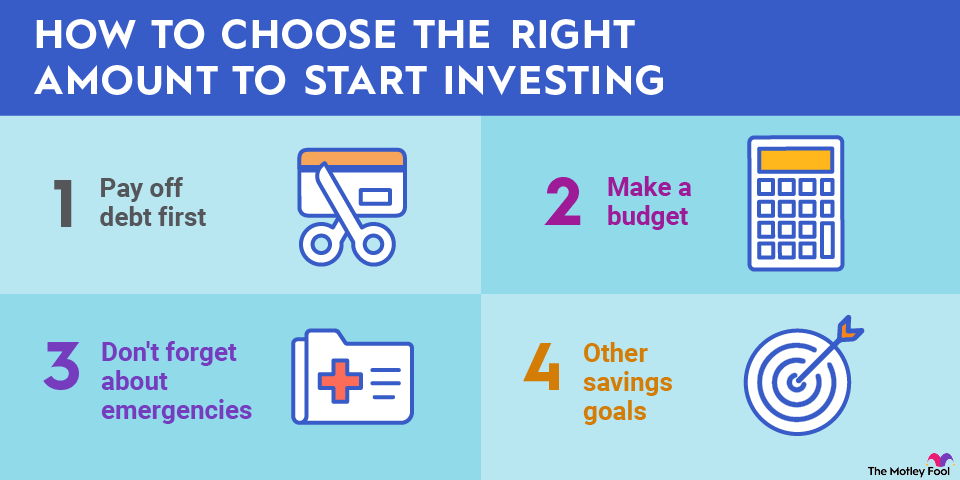
  3. Investing before paying down credit card debt. If you have money in your savings account and you have revolving debt on your credit card, pay it off. Many credit cards have an annual interest rate of 15% or more. Let's say you have $5,000 to invest, but you also have $5,000 debt on your credit cards with an average annual interest rate of 18%. It doesn't take an astrophysicist to figure out that you're going to have to get an 18% return after you pay taxes just to break even on that $5,000. Pay the debt off first, then think about investing.
  4. Investing for the short term. Only invest money for the short term that you're actually going to need in the short term. Invest money in the stock market that you won't need for at least three years, and preferably five years or longer. If you'll need your cash next year for a down payment on a house or for the family Caribbean cruise, use one of the shorter term and safer havens for your cash, such as money market funds or CDs.
  5. Turning down free money. You'd never turn down a dollar if it was offered with no strings attached. That's what you're doing if your company offers a 401(k) or similar retirement savings plan with an employer match and you're not participating. Take advantage of all tax-advantaged, employer-matched savings programs.
  6. Playing it safe. If you're young, most of your investing dollars should be in the stock market. You have enough time to weather any dips in the market and to reap the rewards of long-term gains. Although you may want to transition into bonds later in life as you depend on your investments for income, stocks should make up a large portion of the portfolio of every investor.
  7. Playing it scary. Not every investment is for everyone. Even if you're a daredevil, you shouldn't pour all of your money into something that could end up going down the drain.
  8. Viewing collectibles or lottery tickets as investments. If old comic books, Barbie dolls, and abandoned exercise equipment could be used to fund retirements, do you think the stock market would exist? Probably not. Don't make the mistake of thinking your jewelry, those Beanie Babies, or the lottery will provide for you in your latter years.
  9. Trading in and out of the market. We believe the best approach to investing is the long-term one. Pick your investments well and you'll reap greater rewards over the long term than you had ever dreamed possible. Trade in and out of the market and you'll be saddled with fees that chip away at your returns, and you'll potentially miss out on gains that long-term investors enjoy with much less effort.

Congratulations! You've made it through the first part of Investing Basics. (Bet you didn't even break a sweat.) You've witnessed the power of compounding and you understand how some common pitfalls can ruin even the healthiest investing plan. Now, let's turn to the various ways you can start investing.

Comments from our Foolish Readers

Help us keep this a respectfully Foolish area! This is a place for our readers to discuss, debate, and learn more about the Foolish investing topic you read about above. Help us keep it clean and safe. If you believe a comment is abusive or otherwise violates our Fool's Rules, please report it via the Report this Comment Report this Comment icon found on every comment.

  • Report this Comment On September 16, 2008, at 7:10 PM, shifkin wrote:

    I am a Stock Advisor subscriber and I understand that compounding interest delivers excellent growth. What I don't understand is how a stock actually compounds. One of your ads on the site mentions that since its IPO in 1970, Walmart has "turned every $10K into $57,000,000." How? By reinvesting the dividends back into the stock, stock splits, etc.? Or, does that mean that the initial $10K is worth $57,000,000 because the share price has risen so much? Or some combination?

    Likewise, I don't really understand what it means that the Stock Advisor's recommendations have gained 42%. Does that mean someone would have to sell now to realize that 42% gain?

    I'm not sure exactly how to ask but I know that I am not sure how someone actually makes money in the market besides buying low and selling high.

    Thanks in advance your your response and any advice where I can read up on this.

  • Report this Comment On September 24, 2008, at 12:30 AM, gustavox wrote:

    I read Why I invest? and I like learn and I want to commence to invest to my retirement, right know I can invest more or less $100 monthly, how is the best way for me to commence?

  • Report this Comment On October 02, 2008, at 10:25 AM, StocksBuyorSell wrote:

    I think this article is good advice for the novice investor - someone who is completely unfamiliar with stock investing. http://stocksbuyorsell.com

  • Report this Comment On October 10, 2008, at 2:33 PM, MalachiJones wrote:

    What I know about investing I learned from Daddy Warbucks in the movie Annie. Smoke cigars and read the ticker tape machine while talking into at least three phones yelling "sell" and "buy"! I also have a certain amount of money, math skills, and irrational fear, so I figure I'll be a good investor. How do I start? I mean, how do I trade my money for stocks, and how do I convert stocks back into money?

    I'm already participating in my company's 401K, but that was just a matter of picking some numbers and signing my name to a form. I make about $30 or $40 per year for the past 5 years from the 401k, which doesn't seem like enough to retire on. I think a 401K isn't a good thing, but maybe I'm not doing it right. Any help would be great.

  • Report this Comment On October 24, 2008, at 3:36 PM, notstressin wrote:

    If you have any further unanswered questions, try reading, "A Compounding Tale" amongst others at www.financialtales.com

  • Report this Comment On November 17, 2008, at 9:50 PM, nikosuave123 wrote:

    Is anyone ever going to answer shifkins question? I have some of the same concerns and misunderstandings. Any comments from the fool?

  • Report this Comment On November 25, 2008, at 10:42 AM, Dmailman wrote:

    I wouldn't mind getting an answer to shifkins question either! Thanks!

  • Report this Comment On December 17, 2008, at 12:59 AM, SourdoughLance wrote:

    Agreed

  • Report this Comment On December 17, 2008, at 7:10 AM, DrDM0001 wrote:

    I also would like to hear answers to shifkin's questions!

  • Report this Comment On December 18, 2008, at 5:05 PM, UltimateAnalyst wrote:

    "But what if we go all the way back to Wal-Mart's IPO, when it became a public company in October 1970? The business was valued at a tiny $21.5 million then. That means the stock is up more than 13,000 times since. That's more than 30% growth per year, and would have turned a $5,000 investment into $65 million today." - http://www.fool.com/investing/general/2004/12/17/be-a-penny-...

    There is your answer. Yes, you would have to reinvest divs for this return. Use market caps for calculating return on investments because you don't have to factor in stock splits. The link below has a simple dividend reinvestment calculator however it fails to take into account irregular growth rates, but should give you a basic idea:

    http://www.buyupside.com/calculators/dividendreinvestmentdec...

    As for how Stock adviser determines its return:

    "How is performance calculated?

    Fool newsletters measure performance by averaging the percentage gains in stock price of each recommendation arithmetically. What?! In plainer English, we simply add the percentage gains and divide by the number of recommendations. All stocks are weighted evenly, regardless of holding period. The S&P 500 returns, which we use for comparison in most cases, are calculated the same way. They represent the returns to an investor making regular investments in the S&P 500 on the same days our newsletters are released.

    Our Motley Fool Income Investor and Motley Fool Inside Value newsletters include dividends in their return, accounted for by adjusting the cost bases of the respective stocks. These newsletters compare their returns to the SPDR unit investment trust, a dividend-incorporating exchange-traded fund that mimics the S&P 500.

    Motley Fool Stock Advisor incorporates only special dividends, which it subtracts from stocks’ cost bases. Motley Fool Champion Funds, our mutual fund newsletter, accounts for distributions by reducing funds’ costs bases. It compares recommended stock funds to the S&P 500 and bond funds to the Lehman Brothers U.S. Aggregate Bond Index.

    Finally, out- and underperformance differentials are given as percentages of the investment principal." - I just clicked "how is performance calculated" under the performance rating.

    Good luck

  • Report this Comment On September 16, 2009, at 12:38 PM, Investable1876 wrote:

    If you decide to invest in the stock market, you can either go it alone using a website like ameritrade.com or etrade.com, or you can hire a professional stockbroker to do the work for you. Either way, someone will need to decide what company or companies in which you will invest. Choosing your favorite companies may not be the smartest move. You should make the choice based on research which either you can do using the aforementioned websites or your stockbroker will do for you.

    Mutual funds are a combination of different stocks. Investing in mutual funds means you aren't investing in one specific company, but instead you are investing in several companies through the service of a mutual fund brokerage house. It gives you more opportunities to diversify your investments, but you have less association with one company and less risk. Of course, less risk means less opportunity to score big, but it also protects the money you already have. When choosing your mutual funds, you decide what level of risk you are willing to take.

    --------------------------

    Money is like muck, not good except it be spread.

    http://topinvestingtips.com

Add your comment.

Compare Brokers

TD AMERITRADE
more info
ShareBuilder
more info
Power E*Trade

more info
Scottrade
more info
Fool Disclosure

DocumentId: 646910, ~/Articles/ArticleHandler.aspx, 11/21/2009 2:10:39 PM

The Must-Read Story on Fool.com
An Open Letter to the Federal Reserve

Community: Investing Wiki

Term Of The Hour

Delisted stock: A delisted stock is one whose fundamentals no longer meet the requirements of the NYSE or the Nasdaq.

Want to learn more or edit this definition?
Click here to read more!