Apple (AAPL -0.14%) lost roughly $500 billion of its market cap over 25 days in June. That's the equivalent of an AbbVie (ABBV +0.16%), Caterpillar (CAT -2.42%), or Mastercard (MA -1.52%) being completely wiped out.
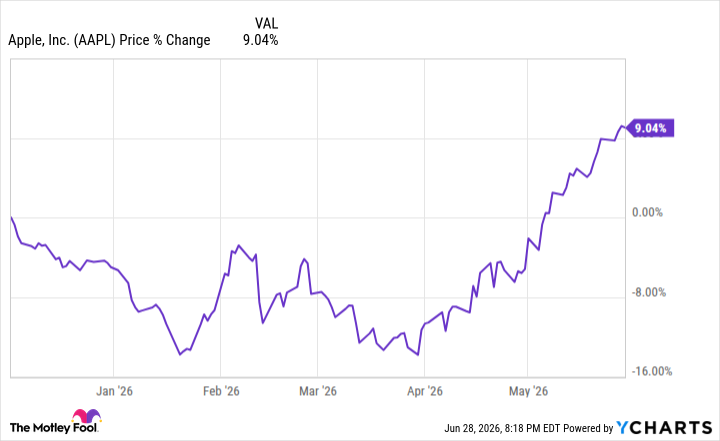
What was once a solid year-to-date performance for Apple has turned into a puny gain. But is the stock a buy after its recent pullback? Here's what history suggests.
Image source: The Motley Fool.
What's behind Apple's recent decline?
The first factor that caused Apple stock to fall in recent weeks stems from the company's discussions about a new version of the Siri AI assistant at its 2026 Worldwide Developer Conference (WWDC) in early June. Deepwater Asset Management's Gene Munster summed up the concerns in a post on X (formerly Twitter):
$AAPL has sold off 2.6% because the jury is still out on whether Apple can deliver compelling AI.
-- Gene Munster (@munster_gene) June 8, 2026
Yes, the demo is amazing, but Craig didn't give any timing updates on the new Siri. Most investors (including Gurman) expected it to launch this fall, but Apple provided no comfort... https://t.co/WUC6EQ5h83
Munster was probably right that some investors aren't confident that Apple's new Siri will excite customers. And he was almost certainly on point about concerns over the timing of the Siri launch, especially considering the company's previous delays.
AAPL Apple
NASDAQ · As of 4:00 PM ET 10/23/26

However, the biggest reason for Apple's recent decline was last week's announcement that it would increase prices for its Mac and iPad products. The company said in a statement, "The consumer electronics industry is facing an unprecedented challenge. The rapid expansion of AI data centers has created an extraordinary surge in demand for memory and storage. We have never seen a component price increase this much, this quickly."
Apple CEO Tim Cook told The Wall Street Journal that the memory and storage shortage is like a "hundred-year flood." The big question for investors is whether or not this flood's waters will impact pricing for Apple's crown jewel -- the iPhone.
History lessons
History is clear about what investors should do when Apple's shares pull back. In every previous case, the stock declined by nearly 10% or more, which presented a great opportunity to invest in Apple stock.
The most recent example was only a few months ago. Apple's stock fell roughly 13% between Dec. 2, 2025, and Jan. 20, 2026. That proved to be just a temporary trough, though. Apple quickly rebounded, erasing its losses and tacking on a solid gain.
We have seen Apple recover from much worse sell-offs in the past. For example, in 2013, many investors worried that iPhone sales had peaked. Apple responded by launching new iPhones with larger screens, spurring a new growth wave.
Fears arose again in 2016 that iPhone demand was slowing. Apple's services business came to the rescue, with strong growth reassuring investors. Fast-forward a couple of years. The tariffs imposed during the first Trump administration negatively impacted Apple's sales in China. Yet again, though, the stock made a comeback.
Is this time different?
However, the question for investors now is: Is this time different? When Apple's CEO refers to a "hundred-year flood," it could seem reasonable to conclude that the answer is "yes." However, investors shouldn't make too much of Cook's analogy.
To be sure, memory and storage costs aren't likely to come down anytime soon. But supply will eventually catch up with demand, resulting in at least price stabilization.
More importantly, the reasons why Apple has survived and thrived every previous challenge remain intact. Apple's competitive advantages haven't disappeared. Its customer base is still highly loyal. And the headwinds affecting the company will hurt its competitors just as much.
Wall Street remains generally bullish about Apple. The consensus 12-month price target reflects a potential upside of over 10%. Of the 47 analysts surveyed by S&P Global (SPGI -0.62%) in June, 29 (roughly 62%) rated Apple as a "buy" or "strong buy." Apple also continues to rank among the favorite tech stocks for billionaires.
This time could be different for Apple in some respects. However, I predict that history will repeat itself. Buying Apple on the dip should pay off for patient investors.