Related investing topics
About the Author
Matt DiLallo has no position in any of the stocks mentioned. The Motley Fool has no position in any of the stocks mentioned. The Motley Fool has a disclosure policy.
Invest better with The Motley Fool. Get stock recommendations, portfolio guidance, and more from The Motley Fool's premium services.
The “Magnificent Seven” are seven mega-cap, tech-heavy companies that have driven a huge share of U.S. stock market gains in recent years. They’re leaders in areas like AI, cloud computing, digital advertising, software, and consumer tech, and they’ve become so large that their performance can move major indexes.
Here's a look at the Magnificent Seven stocks and whether they are good investments right now.

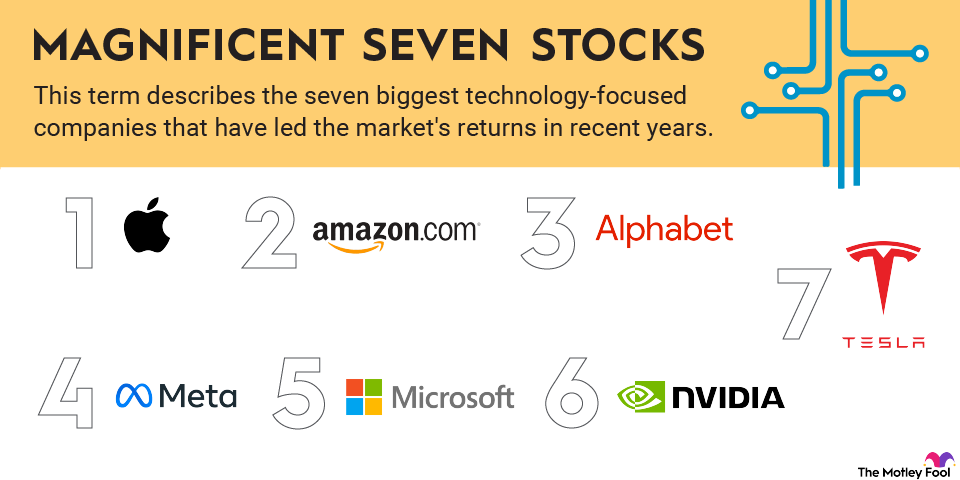
The Magnificent Seven stocks are seven of the largest technology-focused companies by market cap.
All seven companies are focused on capitalizing on large technology-driven growth trends. But technically speaking, five are tech stocks, and two are tech-focused consumer discretionary stocks.
They're leaders in artificial intelligence (AI), cloud computing, video games, social media, digital advertising, software, hardware, e-commerce, and electric vehicles (EVs). These technology trends are driving robust growth for companies focused on them.
Bank of America analyst Michael Hartnett popularized the phrase as a modern update to older groupings like FAANG. The idea is less about a formal index and more about the reality of the market: a small group of companies grew so large and quickly that they drove market returns.
The Magnificent Seven stocks have delivered magnificent returns. As a group, these seven stocks have risen by more than 24% over the last 12 months (as of early July 2026). That compares to the nearly 21% return of the rest of the S&P 500.
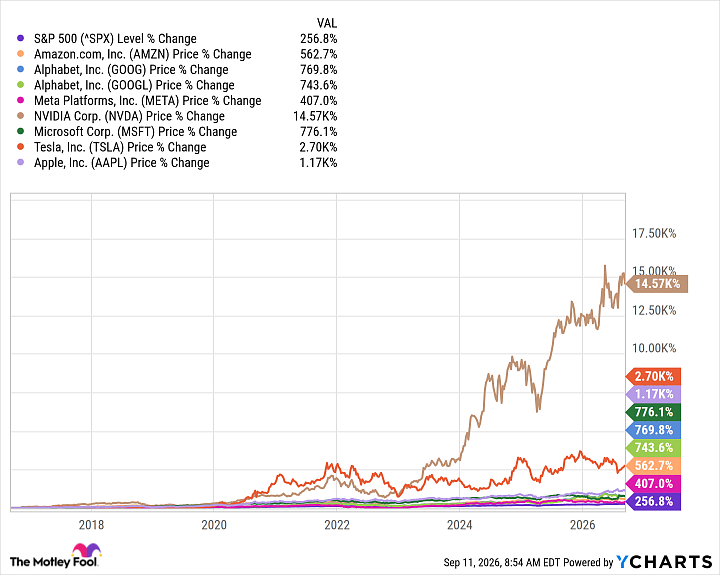
Magnificent Seven stocks have delivered market-crushing returns over the past decade:

Overall, the group has delivered a 119.8% return over the last five years, more than double the rest of the S&P 500 (57.8%).
Many investors believe this group of mega-cap stocks can continue producing dominant returns. They're capitalizing on several technology megatrends that should enable them to continue growing at outsize rates.
Just a few examples are:
That said, “great companies” don’t automatically mean “great buys at any price.” For many investors, the better question is whether to buy all seven, a few, or get exposure through an ETF.
Although the Magnificent Seven are among the world's largest and financially strongest companies, they're not without risk. Here are some risk factors to consider before investing in the Magnificent Seven:
After their market-smashing returns in recent years, the group traded at a premium price. In mid-2026, the Magnificent Seven traded at price-to-earnings (P/E) ratios of over 23 times (Microsoft) to nearly 360 times (Tesla), with most trading at more than 29 times earnings. That was higher than the S&P 500's P/E ratio (25.6 times), though not as much (on average) as the tech-heavy Nasdaq-100 (around 34.5 times). Given their elevated valuations, shares of the Magnificent Seven could stumble if their growth slows.
If there's a recession and economic growth slows, it could significantly affect the growth of the Magnificent Seven.
Given their mammoth sizes, it will likely be challenging for the Magnificent Seven to deliver sustained above-average growth in the years ahead unless a new tech trend emerges that accelerates their growth (like AI). If growth slows, it could erode some of the premium from their share prices. Even a whiff of slower growth could weigh heavily on the group.
Governments might reject future acquisitions they attempt -- much like Microsoft's long road to acquire Activision and Nvidia's blocked deal for Arm Holdings (ARM -2.87%). If regulators block future deals, it could slow that company's growth. Meanwhile, due to antitrust concerns, the federal government could eventually seek to force some of the Magnificent Seven to break up.

Here are some key metrics investors can use to evaluate Magnificent 7 stocks:
The Magnificent 7 are leaders in several megatrends, including e-commerce, robotics, AI, and cloud computing. They're investing heavily to capitalize on these growth trends. For example, McKinsey estimates that companies will invest a staggering $7 trillion in data centers by 2030 to support AI and traditional workloads. This heavy investment period will limit the Magnificent Seven companies' ability to return cash to shareholders through dividends and buybacks. However, these investments should help drive accelerated earnings and revenue growth over the long term.
The Magnificent Seven stocks have delivered magnificent returns over the years. These tech-focused companies have capitalized on many of the biggest technological growth trends, enabling them to grow rapidly and produce strong returns for their investors.
While they're in excellent positions to continue growing rapidly, they're not without risk. Investors must understand the risks before loading their portfolios with these seven stocks.
| Name and ticker | Market capMarket cap calculated using publicly traded shares outstanding only. Does not include unlisted, private, or dual-class non-traded shares. Implied market cap may vary. | Dividend yield | Industry |
|---|---|---|---|
| Apple (NASDAQ:AAPL) | $4.5 trillion | 0.35% | Technology Hardware, Storage and Peripherals |
| Alphabet (NASDAQ:GOOG) | $4.2 trillion | 0.25% | Interactive Media and Services |
| Amazon (NASDAQ:AMZN) | $2.8 trillion | 0.00% | Multiline Retail |
| Meta Platforms (NASDAQ:META) | $1.5 trillion | 0.36% | Interactive Media and Services |
| Nvidia (NASDAQ:NVDA) | $5.4 trillion | 0.12% | Semiconductors and Semiconductor Equipment |
| Microsoft (NASDAQ:MSFT) | $3.7 trillion | 0.72% | Software |
| Tesla (NASDAQ:TSLA) | $1.4 trillion | 0.00% | Automobiles |