About the Author
Matt DiLallo has positions in Meta Platforms and Pinterest. The Motley Fool has positions in and recommends Meta Platforms, Pinterest, and Roblox. The Motley Fool recommends Shutterstock. The Motley Fool has a disclosure policy.
Invest better with The Motley Fool. Get stock recommendations, portfolio guidance, and more from The Motley Fool's premium services.


The tech titan built its platforms through organic investment and acquisitions. Meta has purchased several notable companies over the years that form the foundation of some of its most popular apps and products. Meta Platforms will likely continue to acquire companies to build out its platforms and talent. Future deals could make it even better to invest money in Meta.
Here's a look at some of the notable companies Meta owns and brands that the social media company might acquire in the future.
Meta Platforms is one of the world's largest technology companies. It has two business segments:
The company generates almost all of its revenue from advertising (98% of its $60.8 billion in the second quarter of 2026). Meanwhile, its family of apps produces all of its profits ($23.4 billion in total income from operations in the second quarter of 2026 vs. a $4.6 billion operating loss for Reality Labs).
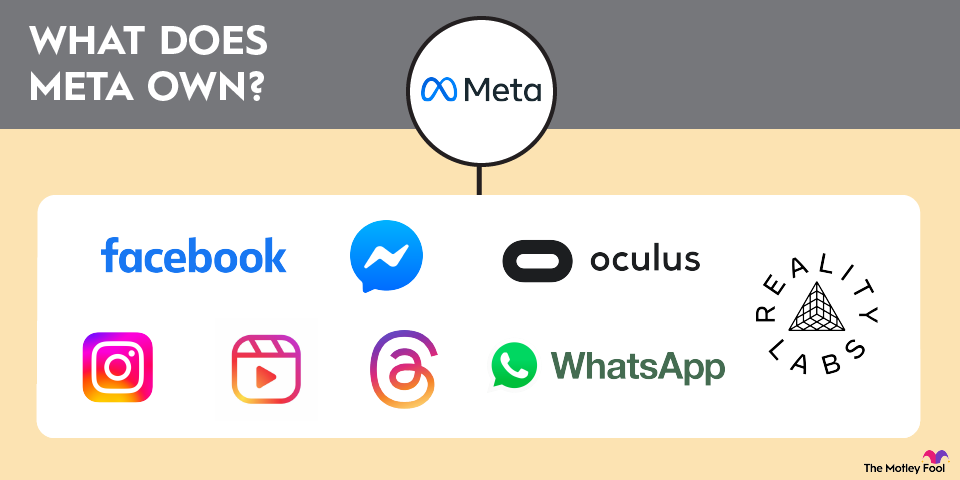
Here's a look at some of the notable companies Meta Platforms owns.
Mark Zuckerberg co-founded Facebook in 2004 (originally FaceMash and then TheFacebook). It was the biggest social media platform in the world in mid-2026, with more than 3.1 billion monthly active users. Facebook is now part of Meta's family of apps business after the social technology company rebranded to Meta Platforms in 2021 to reflect its growing platform and focus on the metaverse.
Facebook acquired group messaging service Beluga for an undisclosed sum in 2011. The company used Beluga to help bolster its instant messaging platform, which is now Facebook Messenger. It's the seventh-largest social media platform with the potential to reach an estimated 1 billion people with advertising. Facebook Messenger is part of Meta's family of apps business unit.
Facebook bought messaging company WhatsApp in 2014 for $16 billion in cash and stock. At the time, 450 million people used it on any given day. WhatsApp has grown into the third-largest social media platform as of mid-2026, behind Facebook and YouTube, with at least 3 billion monthly active users.
Facebook bought the popular photo-sharing app Instagram for $1 billion in cash and stock in 2012. That acquisition has been a smashing success for the company. Instagram is the second-largest social media platform globally, with 3 billion monthly active users.
The company launched Instagram Reels in 2020 to compete against social video sites like YouTube and TikTok. The app is part of Instagram. Users can also watch and share Reels on Facebook and its messenger apps.
Meta Platforms launched the text-sharing app Threads in 2023. The team behind Instagram built the app to compete with Twitter (now X). Threads reached 500 million monthly users in mid-2026. Meta aims to grow Threads to 1 billion users.
Facebook bought Oculus VR for $2 billion in cash and stock in 2014. Oculus was a leader in immersive VR technology. Oculus VR is now part of Meta's Reality Labs business unit. The company has developed several VR headsets, including Meta Quest 3.
Meta formed Reality Labs in 2020, combining its VR and AR hardware and software, including Oculus, Portal (discontinued), and Spark AR. Meta is investing heavily in research and development (R&D) in Reality Labs on new products, including Project Aria (smart glasses, including its Ray-Ban Meta glasses) and AI.
Reality Labs hasn't been a major revenue driver for Meta (only $833 million during the first half of 2026 compared to $116.3 billion for its family of apps). It's also losing a significant amount of money ($8.6 billion in the first half of 2026). However, Meta is investing heavily in the business because it believes Reality Labs can eventually become a meaningful contributor to its results as it launches new AI products like Muse.
Meta invested $14.8 billion in Scale AI in June 2025, giving it a 49% stake in the data labeling AI start-up. It's the company's second-largest deal. Scale AI's CEO, Alexandr Wang, joined Meta as part of the deal to join its superintelligence efforts.
Meta Platforms is a behemoth in the social media space. That will make it more challenging for the company to make additional acquisitions in the sector. However, Meta has other avenues for growth, including deals to expand its gaming and AI capabilities. A meaningful acquisition that could turn Reality Labs from a money pit into a profit machine could help Meta create significant value for its investors in the future, making it an even better stock to buy and hold.
Meta Platforms (META -0.96%) is the undisputed leader in social media. The technology company owns the three biggest platforms by monthly active users (Facebook, WhatsApp, and Instagram). Its growing family of apps is a huge moneymaker. Meta also has a growing artificial intelligence (AI) platform.
Meta Platforms has made more than 100 acquisitions over the years. Most of these acquisitions have been to buy talent, not products or companies. It will buy start-ups to bring their founders into the Meta family (e.g., Scale AI CEO Alexandr Wang).
However, Meta will make product acquisitions when it finds a compelling opportunity. Notable ones include its purchases of Instagram, WhatsApp, and Oculus VR.
The company certainly has the financial firepower to continue making big deals. It ended the second quarter of 2026 with $90.3 billion of cash against $83.7 billion of debt. Meanwhile, it has become a cash-generating machine. It generated $31.9 billion in cash flow from operating activities in the second quarter of 2026, giving the social media giant the funds to invest in its AI build-out.
The company could expand its family of apps by acquiring rival social media platforms. For example, potential social media app acquisition targets Meta might consider are Snap (SNAP -0.16%), a camera-focused technology communications company, and Pinterest (PINS -2.66%), a visual discovery company. Snap is the ninth-largest social media platform, with 900 million monthly active users, while Pinterest clocks in at No. 13 with 578 million. Buying either company would enable Meta to expand its family of apps. Its expertise in monetizing social apps could enable it to maximize the profitability of a platform like Snapchat or Pinterest.
However, buying another app could prove difficult from a regulatory perspective, since Meta is already the largest social media company, owning three of the four most popular apps. For example, Meta acquired the popular Giphy platform for sharing animated images in messaging apps in 2020 for $315 million. However, due to anti-competitive concerns, the U.K. Competition and Markets Authority ordered the company to sell that app in 2022. It took a huge loss by selling it to Shutterstock (SSTK -2.96%) for $53 million. Given the likelihood of regulatory pushback if it tried to buy another social media company, Meta might opt to focus on deals that grow its Reality Labs unit, though even purchases in that space could be tough to get past regulators.
The most likely approach is to continue acquiring talent by purchasing small start-ups that fly under regulators' radar. However, if Meta wanted to make a more impactful acquisition, it could acquire a glasses company to accelerate its smart glasses strategy. Meta bought a 3% interest in EssilorLuxottica (OTCMKTS:ESLOY), the maker of Ray-Ban glasses. Meta has a partnership with EssilorLuxottica to make smart glasses and could seek to acquire the company or a rival to further advance its smart glasses strategy.
Another option Meta could consider is making acquisitions to build its AI capabilities. The company launched several AI experiences across its family of apps and devices over the past year. One of the tools it's seeking to build is AI for businesses and creators. It could potentially accelerate its AI ambitions by acquiring a company like Canva.