9. Pipers Crisps (2019): 100% ownership
To complement its snack portfolio anchored by Frito-Lay, PepsiCo acquired Pipers Crisps in 2019. Pepsi paid approximately $30 million for the U.K. brand known for its premium chips.
Invest better with The Motley Fool. Get stock recommendations, portfolio guidance, and more from The Motley Fool's premium services.
PepsiCo (PEP -0.69%) is one of the biggest consumer products companies in the world, but Pepsi's assets go well beyond its namesake soda brand.
It's diversified across supermarket aisles with a portfolio spanning both food and beverage brands, making Pepsi a solid investment option. Unlike rival Coca-Cola (KO +0.24%), which only owns beverages, Pepsi owns some healthy brands in addition to sodas and snacks.

Like its peers in the beverage industry, the company has grown from humble origins more than 100 years ago by launching new brands, expanding its distribution worldwide, and making numerous acquisitions that have given it ownership of dozens of global and local brands. It also has valuable licensing arrangements with brands like Starbucks (SBUX +3.89%) and Lipton.
Although the business is placed in the consumer staples category, many of its products are discretionary purchases.
Pepsi's portfolio primarily consists of sodas and non-carbonated beverages, snacks, and other foods. Over the years, the company has experimented with other types of businesses, such as restaurants, but today it is squarely focused on packaged food and beverage products, supplying grocery stores, convenience stores, restaurants, and other retail businesses through a massive distribution network.
Mountain Dew was Pepsi's first major acquisition and is one of the most popular sodas in the country, behind Coke, Diet Coke, and Pepsi.
Mountain Dew was invented in the 1940s and sold in Virginia and Tennessee. Pepsi expanded its distribution nationwide after the acquisition.
The deal that gave the modern-day PepsiCo its shape was its 1965 merger with Frito-Lay, the leading snack maker and owner of brands including Fritos, Lay's, Ruffles, and Doritos.
The deal marked Pepsi's first foray into the food industry and came just four years after The Frito Company had merged with H.W. Lay & Company, forming Frito-Lay. At the time of the merger with Pepsi, Frito-Lay had 46 plants in North America and stakes in European businesses, indicating it was a sizable company.
Pepsi also renamed itself from The Pepsi-Cola Company to PepsiCo after the deal, reflecting its diversification.
The Frito-Lay North America division now contributes 26% of Pepsi's total revenue, or $25 billion as of 2025.
Pepsi's current root beer brand is Mug, which it acquired in 1986 when it bought the New Century Beverage Company, replacing its existing root beer brand, OnTap Draft. According to PepsiCo, root beer is the second-largest carbonated drink flavor in the U.S. after cola.
In 1998, PepsiCo made its largest acquisition to date, acquiring the Tropicana juice business from Seagram for $3.3 billion.
The move heightened Pepsi's competition with Coca-Cola, which acquired Minute Maid in 1960 and still owns it.
At the time, Tropicana was the leader in "not from concentrate" juice.
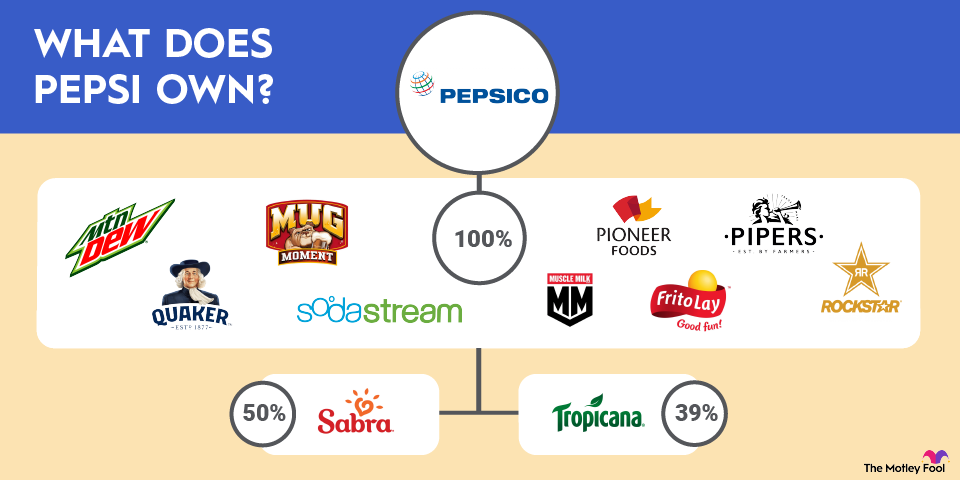
In 2022, Pepsi sold its majority stake in Tropicana and other juices in its portfolio for $3.3 billion, but Pepsi will retain a 39% stake in a newly formed joint venture with private equity firm PAI Partners.
In 2001, Pepsi made a significantly larger acquisition than the Tropicana deal, shelling out $13 billion to acquire the Quaker Oats Company.
The Quaker deal brought Pepsi Quaker-branded products like oats and granola bars, but it also gave it Gatorade, the leading sports drink brand, which was believed to be its primary reason for making the deal. Quaker also owns packaged foods brands like Rice-a-Roni, Pearl Milling Company (formerly known as Aunt Jemima), and Cap'n Crunch.
For Pepsi, the move was a response to a shift in consumer tastes away from sodas, which led the company to believe it needed to diversify its portfolio.
Quaker Foods North America, which does not include Gatorade, accounts for between 3% and 5% of the company's total revenue, with $2.8 billion in 2025.
You might be surprised to learn that PepsiCo owns the popular hummus brand Sabra and Obela, its sister dip brand. Pepsi formed a joint venture with Strauss Group and acquired a 50% ownership stake in Sabra in 2008. They expanded the partnership to other products in 2011, and acquired 50% of Obela in 20212.
In November 2024, PepsiCo announced it would acquire full ownership of the two brands, though terms were undisclosed.
Today, Sabra is a leading hummus brand with almost $400 million in annual retail sales in the U.S.
In 2018, PepsiCo made a somewhat surprising move, acquiring SodaStream for $3.2 billion. SodaStream is best known for its countertop DIY soda machines and has extended Pepsi's exposure to healthier drinks, since SodaStream is often used for seltzer water.
The deal represents Pepsi's interest in going further into the water and sparkling water industries, and it launched the Bubly brand around the same time.
Pepsi acquired the CytoSport sports nutrition business, the parent of Muscle Milk, from Hormel (HRL +1.92%) in 2019. Terms of the deal were not disclosed. Hormel acquired CytoSport in 2014 for $450 million to gain the Muscle Milk brand, known for ready-to-drink beverages, protein powders, sports bars, and energy chews.
Pepsi's $1.7 billion purchase of Pioneer Foods might not have gotten much attention in the U.S. because Pioneer is a South African company.
Pioneer Foods is one of South Africa's largest food producers and distributors, known for snack foods and other packaged foods, and exports to 80 countries.
Pepsi was a bit late to the energy drink market, leveraging the Mountain Dew brand for new energy drinks. But in 2020, the company entered the space with the $3.85 billion acquisition of Rockstar Energy Beverages. The news comes years after Coke formed a strategic partnership with Monster Beverage (MNST +2.53%).
PepsiCo followed up its acquisition of Rockstar Energy by forging a strategic partnership with Celsius Holdings, known for its sugar-free energy drinks. As part of that agreement, Pepsi invested $550 million for an 8.5% ownership stake in Celsius. As of 2025, Pepsi increased its investment to 11% of the company.
While Celsius was growing rapidly at the time, the partnership hit a roadblock in 2024 after Pepsi overstocked its Celsius inventory, leading to a plunge in the energy drink company's revenue growth.
Pepsi acquired Siete Foods for $1.2 billion in a deal that closed in Jan 2025.
Siete Foods makes a wide range of grain-free snacks, including tortilla chips and tortillas made with flours such as almond and cassava. It also makes salsa, enchilada sauce, and other condiments.
Pepsi followed up the Siete acquisition with a deal to purchase Poppi, a maker of prebiotic soda, for $1.65 billion, including $300 million in cash tax benefits.
The combination of those two moves shows Pepsi is eager to stay on top of emerging food trends.
Pepsi seems likely to continue pursuing its acquisition strategy of acquiring food and beverage brands.
Pepsi previously pursued Vita Coco (COCO -1.52%), so it wouldn't be surprising to see it make another offer for that company, especially since its growth has been impressive, and coconut water is a growth category in the beverage industry.
On the food and snack front, there are a range of directions Pepsi could go. Rival Hershey (HSY +2.70%) has pivoted towards protein-rich snacks due to slowing growth in candy, and Pepsi could make a similar move, acquiring a jerky brand or another protein-based snack to complement its ownership of Muscle Milk.
It could also follow Coca-Cola into categories where it doesn't yet compete, like milk. Coke acquired Fairlife, a protein-fortified milk, and has grown it into a brand that generates $1 billion in revenue every year.
In the 1980s, PepsiCo owned restaurants, including Pizza Hut, Taco Bell, and KFC, which later became Yum! Brands (YUM +2.82%). It even owned Wilson Sporting Goods and North American Van Lines moving company, but sold both in the 1980s.
Today, the company seems unlikely to venture outside of packaged food and beverages.
Pepsi has grown into a diversified packaged foods and beverages giant through a combination of acquisitions, licensing, and the development of its own brands.
Much like Coca-Cola, Pepsi's size gives it a competitive advantage, as smaller brands struggle to match its distribution network and marketing expertise. Its scale also helps Pepsi increase sales for the brands it acquires since it can ramp up distribution and give it more visibility in stores with a marketing push.
So far, that strategy has worked well for Pepsi. It continues to deliver steady growth and reward investors through a rising share price and increasing dividends. It's likely to continue to execute that strategy through acquisitions and expansions.