A wisely crafted investment portfolio can build tremendous wealth over time. Investing money the right way can help send your kids to college, plan for a comfortable retirement, or meet any other financial goals.

It's common knowledge that investing is a smart idea. However, there's also the vital question of what you should invest in. In this article, we're going to take a closer look at some of the most popular investment vehicles.
To clarify, we will not be discussing specific investment ideas here. If that's what you're looking for, we have tons of great content, including our list of top stocks to buy right now.
Even though we aren't getting into specifics, the type of investments you can choose from is still a critical discussion. Equally important, we'll also examine some investments you may want to avoid. As many experienced investors can tell you, avoiding mistakes can be just as valuable as finding great investments.
Best investments to consider in 2026
Here are some of the most common ways to invest your money.
1. Stocks
Let's be perfectly clear. Almost everyone should own stocks or stock-based investments, such as exchange-traded funds (ETFs) and mutual funds (more on those later).
If you have a 401(k) or similar retirement plan at work, you probably already have money in the stock market. There's a good reason for this. Stocks have consistently proven to be the best way for the average person to build wealth over the long term.
Stocks have outperformed most investment classes over almost every 10-year period in the past century.
The S&P 500 benchmark index has historically averaged annual returns of 9% to 10%, depending on the time interval under consideration. To put returns like this into perspective, a $10,000 investment compounded at 10% for 30 years would grow to almost $175,000.
As legendary investor Warren Buffett puts it, investing in U.S. stocks is a bet on American business. This has been an excellent bet for more than two centuries.
2. Exchange-traded funds (ETFs)
If researching and selecting individual stocks doesn't sound like your thing, that's perfectly fine.
An alternative is to invest (either exclusively or partially) in exchange-traded funds, or ETFs. The basic idea is that ETFs trade on major exchanges like stocks, and your money is invested to achieve a stated objective.
For example, if you invest in an S&P 500 index fund, your money will be spread out among the 500 companies that make up the index. The value of your investment should track the index's performance over time.
3. Mutual funds
Mutual funds are similar to ETFs. They pool investors' money and use it to accumulate a portfolio of stocks or other investments.
The most significant difference is that ETFs trade on major stock exchanges, and you can buy shares whenever the stock market is open. Mutual funds price their shares only once a day and aren't nearly as liquid.
4. Bonds
Over the long term, accumulating wealth is the primary focus. But once you've built that wealth and are closer to retirement age, bonds -- which are loans to a company or government -- can help you stay wealthy. There are three main kinds of bonds:
- Corporate bonds issued by companies
- Municipal bonds issued by state and local governments
- Treasury notes, bonds, and bills issued by the U.S. government
For most investors, the best way to go is to buy ETFs and mutual funds that invest in bonds on your behalf.
The main goals of investing in bonds, as opposed to stocks, are capital preservation (preventing losses) and income generation.
5. High-yield savings accounts
Savings accounts offered by branch-based banks are notorious for paying minuscule interest rates.
On the other hand, some excellent banks, primarily based online, offer very competitive rates, to the point that they can be considered investment-worthy in many cases. As of January 2026, savings account interest rates in the 3.5% ballpark (or higher) were still readily available if you do a little research.
Finding the best rate takes time though. The good news is, Motley Fool Money regularly reviews the top high-yield savings accounts so you don't have to.
6. Certificates of deposit (CDs)
Many reputable banks offer excellent high-yield certificates of deposit (CDs). These pay guaranteed yields for anywhere from a few months to five years or more.
Unlike savings accounts, CDs allow you to lock in a specific yield for a set period. This can be an especially valuable feature when interest rates are relatively high, and you want predictable returns.
The Federal Deposit Insurance Corp. (FDIC) insures CDs and savings accounts up to $250,000 per person per bank to protect you against bank failure.
Not sure which CD term or rate is right for you? Motley Fool Money's Best CD Rates are updated regularly and breaks down top offers by term length.
7. Real estate
Like owning great companies, owning real estate can be a wonderful way to build wealth. In most periods of economic recession throughout history, commercial real estate has performed rather well. It's often viewed as a safer, more stable investment than stocks.
There are ways for people at almost every financial level to invest in and make money from real estate. The most obvious option is to buy a rental property, which can be a great way to build wealth and create a steady income stream. However, this isn't the best fit for everyone.
Fortunately, there are alternative ways to invest in real estate. Many, such as real estate investment trusts (REITs), are much more passive than actually becoming a landlord.
Publicly traded REITs are the most accessible way to invest in real estate. REITs trade on stock exchanges just like other public companies. REITs can be especially great for income since they are required to pay out at least 90% of taxable income as dividends.
Factors to consider
No investment approach works for everyone. So, to figure out the best way for you to invest your hard-earned money, here are some things to think about:
Your risk tolerance
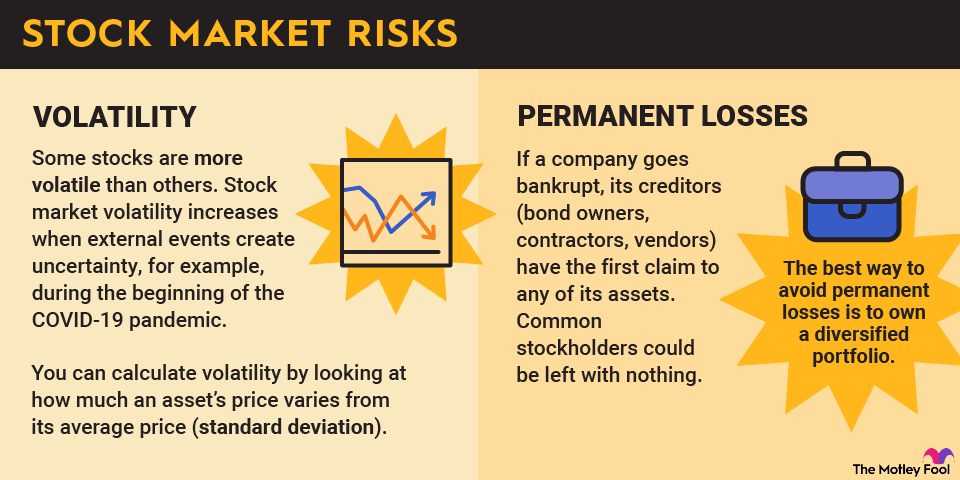
Stocks are not risk-free investments by any definition. Even the most stable companies' stocks can fluctuate dramatically over short periods. Over the past 50 years, the S&P 500 has declined by as much as 37% in a single year and has risen by as much as 38%.
On the other hand, bonds and other fixed-income investments have less long-term return potential than stocks. However, they compensate for this with steady income generation and minimal volatility.
Time horizon
If you have a kid heading off to college in a year or two, or if you're retiring in a few years, your goal should no longer be maximizing growth. It should be protecting your capital.
It's a good idea to shift the money you'll need in the next several years from stocks into bonds and cash. This concept is known as asset allocation, and determining the appropriate mix is a crucial part of investing.
Investment amount
With $100 to invest, you can certainly get started. However, your approach will likely be significantly different, and your options will be somewhat limited compared to an investor with $100,000 available.
For example, if you want to buy a rental property, you'll probably need enough money to make a down payment. If you want to invest in a high-yield CD, some of the best options require a minimum deposit.
Knowledge level
Investing in individual stocks can be a great way to build wealth -- if you have the time and knowledge to do it right. If you don't, there's absolutely nothing wrong with investing in ETFs or mutual funds to get hands-off exposure to the stock market.
How to determine your investment strategy
The best way to determine which of the investment types are the best places to put your money is to carefully consider the factors discussed in the previous section. Use them to craft an investment approach that makes sense for you.
As an example, I consider myself to have a reasonably high risk tolerance. I'm 43, so I'm about 2 decades away from retirement. Because of what I do for a living, I have extensive experience evaluating individual stocks. So, my investment strategy consists mainly of a diversified portfolio of individual stocks with a few ETFs in both retirement and standard brokerage accounts (more on those in a bit), some money in CDs, and an investment property.
What should you invest in?
To be perfectly clear, every investor is different, and no one pathway works for everyone. However, the best answer for most people is a portfolio that combines stocks (or stock-based ETFs and mutual funds) with fixed-income investments, such as bonds and CDs.
One popular asset allocation guideline used by financial planners, known as the Rule of 110, is to subtract your age from 110 to determine the approximate percentage of your portfolio that should be in stocks. For example, according to this rule, a 40-year-old should have roughly 70% of their money invested in stocks and stock-based funds.