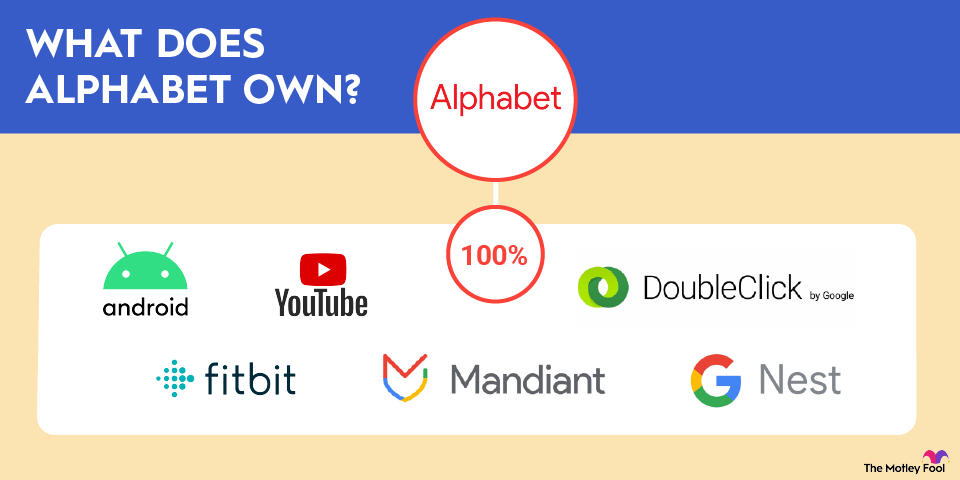
What companies does Alphabet own?
Alphabet's acquisition journey is more than a mere expansion strategy; it's a quest for innovation across the digital landscape. From essential tools like YouTube and Android, which have become integral to our daily digital lives, to ventures into future-forward areas like artificial intelligence with DeepMind and health tech with Fitbit, Alphabet's acquisitions paint a picture of a company always looking ahead.
These acquisitions not only enhance Alphabet's portfolio but also bring fresh challenges and opportunities, pushing the boundaries of what's possible in tech. While some deals, like the purchase of Motorola Mobility, might have seemed off-course, they provided valuable lessons and assets that furthered Alphabet's long-term strategy.
It would take entire books to cover all of Alphabet's buyout history in detail, so let's take a quick look at just a handful of important examples. The variety in Alphabet's acquisitions, ranging from household names to niche pioneers, demonstrates a deliberate strategy to diversify and solidify its influence across multiple sectors. Each acquisition, regardless of its immediate impact, contributes to Alphabet's broader vision of a seamlessly connected and technologically enriched world.
1. YouTube: $1.65 billion, 100% ownership since 2006
The internet never forgets, so I'm forever on the record saying YouTube wouldn't make any sense as a Google business in 2006. But the video-sharing platform signed on the dotted line just a couple of days later, sealing a stock-swap buyout worth $1.65 billion.
A lot has happened on that video service since then, but let's just skip ahead almost two decades. YouTube ads accounted for ad revenues of $36.1 billion in fiscal year 2024. Apart from Google Cloud, Alphabet doesn't break out detailed operating profits for subsidiaries, so it's hard to tell exactly how profitable that modest YouTube investment has been over the years. With the benefit of hindsight, the YouTube buyout was a spectacular business decision with an incredible return on the original price.
2. Android: Estimated $50 million, 100% ownership since 2005
The top mobile phones in 2005 were flip phones with text messaging. Apple (AAPL +1.02%) was reportedly working up the first iPhone in secret, and consumers hadn't seen the first true smartphone yet.
But Google had already laid the groundwork for the upcoming smartphone market. The company spent approximately $50 million on the Android development team that year. And so, the smartphone rivalry that would define the next decade was underway long before consumers could get their hands on the first next-generation handsets.
The smartphone wars began with the release of the first iPhone in 2007, followed by the first Android devices in 2008. App stores and mobile ads have added untold billions of top-line revenue and bottom-line profit for Apple and Alphabet. The YouTube deal was great, but Android delivered an even richer return on a smaller investment.
3. DoubleClick: $3.1 billion, 100% ownership since 2007
The game-changing YouTube and Android deal would not have been possible if Google hadn't first built a robust online advertising business. Its first ad service was created from scratch, but the buyout of digital advertising leader DoubleClick took that operation to the next level.
Before the DoubleClick deal, Google only served text ads next to search results. The buyout elevated Google's AdWords platform to a full-featured ad delivery service, with graphic banners and publishing solutions across many websites beyond Google.
Alphabet has added a few separate revenue streams since then, including cloud computing services, high-speed internet connectivity, and sales of smart home hardware. But Google-branded advertising still accounted for 75% of Alphabet's overall sales in the fourth quarter of 2024. The DoubleClick name disappeared when all ad services were rebranded to Google Ads in 2018, but this deal played a critical part in Alphabet's lucrative ad business.