One aspect of market psychology is that investors often think in terms of one quarter at a time. Nvidia (NVDA -1.43%) may have broken this habit in its fiscal 2027 second-quarter report. During the earnings call, management provided something public companies rarely give quite this early: a forecast for next year's growth.
Below, I'll detail why Nvidia's growth is redefining the debate about whether the artificial intelligence (AI) build-out is late-cycle theater or still in the early innings. Moreover, the analysis will touch on two important points that have haunted Nvidia stock for nearly a year: how much of this growth forecast does Wall Street actually believe, and whether Nvidia needs to regain its position in China's market to keep its empire running.
Image source: The Motley Fool.
What was Wall Street expecting for Nvidia's fiscal 2028?
Nvidia's preliminary fiscal 2028 outlook is straightforward. Revenue is expected to rise 70% year over year. Chief Financial Officer Colette Kress framed that figure as "supply constrained." Chief Executive Officer Jensen Huang made it clear that demand for the company's processors is growing by more than that. In essence, a 70% growth rate is what Nvidia's supply chain can "confidently deliver," especially with shortages of memory and other parts of the AI chip stack creating bottlenecks to production.
For reference, Wall Street analysts were modeling about 44% revenue growth for Nvidia's fiscal 2028, which begins Jan. 31, 2027. Given the Street's consensus estimate of $397 billion of revenue in fiscal 2027, that implies fiscal 2028 sales of roughly $574 billion. When applying Nvidia's 70% forecast rate to the same starting base, next year's expected revenue sits closer to $675 billion.
Here's where it really gets lucrative: If I use a higher fiscal 2027 revenue figure based on Nvidia's current run rate, the implied sales for next year land closer to $700 billion. In either case, the gap between Wall Street's expectations and Nvidia's new reality is roughly $100 billion in revenue.
What's astounding is that Nvidia is no longer growing off a small base of data center sales. Given its current trajectory, Wall Street must accept that a business already measured in hundreds of billions of dollars of annual sales can go on to add yet another several hundred billion in growth in just a single year. Under these conditions, procuring GPUs is no longer the constraint for AI training and inference. Instead, the pain points revolve around high bandwidth memory, packaging, power supply, and land.
NVDA Nvidia
NASDAQ · As of 4:00 PM ET 10/16/26

Does Nvidia need China?
During the fiscal second quarter, Hopper-architecture products shipped to China accounted for less than 1% of Nvidia's data center revenue. Moreover, these shipments were dilutive to Nvidia's gross margin. Kress made it clear that "given ongoing geopolitical uncertainty, there is no China data center compute revenue in our forward outlook."
Think about that for a minute: Nvidia expects to generate $108 billion in sales in the third quarter, alongside a 70% growth rate in 2028, and the Chinese market is merely an option rather than a core pillar supporting the company's sales foundation. This matters for a few reasons. First, this level of growth, excluding China, discredits a convenient bearish argument that Nvidia would need a large presence in that market to sustain its dominance in AI processors.
Second, and more subtly, Nvidia's growth outlook over the next 18 months underscores that AI labs, neoclouds, enterprises, and sovereign buyers are becoming just as important as the hyperscalers. Kress quantified the non-hyperscale cohort as representing "roughly half of our data center business." When demand for its wares is this broad, the fact that it continues to cede ground in an important market like China is only a disappointment, not a thesis-killer.
Third, Nvidia's position in data centers remains undeniable, despite increasing competition from Advanced Micro Devices and custom silicon designers like Broadcom. Nvidia's outlook suggests the company is still fighting effectively to win incremental server demand in a contested AI infrastructure landscape. A vendor in Nvidia's position does not "need" China the way a competitor like AMD needs to prove it can expand globally at a comparable scale. For Nvidia, China is purely a source of incremental dollars and a strategic hedge, not a key engine powering its future growth.
Is Nvidia stock a good buy?
Nvidia stock trades at a forward price-to-earnings (P/E) ratio of about 23. This is a rather modest valuation compared to the highs it reached during the early cycles of the AI revolution. When paired with the company's reaccelerating data center growth, it's hard not to see Nvidia as a terrific value right now.
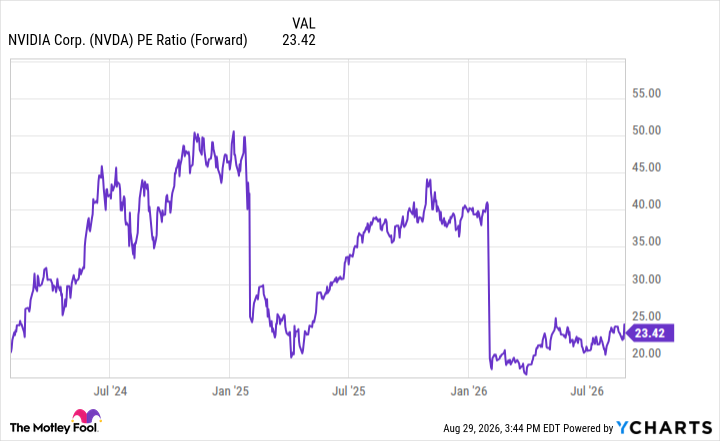
NVDA PE Ratio (Forward) data by YCharts.
But take a look at Nvidia's price/earnings-to-growth ratio (PEG ratio) as well. The PEG ratio measures a company's price relative to its expected future earnings growth. As a rule of thumb, any positive PEG ratio of less than 1 suggests a stock is undervalued. Currently, Nvidia's PEG is around 0.6. To me, it's clear the market is not paying up for the earnings path that Nvidia's management just outlined.
The takeaway here is simple: Nvidia's multiyear guidance is not a victory lap. It's a declaration that the bottlenecks to the AI build-out revolve around physical components, and that a meaningful return to the Chinese market is not something that the company would need in order to achieve a financial performance that the Street is under-predicting by a mile. At a forward earnings multiple that has somehow compressed even as the company's earnings power continues to compound, Nvidia stock is still worth owning.