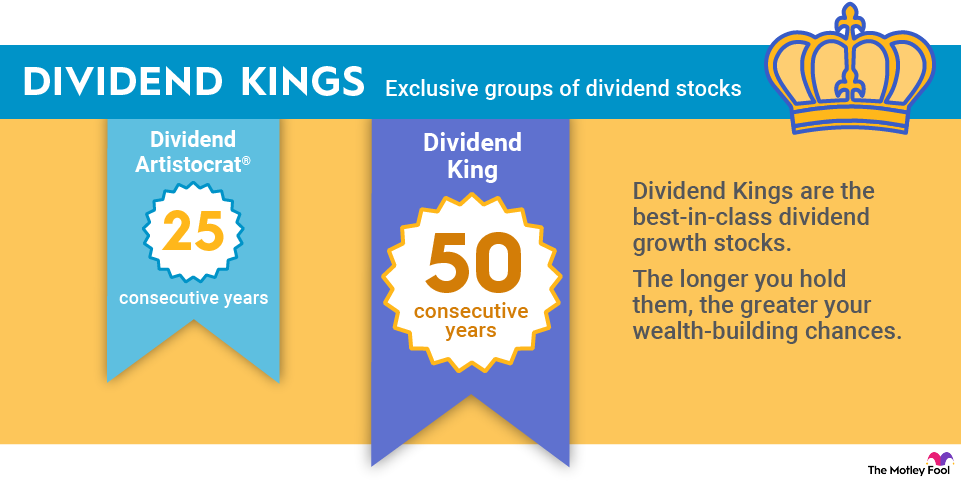
Colgate-Palmolive (CL -0.03%) has raised its dividend annually for 63 consecutive years. That makes it a Dividend King, or a company that has increased its payout for at least 50 years in a row, as well as a stable investment for income-oriented investors.
Over the past 20 years, it delivered a total return of 347% when reinvested dividends are included. It achieved that growth even as the U.S. endured two official recessions.
But on Sept. 21, S&P Global removed Colgate-Palmolive from the S&P 100 index during its quarterly rebalancing, as its $69 billion market cap was too small to make the cut. That sounds like a major setback, but it doesn't change my bullish opinion about the stock.

Image source: Getty Images.
Why isn't Colgate-Palmolive's exclusion from the S&P 100 meaningful?
Colgate-Palmolive remains in the S&P 500 (^GSPC -0.02%), so it will continue to be passively purchased by investors who buy index funds and ETFs tracking the S&P 500. Being removed from the S&P 100 will only eliminate Colgate-Palmolive's exposure to much smaller ETFs, such as iShares S&P 100 ETF (OEF -0.05%), which track only the top 100 stocks.
Colgate-Palmolive wasn't dropped from the S&P 100 because its stock was sinking. Instead, it was removed because other higher-growth, AI-driven stocks -- including the newly added Palo Alto Networks, Sandisk, and Arista Networks -- grew faster and eclipsed its valuation. As a slower-growth consumer staples giant, Colgate-Palmolive simply couldn't keep up with those AI plays.
Why is Colgate-Palmolive still a solid long-term investment?
Colgate-Palmolive is still one of the largest producers of oral, personal, home care, and pet nutrition products in the world. Its best-known brands include Colgate, Palmolive, Protex, Speed Stick, Ajax, Fabuloso, Murphy, and Hill's premium pet food.
From 2025 to 2028, analysts expect Colgate-Palmolive's EPS to grow at a 17% CAGR from $2.63 to $4.22. That gives it plenty of room to raise its annual dividend, currently $2.12 per share, for a forward yield of 2.4%. That growth should be driven by its expansion of Hill's pet nutrition business, the premiumization of its personal care and household products, its robust sales in emerging markets, and new AI-driven optimization initiatives.
At $86, Colgate's stock still looks reasonably valued at 22 times next year's earnings. It's still a stable investment that usually holds up well during recessions, and it should gradually head higher over the next few years -- even if it never rejoins the highfliers of the S&P 100.