Innodata: Gradual Upward Momentum in Quarterly Revenue
Innodata (INOD -8.98%) primarily generates revenue by supplying global enterprise clients across the financial, insurance, and technology sectors with specialized data engineering services, digital transformation strategies, and proprietary software platforms designed for training artificial intelligence and complex machine learning algorithms. It recently announced a planned leadership transition in its chief executive officer position, and it subsequently opened a new motion-capture research laboratory in New York City to generate high-accuracy training data for humanoid robotics.
IONQ: Rapid Acceleration From a Smaller Base
IONQ (IONQ -9.53%) primarily generates revenue by building advanced, general-purpose quantum computing hardware systems and providing commercial access to those processing resources through major third-party cloud computing service providers, including Amazon Web Services and Microsoft Azure, as well as its own proprietary network. It recently introduced its sixth-generation quantum computing hardware platform for immediate commercial deployment, while executing a definitive agreement to acquire an enterprise security infrastructure company in an all-stock transaction valued at $1.3 billion.
Why Revenue Matters for Investors
Revenue serves as a fundamental baseline measure of total overall commercial demand for an organization's products or services before any operating expenses, taxes, or capital costs are deducted. It reveals whether a company is successfully attracting customers and growing its overall business volume over time.
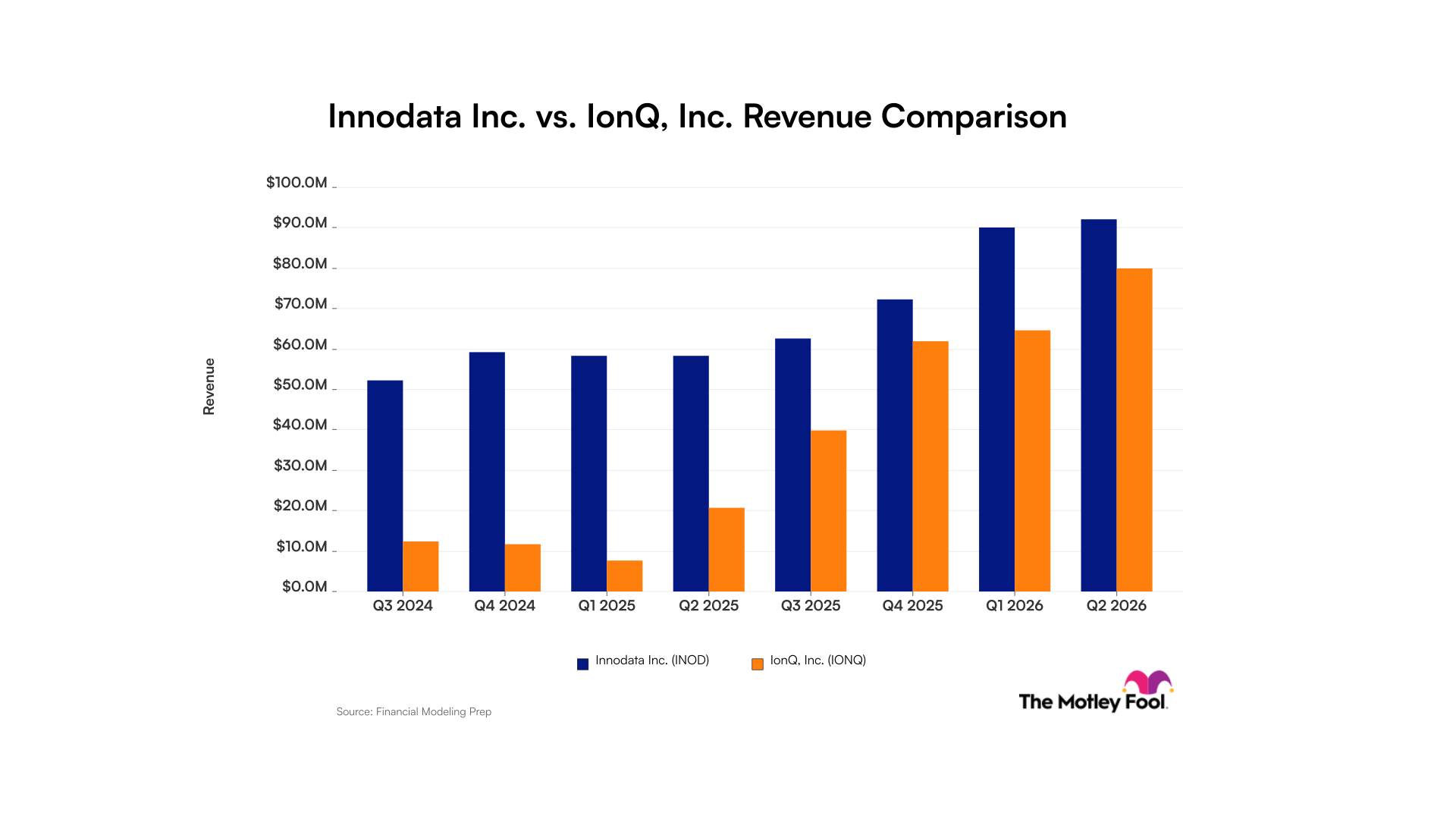
Innodata vs. IONQ Revenue over the last 8 quarters.
Comparing Quarterly Revenue Trends for Innodata and IONQ
| Calendar quarter | Innodata Revenue | IONQ Revenue |
|---|---|---|
| Q3 2024 | $52.2 million (quarter ended Sept. 30, 2024) | $12.4 million (quarter ended Sept. 30, 2024) |
| Q4 2024 | $59.2 million (quarter ended Dec. 31, 2024) | $11.7 million (quarter ended Dec. 31, 2024) |
| Q1 2025 | $58.3 million (quarter ended March 31, 2025) | $7.6 million (quarter ended March 31, 2025) |
| Q2 2025 | $58.4 million (quarter ended June 30, 2025) | $20.7 million (quarter ended June 30, 2025) |
| Q3 2025 | $62.5 million (quarter ended Sept. 30, 2025) | $39.9 million (quarter ended Sept. 30, 2025) |
| Q4 2025 | $72.4 million (quarter ended Dec. 31, 2025) | $61.9 million (quarter ended Dec. 31, 2025) |
| Q1 2026 | $90.1 million (quarter ended March 31, 2026) | $64.7 million (quarter ended March 31, 2026) |
| Q2 2026 | $92.1 million (quarter ended June 30, 2026) | $80.0 million (quarter ended June 30, 2026) |
Data source: Financial Modeling Prep. Data as of Oct. 13, 2026.
Foolish Take
Both Innodata and IONQ operate in cutting-edge fields, the former in artificial intelligence and the latter in quantum computing. Looking at their revenue trends provides insights for investors to understand how each business is performing.
In that regard, IONQ's sales trajectory is impressive, given quantum computers are still an emerging technology and have yet to achieve widespread adoption. Its revenue over the past year has soared, and now, it's on the verge of catching up to Innodata. The outstanding revenue growth indicates IONQ's technology is winning customers. The strength of its quantum computers was further validated by the company advancing to the final round of the Defense Advanced Research Projects Agency's Quantum Benchmarking Initiative on Oct. 7.
Meanwhile, Innodata's strong quarter-over-quarter sales growth seen in 2025 seems to have slowed down in 2026, a disappointing trend amid the rapid expansion of the AI market. This combined with a leadership transition this year in both the CEO and CFO roles have contributed to a share price decline, with the stock down about 35% over the past 12 months through Oct. 13.