Image source: The Motley Fool.
DATE
Thursday, July 23, 2026 at 8:30 a.m. ET
CALL PARTICIPANTS
- Executive Vice President, Investor Relations - Marci Ryvicker
- Co-Chief Executive Officer - Brian Roberts
- Co-Chief Executive Officer - Mike Cavanagh
- Chief Financial Officer - Jason Armstrong
- Steve Croney - Steve Croney
TAKEAWAYS
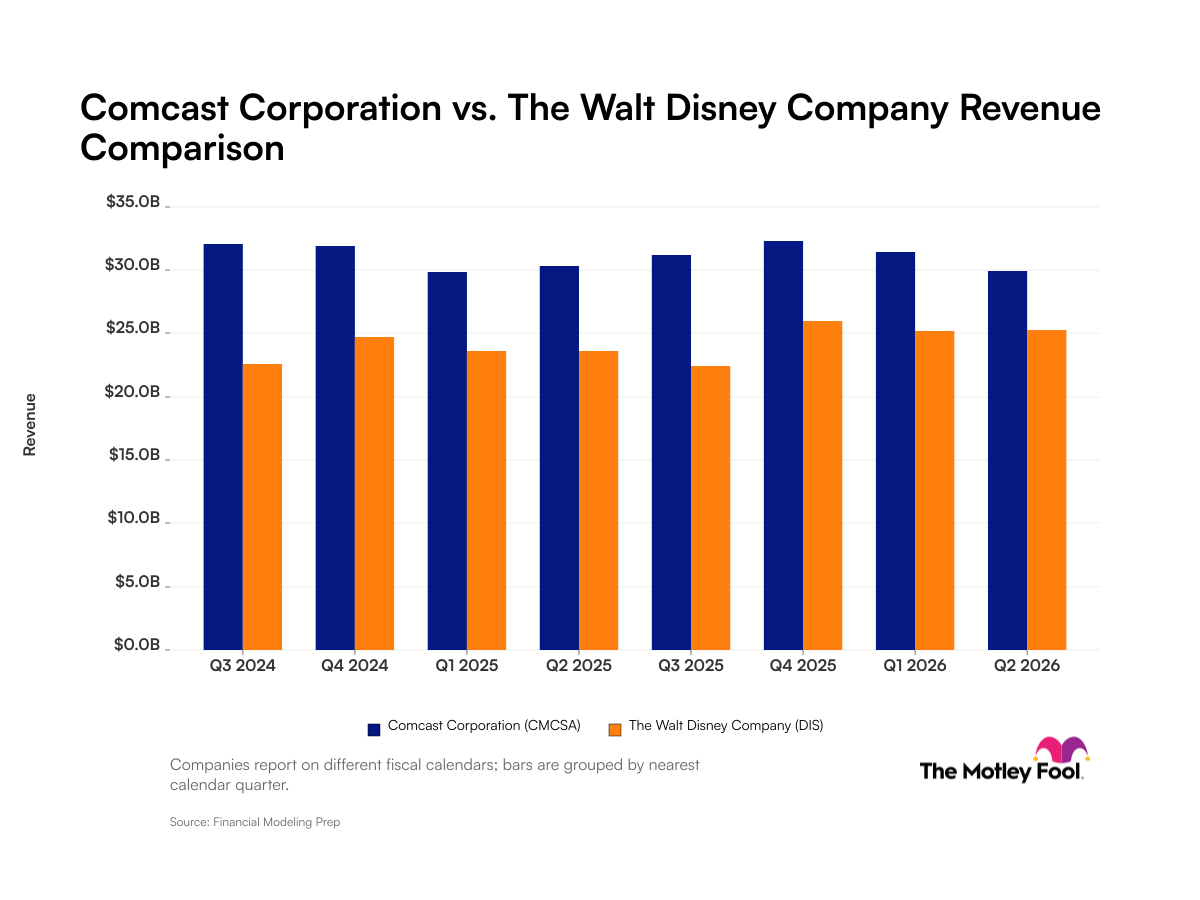
- Revenue -- $29.94 billion, representing a 1.2% decrease compared to the prior year period.
- Pro Forma Revenue -- $29.57 billion, an increase of 4.7% when excluding the impact of Versant and Sky Germany operations.
- Adjusted EPS -- $1.04, reflecting a 16.7% decline from $1.25 in the second quarter of 2025.
- Free Cash Flow -- $4.60 billion, an increase of 2.3% year over year.
- Domestic Residential Broadband Net Loss -- 167,000 customers, which management noted was an improvement of 34,000 versus the prior year.
- Domestic Wireless Net Additions -- 448,000 lines, marking the highest quarterly result on record for the company.
- Total Wireless Lines -- 10.2 million total lines, representing a 7% penetration rate of the addressable lines in the company footprint.
- Peacock Adjusted EBITDA -- $189 million profit, the first time the streaming service achieved quarterly profitability since its launch.
- Peacock Paid Subscribers -- 48 million, following the addition of 2 million net subscribers during the second quarter.
- Broadband ARPU -- Decreased 3.8%, reflecting the impact of simple pricing and the initial dilution from free wireless line promotions.
- Connectivity & Platforms Adjusted EBITDA -- $7.96 billion, representing a 5.8% decrease on a constant currency basis.
- Business Services Connectivity Revenue -- $2.67 billion, an increase of 3.7% driven primarily by enterprise solutions offerings.
- Media Segment Revenue -- $5.69 billion, a 25.3% increase fueled by the FIFA World Cup and higher revenue from Peacock.
- Studios Revenue -- $3.04 billion, an increase of 25.0% driven by theatrical performances including The Super Mario Galaxy Movie and Obsession.
- Theme Parks Adjusted EBITDA -- $609 million, a 5.1% decrease attributed to attendance softness in Orlando and international parks.
- Capital Expenditures -- $2.9 billion, an 8.3% increase primarily due to higher spending on scalable infrastructure within Connectivity & Platforms.
- Domestic Video Customer Loss -- 280,000 customers, compared to a loss of 325,000 in the second quarter of 2025.
- Convergence ARPA -- Approximately $85, a figure management stated is significantly below the levels reported by telecom competitors.
- Enterprise Solutions underlying growth -- Just under 3%, after adjusting for the impact of the Nitel acquisition.
- Advanced Solutions Mix -- $0.70 for every dollar of connectivity sold, up from $0.20 three years ago.
- Broadband High Tier Migration -- 45% of the broadband customer base is now on gigabit plus tiers.
- Domestic Advertising Revenue -- $2.16 billion, a 55.0% increase benefiting from the FIFA World Cup and NBA coverage.
- FIFA World Cup Incremental Revenue -- $440 million, which drove record engagement across Telemundo and Peacock.
- Shareholder Returns -- $2.1 billion, consisting of $1.2 billion in dividends and $900 million in share repurchases.
- Business Services EBITDA Margin -- 56.7%, an increase of 60 basis points compared to the prior year.
Need a quote from a Motley Fool analyst? Email [email protected]
RISKS
- Cavanagh stated, "The operating environment has softened more than we anticipated," regarding the Theme Parks division, where Orlando attendance began to decline in June and remained pressured into the third quarter.
- Armstrong noted, "The broadband market remains highly competitive," citing aggressive expansion from fiber, fixed wireless, and emerging satellite alternatives as ongoing headwinds.
SUMMARY
Management at **Comcast Corporation** (CMCSA +0.81%) announced a plan to separate its Media and Sky assets into an independent publicly traded company, a process expected to conclude in approximately one year. The company reported record growth in its wireless segment and achieved the first quarterly profit for Peacock, though total revenue and adjusted EBITDA faced pressure from a deliberate strategic pivot in broadband pricing. Executives stated that while the competitive environment in broadband remains intense, the company is focusing on a converged service model and infrastructure investments to support future data demands driven by artificial intelligence.
- Co-Chief Executive Officer Roberts stated that the separation will give two exceptional companies the "focus and agility to win in markets that are changing fast."
- Chief Financial Officer Armstrong projected that financial trends in the Connectivity & Platforms segment should show modest improvement starting in the third quarter as free wireless lines begin converting to paid status.
- President Cavanagh attributed the attendance decline in Orlando to "higher fuel prices and weaker consumer sentiment," though he maintained a positive long-term outlook for the parks business.
- Management reported that 30% of postpaid phone connects came from premium unlimited plans, indicating successful movement into the higher-value wireless market segment.
- Steve Croney noted that upstream broadband traffic is growing at 2.5 times the rate of downstream volume, a trend he linked to the rise of AI-driven queries.
- The company paused share repurchases as of July 1 to ensure that both stand-alone companies maintain strong investment-grade balance sheets during the separation period.
- President Cavanagh reported that Love Island has been the "#1 overall streaming title in the U.S. this summer," contributing to strong engagement and advertising demand on Peacock.
INDUSTRY GLOSSARY
- ARPA: Average Revenue Per Account, a metric used to measure the total value of a customer across multiple service relationships.
- MVNO: Mobile Virtual Network Operator, a wireless communications service provider that does not own the wireless network infrastructure over which it provides services.
- Gig plus tiers: Broadband service levels providing download speeds of 1 gigabit per second or higher.
- Convergence: The strategy of bundling broadband and wireless services into a single customer relationship to increase retention and revenue.
- Constant Currency: A financial measurement that excludes the impact of foreign exchange rate fluctuations to compare underlying business performance.
- Advanced Solutions: Higher-value business services including managed connectivity, security, and cloud solutions beyond basic internet access.
Full Conference Call Transcript
Operator: Good morning, ladies and gentlemen, and welcome to Comcast's Second Quarter Earnings Conference Call. [Operator Instructions] Please note this conference call is being recorded. I will now turn the call over to Executive Vice President, Investor Relations, Ms. Marci Ryvicker. Please go ahead, Ms. Ryvicker.
Marci Ryvicker: Thank you, operator, and welcome, everyone. Joining us on today's call are Brian Roberts, Mike Cavanagh, Jason Armstrong and Steve Croney. I will now refer you to Slide 2 of the presentation accompanying this call, which can also be found on our Investor Relations website and which contains our safe harbor disclaimer. This conference call may include forward-looking statements subject to certain risks and uncertainties. In addition, during this call, we will refer to certain non-GAAP financial measures. Please see our 8-K and trending schedule issued earlier this morning for the reconciliations of these non-GAAP financial measures to GAAP. With that, I'll turn the call over to Brian.
Brian Roberts: Good morning, and thanks, Marci. Before Mike and Jason take you through the quarter, I'd like to spend a few minutes on the separation we announced 3 weeks ago. Since then, we've talked with our key constituencies, employees at every level and most of our key partners, and the reaction has been overwhelmingly positive. I feel more positive and energized today than I was on the day we announced it. What's come through most clearly is renewed conviction in both businesses. There's real excitement about taking 2 exceptional companies and giving each the focus and agility to win in markets that are changing fast.
We've also spent time with leaders across media and tech, and we've come away more optimistic than ever about the next wave of innovation. One thing is clear, AI and the coming generation of technology will demand more data, more bandwidth, lower latency and smarter networks and platforms. They'll bring together connectivity, entertainment and new experiences in ways we are only beginning to see. And that is exactly where Comcast is built to lead. The market is moving to our strengths and winning now is about focus, speed and relentless execution. That's also why this is the right time for Michael Angelakis to return. He's been welcomed back with tremendous enthusiasm and confidence. He has deep relationships across the industry.
He knows this company and his return will help accelerate the work Steve and the team already have underway. Wireless is a great proof point of what this team can do. In the second quarter, we crossed 10 million lines for the first time, a meaningful milestone that's just 7% penetration of the total addressable lines in our footprint and perhaps a new way to look at the wireless opportunity and the significant runway we have ahead. We're building this business on top of a deep customer base, leadership in WiFi, strong wireless partnerships and products that are already in tens of millions of homes and businesses.
On the media and entertainment side, with NBCUniversal and Sky, we're equally excited about the next chapter. The strength of these businesses isn't just the world-class assets we own, it's the role we play as a trusted partner to talent, creators, sports leagues and platforms throughout the industry. In just 6 years, we've built Peacock into a streaming business with real scale in the U.S. We've added 2 million paid subscribers in each of the last 2 quarters, had our biggest viewership month ever in June and reached profitability, all anchored by what NBCUniversal does best, premium entertainment, live sports, news and extraordinary storytelling.
With the combined reach of NBC, Peacock, Telemundo, Bravo, Sky and possibly ITV, and the many relationships we've built with partners across tech and streaming, we will be well positioned as an independent media company to drive engagement and growth. And when you look at things like the amazing and recent success of The Odyssey and Christopher Nolan and the strength of our film slate, it underscores that creativity and collaboration with the world's best talent. And that all remains at the heart of what makes this company so special. That is why I feel so energized. We spent years investing to build these 2 great companies, each with distinct world-class assets and leaders I trust deeply.
This structure gives both companies the freedom to pursue the priorities that matter most to their futures. There's a lot of work ahead, and we're moving with real urgency. With that, I'll turn it over to Mike.
Michael Cavanagh: Thanks, Brian. I'll just add a few additional comments on the separation before turning to some highlights of the quarter. When we made the announcement, we were clear about the core assets that would sit within each company. With that foundation in place, we are off and running on the work to finalize the remaining details and move towards execution with the goal of completing the separation in approximately 1 year. Over the next several months, our teams will continue working through the items that naturally come with a transaction of this scale.
A key part of our work is on the balance sheet and capital structure as our intention is to set both companies up with strong investment-grade profiles and the financial strength and flexibility to pursue their respective growth strategies. With that, I'll turn to highlights of the second quarter, starting with Connectivity & Platforms, where results were broadly in line with our prior commentary. We are well into the deliberate broadband pivot that began almost a year ago.
That pivot has included significant changes in pricing and packaging to make our value proposition clearer and more predictable, continued investment in a simpler, more seamless customer experience and a more aggressive push into wireless, both through free lines to build awareness in the market and through the launch of our premium unlimited plans. These actions are intended to address the areas we need to improve while leaning on the structural advantages we already have, a scaled network, industry-leading WiFi and a capital-efficient mobile platform.
While this pivot comes with investment that is weighing on financial results in the near term, we are making real progress against the objectives we set out, which are to build a durable converged customer base, deepen our relationships and transform the experience so as to position this business for long-term growth, and we are pleased with the progress we are making. Broadband subscriber losses in the second quarter improved year-over-year. We also continue to see year-over-year gains in our Net Promoter Scores, which is an important signal that our moves in pricing, packaging and experience are resonating with customers. Wireless is becoming a more meaningful growth engine for us.
We just had our best quarter ever with 448,000 net line additions, our second consecutive record quarter, supported by stronger gross additions and improved churn, even as the initial cohort of free lines began rolling into the paid base. Year-to-date, net line additions are up 25%. And importantly, we are seeing positive early traction converting those free lines into paid wireless relationships, which reinforces the value customers are seeing in our products and which will support better monetization as we move through the year. We are also extending that same convergence opportunity into business services. This quarter, we went live with our T-Mobile MVNO partnership for business customers and the early signs are encouraging.
We expect activity to ramp as we move into the latter part of the year. Separately, we continue to win significant new contracts in enterprise, which reinforces the strength of our position as the fastest-growing enterprise provider in the market. So while the environment remains highly competitive, we like the progress we are making on the things we can control. Wireless is scaling quickly, Enterprise continues to gain momentum and the work underway across pricing and the overall experience is strengthening the foundation for a converged valuable customer base over time. Turning to Content & Experiences.
The Media segment had a strong quarter, generating mid-single-digit EBITDA growth with Peacock delivering meaningful profitability for the first time even as we absorbed the final quarter of the first full year of our NBA contract. That performance reinforces the value of NBC, Telemundo, Bravo and Peacock together as one integrated Media business with continued opportunity to drive stronger engagement, advertising and profitability into the future. Peacock added another 2 million paid subscribers in this quarter, bringing us to 48 million paid subscribers and have its biggest viewership month ever in June, fueled by the World Cup and Love Island.
That builds on the 2 million subscribers added in the first quarter around legendary February and is important evidence that we are managing event-driven churn effectively by bringing users in around major moments and keeping them engaged with the broader content slate. The NBA, Love Island and the World Cup are all contributing to strong engagement and robust ad sales across both linear and streaming. The World Cup has been terrific for us, delivering the biggest Spanish language sporting event in U.S. media history and record engagement for Telemundo and Peacock. And Love Island has been the #1 overall streaming title in the U.S. this summer.
Our Studios business is having a great year with momentum across franchises, animation, originals and specialty titles. In the second quarter, Super Mario Galaxy and Minions & Monsters extended the strength of our animation slate with Minions & Monsters taking the Minions franchise to $6 billion globally and further extending its position as the highest grossing animated franchise of all time. Focus had a standout performance with Obsession, which crossed $400 million worldwide and became its top-performing film ever, while Disclosure Day delivered Steven Spielberg's biggest original opening to date.
And just last week, The Odyssey became one of the defining theatrical events of the year, reinforcing the power of our creative partnerships and ambitious storytelling with the Odyssey becoming Nolan's biggest global opening of all time. Turning to Parks. The operating environment has softened more than we anticipated. Unpacking this by geography, in Orlando, Epic Universe continues to perform well and is delivering the strong guest response we expected. At the same time, attendance across the broader Orlando market began to soften in June, and that trend has continued into the third quarter. We believe there are some temporary factors at work, including higher fuel prices and weaker consumer sentiment, but we are watching these trends closely.
Internationally, Osaka continues to be affected by China-related travel restrictions, while Beijing is operating against a challenging macroeconomic backdrop. Despite these near-term pressures, our outlook for the long-term opportunity in Parks is unchanged. We have great brands, great locations and a proven playbook for investing behind attractions and experiences that create real consumer demand and strong returns. With Universal Kids Resort now open in Frisco and our U.K. Park moving toward construction, we continue to see a long runway for growth. Before I hand it over to Jason, I want to touch on Sky's proposed acquisition of ITV's media and entertainment business, which will strengthen Sky's long-term position in the U.K.
The transaction brings together 2 of the U.K.'s most trusted media businesses, pairing Sky's premium content, connectivity and sports leadership with ITV, which reaches 40 million people in the U.K. every week and serves more than 16.5 million digital users. The transaction will enhance Sky's streaming and advertising capabilities, create meaningful operating efficiencies and broaden the opportunities to grow customer relationships. So with that, let me turn it over to Jason to go through the financial results in more detail.
Jason Armstrong: Thanks, Mike, and good morning, everyone. Let me start with a high-level overview of our consolidated results and then get into more detail on our businesses. Before I begin, I want to note this morning, we issued updated pro forma trending schedules to reflect the removal of Sky Germany from our consolidated results following the sale of that business on May 31. For context, Sky Germany generated over $2 billion in annual revenue, but had an immaterial EBITDA contribution and had previously been reflected within Corporate and Other. As a result, all year-over-year comparisons in my remarks today will be presented on a pro forma basis.
In the second quarter, revenue increased 5%, in part benefiting from Telemundo and Peacock's successful airing of the FIFA World Cup. Adjusted EBITDA declined 5%, reflecting pressure from 2 areas. In Connectivity & Platforms, as we have discussed, we are investing behind the go-to-market pivot we began last year with a focus on simpler pricing and packaging and an improved customer experience. And in Content & Experiences, we are still in the first year of the NBA right cycle and absorbing the full cost of that contract, while the revenue opportunity builds over time.
Adjusted earnings per share were $1.04, and we generated $4.6 billion of free cash flow in the quarter, of which we returned $2.1 billion to shareholders, including $900 million in share repurchases. Now turning to our businesses, starting with Connectivity & Platforms. We are almost a year into this go-to-market transition. So let me start with where we stand before moving to this quarter's specific results. The broadband market remains highly competitive. Fiber continues to expand, fixed wireless remains aggressive, satellite is emerging as another alternative and convergence-based promotional activity remains elevated across the industry. We are operating under the assumption that the market will remain intensely competitive.
Against that backdrop, at the end of the second quarter of last year, we made a deliberate shift in how we go to market to compete more effectively in a competitive environment increasingly defined by convergence. Since then, we have focused on simplifying pricing, improving transparency, streamlining the customer experience, investing in our best-in-class network and products and leaning further into wireless, including through our free wireless offer. We continue to see encouraging signs from these actions. Broadband losses improved versus last year. Customers continue to migrate to higher tier plans with about 45% of our base now on gig plus tiers.
Wireless net additions reached a new record and NPS improved again year-over-year, reflecting better customer perception of our service experience. At the same time, we have been transparent that this pivot comes with investment. We made several deliberate choices this year to reposition the business for stronger long-term performance. We did not take a broadband rate increase, and we've been migrating customers into simplified pricing with lower everyday price points. At the same time, we continue to see strong adoption of free wireless lines, which is initially dilutive to broadband ARPU. As a result, broadband ARPU declined 3.8% in the quarter.
Additionally, we continue to invest in the customer experience and go-to-market capabilities needed to support this broader shift, which contributed to a 5.8% decline in Connectivity & Platforms EBITDA. These results are consistent with our remarks on last quarter's earnings call, where we previewed incremental pressure on both ARPU and EBITDA growth. At the same time, we indicated that trends should improve beyond the second quarter as we lap the initial go-to-market investments and as free wireless lines convert into paying relationships in greater volumes. That remains our expectation, and we expect modest improvements starting in the third quarter. Looking ahead, and as we have highlighted before, consumers are increasingly choosing converged broadband and wireless offerings.
We believe we have a strong position to compete in convergence. We have the largest converged footprint offering gig plus broadband and wireless ubiquitously, and our product experience continues to receive external validation. Opensignal has consistently ranked our WiFi #1 in our footprint. And in its first U.S. converged experience report, Xfinity ranked #1 nationally in 2 of 3 categories measured: converged consistent quality, which assesses reliability across the combined network and converged download speed. This reinforces why convergence ARPA is an important metric for how we think about running the business. Broadband remains the anchor product, but the value of the relationship expands meaningfully when we add wireless.
At roughly $85, our convergence ARPA remains well below levels reported by telecom competitors, which highlights the long runway and opportunity we have ahead of us, particularly as we stabilize broadband and continue to scale wireless. With that outline of strategic priorities, let's get into more detail of the quarter, starting with broadband. Broadband subscriber losses improved by 34,000 year-over-year to a loss of 167,000. That improvement reflects continued traction from our new go-to-market strategy even as we continue to operate in a highly competitive environment across our footprint. Broadband ARPU declined 3.8%.
As I said earlier, we expect to see modest improvement as we anniversary the launch of the go-to-market strategy and as free wireless lines begin converting into paid relationships in greater volume as we exit this year. Turning to convergence. Convergence revenue declined 3.2% and convergence ARPA declined 1.5%, reflecting the pressure on broadband revenue, partially offset by 14% growth in wireless service revenue. Wireless had another very strong quarter. We added 448,000 net lines. That's our best quarter on record with roughly half of our residential postpaid phone connects coming from customers taking a free line. We are actively leaning into this opportunity. The free line offer is doing what we intended.
It's building awareness, it's driving attachment and it's expanding the base of customers we can convert into paying wireless relationships over time. Most importantly, this is a product that provides real value across a range of customer segments. We compete effectively in value-oriented segments with substantial savings offered relative to competitor offerings, and we are also gaining traction in the higher value segment of the wireless market. In fact, premium unlimited plans accounted for roughly 30% of postpaid phone connects, demonstrating that we are now competing very effectively in a segment of the market that carries higher expectations around network quality and data allotments as well as handset availability and refreshment.
We ended the quarter with 10.2 million total lines, representing 17% penetration of our domestic residential broadband customer base, but only 7% penetration of the total wireless line opportunity in our footprint. Looking ahead, as free wireless lines come up for monetization, we are managing those customers with a clear life cycle approach focused on usage, engagement, retention and the overall product experience. Early free line conversion cohorts are tracking in line with our expectations, and we continue to expect a significant majority of these customers to convert to paid relationships as roll-offs accelerate in the second half of the year. Over time, that should provide a real tailwind to convergence revenue and ARPA growth. Turning to Business Services.
Revenue grew 3.7% and EBITDA increased 5%. Both benefited from a nonrecurring item related to a long-term fiber lease renewal. Excluding that benefit, underlying growth in both revenue and EBITDA was just under 3%. That's consistent with the trend we have seen over the past year after adjusting for the Nitel acquisition, which we have now lapped. Growth continues to be driven by strong momentum in Enterprise Solutions, where we are seeing demand from larger customers with more complex connectivity, security and managed services needs. Importantly, the mix shift towards advanced solutions continues to scale. 3 years ago, for every dollar of connectivity we sold, we sold about $0.20 of advanced solutions.
Today, that figure is closer to $0.70, underscoring the increasing value we are delivering to customers. At SMB, competition remains elevated, but we continue to drive ARPU growth by deepening relationships through a strong mix of advanced solutions. We also recently launched our T-Mobile MVNO, adding expanded business mobile capabilities and another differentiated product to the portfolio as we compete for business customers across every segment of the market. Moving to Content & Experiences. There are a few items I'd like to highlight. At Theme Parks, revenue increased 3%, while EBITDA declined 5%. The EBITDA decline was primarily driven by continued pressure at our Osaka park, where China-related travel restrictions are still impacting attendance.
That pressure was partially offset by growth at our U.S. parks. In Orlando, revenue and EBITDA grew as we compared to the partial opening period of Epic in last year's second quarter. That said, growth in Orlando came in below our expectations as attendance began to soften in June and has remained pressured into the third quarter. And at Hollywood, results improved as we began to lap the initial pressure we experienced last year, though we do not expect a more meaningful improvement until the new Fast & Furious roller coaster opens later this year. Turning to Media. We achieved an important milestone as Peacock reached profitability for the first time, generating $189 million of EBITDA in the quarter.
This reflects the strategy we have been executing for several years, building Peacock around a dual revenue model supported by a broad content mix across sports, next-day NBC and Bravo, film, originals, news, library and major events. Peacock was also a primary driver of overall media results with Media revenue increasing 25% and EBITDA increasing 4%, even as we absorbed first year NBA rights costs. Digging into Peacock specifically, revenue increased 54%, driven by strong growth in both distribution and advertising revenue. Distribution revenue grew over 50% with paid subscribers up $7 million year-over-year and $2 million sequentially, reaching $48 million.
And advertising revenue increased nearly 70%, fueled by multiple drivers with notable call-outs, including the simulcast of Telemundo's FIFA World Cup, the NBA playoffs and the latest season of Love Island. At Studios, we had another strong quarter with revenue increasing 25% and EBITDA increasing $141 million year-over-year. Results were driven by recent theatrical releases, including the Super Mario Galaxy movie, Obsession and the international distribution of Michael. As always, Studios will have some quarter-to-quarter volatility based on theatrical release timing and licensing activity. But this quarter was another good example of the breadth of the portfolio with strength across franchise animation, specialty titles, filmmaker-driven projects and international distribution.
Now let me wrap up with free cash flow and capital allocation. In the second quarter, we generated $4.6 billion of free cash flow, underscoring the strength of our businesses even as we make meaningful investments that I've highlighted. This quarter, we returned $2.1 billion to shareholders, including $900 million in share repurchases. As we recently announced on our separation call, we did pause share repurchases as of July 1 and expect to remain paused through our separation. Our priority is to ensure both businesses are well capitalized with favorable investment-grade ratings to provide both the financial foundation to pursue their respective growth strategies.
Now I'll turn it over to Marci, who will moderate the questions we collected from the analyst community in advance of today's call. Marci?
Marci Ryvicker: Thanks, Jason. We're going to start with broadband. The first question comes from John Hodulik of UBS. Can you discuss the competitive dynamics in the broadband market?
Steven Croney: Perfect. John, I appreciate the question. Competition remains intense, and we are operating under the assumption that the market will become increasingly competitive. And that's through continued fiber expansion, aggressiveness will remain in fixed wireless. And although not meaningful to us now, satellite is emerging as another competitor in that space. We've also seen the promotional intensity increase in some markets and some of the behavior has been irrational. But 6 months in, so I'm really focused on transforming the company and a testament to the team, we're doing a great job. We're off to a great start. We have a long way to go.
But foundationally, nothing beats a wire into the home with differentiated reliable WiFi and great customer experience. And our recent organizational changes have streamlined our structure. Our national pricing and packaging construct has simplified our go-to-market approach, and we're more effectively using our data and analytics to improve our effectiveness as well. And what that's enabled is greater agility. It's improved our time to market and our reaction time to competitive changes and enable us to respond in much more targeted ways, maintaining our discipline. Most importantly, though, we remain focused on the end state, and that's 2 multi-gig scaled competitors or 2 multi-gig scaled pipes to the home, and we are one of those.
Additionally, fixed wireless and satellite will remain competitive as well in that space. But we feel real good in that marketplace. Our converged offerings provide a significant advantage, and we really like our challenger position when it comes to that. We recently crossed the 10 million mark, and we like -- and we also had record-setting mobile line net adds in the quarter. With the 7% penetration overall, we feel really good. We have a converged ARPA of $85, which is significantly below the competition, and this provides a long runway for us ahead.
Marci Ryvicker: We got a bunch on satellite and specifically Starlink. So there's a 2-parter. The first from Craig Moffett at MoffettNathanson. There is a robust debate as to whether Starlink broadband is purely a rural solution or whether it's fixed wireless 2.0. How do you see it? And then the second part comes from Vikash at New Street. There's been a lot of chatter around Starlink exploring potential partnerships with both broadband and wireless operators. Is that something you would be interested in?
Jason Armstrong: So it's Jason. Let me take that one, and thanks, Craig and Vikash, for the questions. I know this has certainly been topical in particular, since the IPO in the last couple of months. So on Starlink specifically, I would say right now, we currently are not seeing them as a meaningful competitive factor in our markets. But saying that we don't take any comfort in that. We're not complacent. We fully expect to see them as more of a competitor over time.
I think if you look at their trajectory in terms of capacity that they're bringing online, which is I think everybody is pretty well versed in at this point, they're going to have significant capacity increases in the coming years, particularly expect to see them more in rural and underserved areas. I think that's a core target market for them. And I think that's realistic that we're going to see them as more of a competitor in those markets. I think as we step back, how effective they are or anyone else is in taking share from us, we have a good degree of control over. There's a new competitive category.
It used to be fiber, and now it's become fixed wireless and in parts of our market, it will increasingly become satellite. So the question is how do we position for that? How do we address any vulnerabilities that we have from a competitive standpoint. And as we stack up the sort of network product and experience categories that we've talked about before, let me start with network. Our starting point is a terrific one on network. Nothing beats a wire into the home. That's exactly what Steve just said. That's firmly what we believe here. We're going to be 1 of 2 wires into the home.
If you look at the long-term end state, our path on that wire is a multi-gig symmetrical path. Our network is an active network all the way into the home. There's some debate about this as to whether that's more costly to run. I would tell you it's a little bit more costly to run. We actually love the fact that it's active all the way into the home in an AI-driven world, having active components from head end to node to amps all the way into customer premise equipment, we actually think will be a big advantage in the long term. So we're very comfortable with where we are in network.
On product, we consistently rate really strong WiFi reliability, which is a core metric around product, how do your devices do once they're in the home connected to a great network. WiFi reliability, we're at the top in our footprint. And so I would say that's an advantage. We actually think we can press as we take a look at the pipeline of what we can go attach to our product in the home, exciting things coming down the map and a great position to sort of build from. The opening that we've seen for competitors, this is true largely a fixed wireless has been around our experience. I think we've been very transparent.
Steve, this is sort of mission #1 for him is how do you go attack and address any of the gaps we've seen on the customer experience side. That's been lack of pricing transparency. It's been customer service that hasn't been a strong suit of ours and things that we've been just maniacal in 6 to 12 months of being very honest with ourselves about and getting after. So I would step back and say, whether it's fixed wireless, fiber, satellite, all these are in a sort of a new-ish competitive category. The priority for us is the same. And that's how do you create an experience sort of holistically across network, product and customer service that best insulates you.
And that's fully within our control. It's why we're making the investments we're making. Vikash, I could just get to your question quickly on potential partnerships. You mentioned Starlink. I would also broaden that one out, though. We've got a long history in the connectivity business of partnerships, whether that's multiple MVNOs at this point, deep syndication relationships across the cable industry, and that's a global cable industry. We've got companies that syndicate our products all over the globe. So a deep history here. So we'll certainly explore ways to create value, whether that's Starlink or others, where we can serve our customers better and differently. By the way, I'd also point out, we actually already do work with Starlink.
We have a partnership within Comcast Business, combining our managed connectivity portfolio with their satellite capabilities for enterprise customers.
Marci Ryvicker: Great. We're going to move to wireless. We got a bunch of questions. We're going to take one from Peter Supino at Wolfe Research. Can you talk about your mobile strategy as it relates to converting paid lines and driving premium uptake in the second half of 2026?
Steven Croney: Got it. So wireless remains a major growth opportunity for us. And as I mentioned, about 7% penetration to the overall addressable market, and we're well positioned to take advantage of the opportunity. Our competitive strengths include 2 strong MVNOs, one residential, one in business, and we're just activating the business MVNO now. We have 65 million converged passings that enable both 1 gig plus speeds as well as a mobile service. We have the nation's largest Wi-Fi network. We're currently offloading about 90% of our traffic. And that, along with our lower acquisition costs has provided a great cost structure, and we've been able to offer our customers a great value proposition that significantly undercuts the competition.
And we've rallied the organization around convergence. And in turn, we have seen increased mobile attach rate, both to new customers as well as to our base. And the free line offer strategy is working exceptionally well. We're driving awareness, and we're enabling our customers to trial the product. In parallel, we've significantly improved our customer life cycle management, and that begins with the activation process through usage, through device upgrades, additional mobile line attach and premium sell-in. And what we've seen is in this quarter, about 1/3 of our mobile line connects came from existing mobile customers adding an additional line. Additionally, our premium mobile adoption continues to strengthen, and we're now exceeding 30% sell-in.
And as a result, the significant majority of our free line roll-off customers are converting from free to paid as expected. And a few of those characteristics of the customers is usage is consistent as customers convert to paid. We see porting is comparable to customers who paid from day 1. And our overall churn rate in mobile is down even though we're rolling and accelerating the free line roll-off. So the free line offering is strengthening our customer relationships, supporting the long-term value of our converged strategy.
Marci Ryvicker: Great. We got a bunch on the C&P financials. So we'll take one from Steve Cahall of Wells Fargo. Prior communication has been for broadband ARPU and C&P EBITDA pressure to begin to abate by the second half of this year. This is due to comping both free mobile lines that roll to pay as well as heavier marketing spend. Is this still the outlook?
Jason Armstrong: Yes. Thanks, Steve. This is Jason. So let me just step back and what led us down a path that would have created EBITDA declines as you saw this quarter, just as a reminder and then help that frame sort of the path forward. A year ago, we obviously started to prioritize new go-to-market, simple and transparent pricing. Along with that, we sort of made the determination to be much more aggressive in wireless, both to build awareness in the value segment and then on the higher end with the premium unlimited plans that Steve mentioned. So really getting after it from a pricing perspective, that's caused obviously some dilution on broadband ARPU.
The second was investing in both current and future customer experience, as Steve has mentioned, and then doubling down to ensure both our network and product offerings remain best-in-class. So those all created a little bit of pressure, obviously, as you've seen, stemming from broadband ARPU and ultimately manifesting into declining EBITDA, which you saw this quarter at 5.8%. I think from here, if you use those same factors and say, what improves, what gives us confidence in saying modest improvement in the third quarter, you take each one of those. We decided last year, obviously, on free wireless, we're going to start to monetize those lines.
And as Steve mentioned, we're seeing really good progress on conversion of free line into pay line. And that was a year's journey with the customer, making sure they were activating, making sure they were engaging, making sure usage was driven higher, and there was a seamless handoff where a customer actually saw value in the wireless plan. And so I think we're early stages of having early cohorts roll off and into paying relationships, but we like what we're seeing because the vast majority are actually converting. So I think that's one thing that starts to create a tailwind. The second thing is just we're going to start to lap some of the early investments in customer experience.
That's not to say we're all the way there. We're certainly not. We've got more investments to make, but we will start to lap some of the early costs. But I think those 2 things help out. I think -- but getting away from quarter-to-quarter, our focus is how can we return the business to growth over the longer term. And as we step back and look at some of the broader secular factors, a, traffic demand on broadband continues to grow at a rapid pace. The secular is sort of in your favor. Wireless, we continue to think we have a big right to play.
As we said early on, 7% penetrated across our homes passed with an incredible product offering that's a great value for the customer. So that's the largest end market of anything around us, and we've got an incredible right to play there. And then I just finally mentioned business services, which hasn't come up yet, but growing at a roughly 3% rate with an enormous amount of room to run in particular, in enterprise and being the fastest-growing provider right now, all gives us optimism on the longer-term question about how you rebound to growth.
Brian Roberts: This is Brian. Let me just jump in speaking of longer term. If you look even longer than just a couple of quarters of what's actually happening from the consumer with their broadband and what is likely to be the most likely scenario for future. I come away encouraged. I think we're going to be well positioned. This quarter, broadband downstream traffic was up same as in the past couple of quarters, about 10%. But the upstream traffic was 2.5x that volume growth. And that's being driven, I think, by rapidly changing AI queries.
And if you roll that forward and with the innovation, the speed of change and all the different applications that are going to bolt on to this new capability in society, our road map, which is baked into our plans is to have multi-gig symmetrical, low latency network, which Steve talked about, with intelligence in that network that improves the experience and differentiates us from every other network. And I think we will be one of the winners in this new world being driven by this rapid technological change. So our network is robust and ready for the next generation, and that gives me greater confidence and excitement.
Marci Ryvicker: Great. Now I'm going to move to C&E. We have a general one from Jessica Reif Ehrlich of Bank of America. You clearly have an extremely valuable collection of assets at NBCUniversal at a time the media industry continues to consolidate as it competes against larger global platforms. Do you believe NBCU has sufficient scale to compete and grow on its own? Or is part of the rationale for separation to give it the currency and flexibility to participate in further consolidation?
Michael Cavanagh: Thanks, Jessica. It's Mike. I love the way you asked the question or framed it. We agree. This is an extremely valuable collection of assets at NBC. And we think that separating the business, setting it up on its own is going to give it the focus and opportunity and platform to invest behind the growth opportunities that it has in its own businesses and the spaces around these businesses that offer growth and where the business has the right to play. I think larger consolidation and the implications of that, we've been competing against these players -- all these players in these businesses for many years.
And when you really look at what the business as it stands today has accomplished, I do believe that NBCUniversal and Sky do have the heft and the relationships and the operational capabilities to continue to be a major player as an independent, as Brian talked about earlier, player in the media space that's in a great position to partner with others. When you really go down to a little more detail on why that is, it is the strength of this portfolio. We've got NBC and Telemundo on the broadcast side, incredible reach provided by those assets.
Peacock will spend more time talking about that, but it's in 6 years, as Brian said, has gotten to an incredible scale at a pace that we're very proud of and very much dovetails with the strategy for how we build and program NBC itself. Bravo, NBC Sports, NBC News, Universal Film, where we talked about the great success of this year-to-date and the years of the recent past, along with the TV studios. And then finally, parks, destinations and experiences where we're 1 of 2 of the scale and scope in a great business. And finally, Sky. And we really look at them, each of them are competing really well against their natural competitors and produce great results.
NBC, we talk about it all the time, reaches over 100 million households per quarter with linear and Peacock. That's 80% of the U.S. Legendary February, you remember, we reached 225 million Americans across the Olympics, Super Bowl, NBA, All-Star. We're the most watched primetime broadcast network for the 2025, 2026 season and on and on in film studios and the like. So I think we do definitely have the scale that is needed to compete. I'll go back to sports for a second or go to sports.
There, I think it's a good evidence of what it means to have the capability set that our teams have, which is just a microcosm of what is true across all of our premium content creation, not just sports, it's relationships with the creators. So in that case, our relationships with our leagues go way beyond our financial terms of our deals. We've built very long-standing relationships that are growing their audiences, elevate the presentation of their sports for the long term and expand the value of their rights, frankly. And then we do that through the world-class production that we're known for, great distribution across both broadcast and streaming and the ability to reach fans at scale.
We've had partnerships that go 40 years with the Olympics, long-standing relationships with the Premier League, Sunday Night Football, the best show on television, et cetera, et cetera. So I think the point is that we do feel really good about the business that we have. We do think that these assets are incredibly valuable. We love the fact that they operate well together. Studios creating IP that then feeds Peacock and parks, extending the reach of content for the -- or the reach of Peacock and NBC and back and forth. So it's a great virtuous circle in parts of this business.
And I think one thing to add that Brian may want to pile on, I think as an independent, we take all these great assets and we are willing to partner with others. So other strategies are a little more walled gardens. Our approach is to build great businesses that serve our own platforms, but look for opportunities to partner, bundle and exhibit other people's IP in our parks and create IP in our studios that go to other platforms. I think that's a good strategy for the collection of assets we have and I think presents a path for growth in this business over time. So we're excited about what we have ahead.
Brian Roberts: Look, Mike, Brian here. I think you perfectly covered why there's so much excitement both in the company and from people to partner with us. And we're unique in being independent, we don't have any other agenda other than to do the things you just laid out perfectly, which is partner well and to bring to life people's dreams and content and sporting events and the like. And so we just came from one of the conferences, and there's just great ideas, and I'm excited about the road ahead to expand the partnerships we've already got.
Marci Ryvicker: I have a multiparter on parks. This is a combination of Mike Ng from Goldman Sachs and Kutgun Maral from Evercore. Can you expand on the domestic softness you saw in June? What drove the shift in consumer behavior? And what read do you have on third quarter trends? How much of the softness was attendance versus per cap spending? And can you separate the trends at Epic from those of the other Orlando parks? And then a follow-up from John Hodulik of UBS. In your view, how would you characterize the underlying value drivers in the overall parks business?
Michael Cavanagh: Sure. Thanks. It's a lot there. Thanks to all 3 of you for the questions. So in Orlando, really, the softness that we're seeing affecting this quarter that continues as we look into June is essentially weakness in attendance. And that, we believe, is driven by some weakness in consumer sentiment and higher travel costs affecting demand. Not something that we think is a -- while we see it continuing into the third quarter, not something that we think is a permanent change in the outlook at all because we continue to see continued consumer appeal and satisfaction in all the things we look at as it relates to the excitement that people have about our parks.
And we've seen some of this before. So when you have a great product like we have, we fully expect that once economic conditions and consumer demand stabilizes for us that we'll be getting that attendance back and thrilling our fans in these parks because they are such good businesses and good experiences, and we're proud of the product. Specifically on Epic, we continue to see it doing what we wanted it to do. It's delivering against our expectations. Guest response continues to be strong. It's driving higher per capita spend and strengthening broader Orlando as making it a true multi-destination resort. So we're not seeing anything that causes us to feel at all disappointed in the performance of Epic.
It's an overall demand drop that's hitting Orlando broadly. So that's the point on Epic. And then, John, to your question, we think that this is -- and I said it in the earlier question, we're in a unique position with the capabilities and experience of the leadership team of Mark Woodbury and others creating these parks over the last quarter century and more. It is a long-cycle business. We're, again, 1 of 2 players. We feel very confident that in the long-term opportunity and the fact that we have a great road map over the long term to continue investing behind this team and in future opportunities like the U.K.
Park and other things that are down the road for us. So when we look at that, we're obviously looking at long-term expectations for demand, what consumers are looking for, and we learned from the investments we've made and the great technological advances we've made as we release new parks like Epic, we bring that into the future and continue to build this business as a very long cycle but special business for us and have a lot of confidence in it. So with that, I'll turn it back to you, Marci.
Marci Ryvicker: Great. Next is Peacock. This question is coming from Kutgun Maral of Evercore. Peacock reaching profitability was an important milestone this quarter. Does that represent a durable profitability inflection? Or could seasonality and event timing push Peacock back into losses during the second half or in future periods?
Michael Cavanagh: So thanks, Kutgun. I mean I think it is a very -- it's a milestone event. We feel great about -- we talked about approaching profitability this quarter. And then for all the reasons mentioned earlier, it was strongly profitable, nearly $200 million of profits in Peacock for the quarter. And it does reflect the progress we've made in scaling the business. We talked earlier about adding the subscribers in the earlier part of the year with Legendary February and yet holding on and doing a good job exposing people to other content and then adding more as we hit the season with World Cup on Telemundo, Spanish language and Love Island.
So we think the -- we're achieving the scale and the service that we'd hope to achieve and good work by the team over the last 6 years. The drivers we talked about are pretty broad-based. It was a strong content calendar. We had the playoffs, NBA playoffs first time, great post season, which we benefited from. Again, Love Island, World Cup, next-day NBC and Bravo programming and the rest that's in there help really support strong engagement, really good subscriber trends, great advertising demand and thus overall monetization.
So I think that the factors at work and managing the Peacock business alongside the other assets in the Media segment, which we've long talked about as being the real objective, not Peacock profitability unto itself, are paying off. And as to Peacock profitability itself, we do expect it to continue to improve on an annual basis, but profitability is going to vary quarter-by-quarter just based on the timing of sports schedules and other content hitting one quarter versus another. But I think of it more of as an annual -- think of it on an annual basis rather than the lumpiness quarter-by-quarter, and it's been improving steadily, and we see that continuing to be the case.
Thanks for the question.
Marci Ryvicker: Great. Now this last question is on the separation. It comes from Sebastiano Petti from JPMorgan. Can you provide more detail on target leverage and dividend policy for each of the 2 stand-alone companies and when investors should expect an exchange ratio and updated capital return framework?
Jason Armstrong: It's Jason. Thanks, Sebastiano. So nothing to add relative to what we said 3 weeks ago upon announcement, which is we will take the coming months, obviously, to work through capital allocation, capital structure policies. But stepping back, the clear goal here was to create 2 scaled and focused industry leaders to put strong leadership in place to create the 2 with strong investment-grade balance sheets and really the ability to go invest and pursue growth agendas. So nothing to add from that.
Michael Cavanagh: It's Mike. I think I'll just wrap it up. Thanks for the call today. And just going back to some of the points Brian made at the beginning, we feel the separation, there's a lot of excitement about creating 2 exceptional companies with the great leadership teams that we have across the 2 businesses, giving focus and agility to win in markets that are changing fast. So that's how we feel sitting here today. As you look at the quarter, really proud of the progress we're making on the strategic pivot in broadband that Steve spoke about. It's gaining traction, and we're happy there.
Quite happy with the significant growth in wireless, best quarter on record as again, Brian and Steve covered. And then enterprise, again, another star in the connectivity business that's really performing well for us. Integrated Media strategy I just talked about, mid-single-digit EBITDA growth overall, even with the quarter -- the last quarter of the first year of the NBA and Peacock continuing to scale. Studios, an absolutely great year with Super Mario Galaxy, Minions & Monsters and Obsession and of course, Odyssey. And then finally, parks, our view that the softness we're seeing is not something that dims our view of the long-term health of the business.
So I think that's a good wrap-up of what we've seen this quarter. Thanks, everybody, for calling in, and we look forward to talking to you soon.
Marci Ryvicker: Thank you all for joining us.
Operator: Thank you. That concludes the question-and-answer session and today's conference call. A replay of the call will be available starting at 11:30 a.m. Eastern Time today on Comcast Investor Relations website. Thank you for participating. You may all disconnect.