About the Author
Matt DiLallo has positions in Brookfield Asset Management and Starwood Property Trust. The Motley Fool has positions in and recommends Brookfield Asset Management and Starwood Property Trust. The Motley Fool has a disclosure policy.

Invest better with The Motley Fool. Get stock recommendations, portfolio guidance, and more from The Motley Fool's premium services.

Mortgage REIT | Best for | Reasoning |
Starwood Property Trust | Those seeking diversification and income durability. | It spreads risk across commercial, residential, and infrastructure lending, as well as direct equity investments. STWD has also delivered more than a decade of dividend stability. |
AGNC Investment | Those seeking simplicity and a monthly income stream. | It focuses solely on Agency MBS and pays a high-yielding monthly dividend. |
Annaly Capital Management | Those seeking scale and income growth. | NLY is the largest mREIT, with complementary strategies, and pays a growing dividend. |
Here's a closer look at these leading mortgage REITs.
Benefits:
Risks:
I considered four factors to narrow the list from the nearly 40 publicly traded mortgage REITs: Scale, financial strength, dividend track record, and diversification. I favored the largest mREITs because they tend to have lower cost of capital, longer operating histories, and greater resources to manage risk. I also looked for those with relatively conservative leverage ratios, solid dividend track records compared to their peers, and, in some cases, favored portfolio diversification. These traits make this group of mREITs lower risk ways to invest in the sector, positioning them to pay stable-to-growing dividends over the long term.
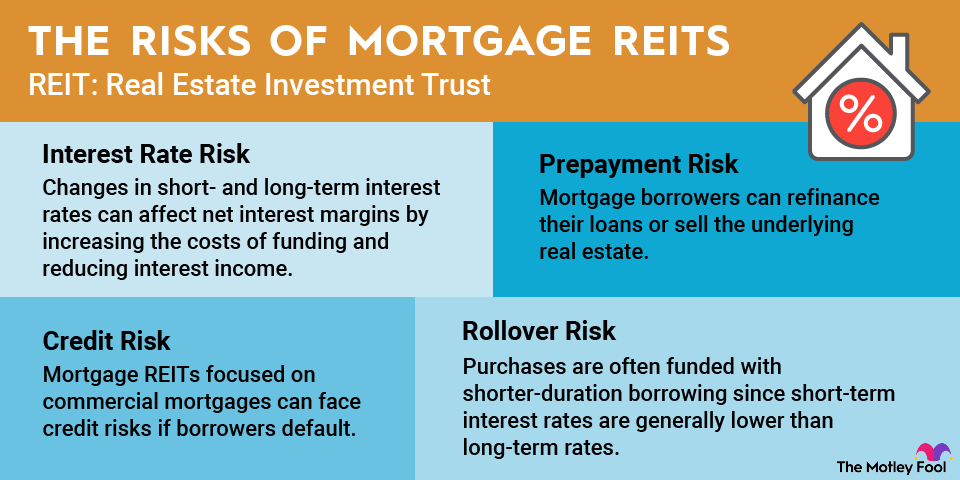
Mortgage REITs make the most money when there's a wide spread between short-term borrowing rates and long-term lending rates. That spread usually doesn't remain wide for long, making mREITs more volatile than equity REITs. As a result, they're not always the best option for investors seeking durable dividend income.
However, this trio of mREITs stands out compared to their peers. Here's a quick snapshot of who might want to consider investing in each one:
These mREITs offer investors comfortable with the sector's risk factors three different ways to collect a high-yielding income stream. However, more risk-averse investors might want to consider investing in a safe REIT instead.
Mortgage REITs, or mREITs, provide real estate financing by originating or purchasing mortgages, mortgage-backed securities (MBS), and other real estate-backed loans. They are an essential part of the residential mortgage market, helping to finance about 1 million homes in the United States each year, according to the National Association of Real Estate Investment Trusts (Nareit). They also support the commercial real estate sector by providing loans to develop, acquire, reposition, and own income-producing properties.
Here's a closer at a few interesting mREITs investors might want to consider buying.
According to Nareit, there were 37 publicly traded mREITs as of early September 2026. They were split relatively evenly between home financing (19 REITs) and commercial financing (18 REITs). The following three stood out in the sector due to their large-scale operations and investment strategies:
| Name and ticker | Market capMarket cap calculated using publicly traded shares outstanding only. Does not include unlisted, private, or dual-class non-traded shares. Implied market cap may vary. | Dividend yield |
|---|---|---|
| Starwood Property Trust (NYSE:STWD) | $6.0 billion | 11.94% |
| AGNC Investment Corp. (NASDAQ:AGNC) | $12.6 billion | 13.52% |
| Annaly Capital Management (NYSE:NLY) | $17.2 billion | 12.49% |


Starwood Property Trust (STWD +1.26%) is the largest mortgage REIT (by market cap) focused on commercial real estate financing. The company built a diversified portfolio with $32.2 billion in assets as of early September 2026, supported by a relatively low balance-sheet leverage ratio (2.7x). Starwood Property's portfolio primarily comprises commercial loans (53%). It also has residential (8%) and infrastructure (9%) lending platforms, as well as equity investments in owned properties (21%) and other investments (9%).
Starwood expanded its equity investments in 2025 by acquiring Fundamental Income Properties from Brookfield Asset Management (BAM +0.62%) for $2.2 billion. The deal increased the company's diversification by adding a large-scale global net lease platform to its portfolio. It provided the REIT with an expandable platform (Starwood had grown it to over $2.7 billion by early September 2026).
Starwood's diversification beyond the commercial lending sector has enabled it to generate steadier earnings and provided additional growth opportunities. That has allowed the company to maintain its high-yielding dividend for more than a decade. That dividend security has been hard to find in the mREIT sector, where payouts have generally declined over the years due to interest rate volatility and other factors. Starwood has also generated a strong 9% annualized total return since its 2009 IPO.
AGNC Investment (AGNC -0.09%) is an mREIT focused on investing in Agency MBS, pools of residential mortgages protected against credit losses by government agencies (Fannie Mae, Freddie Mac, and Ginnie Mae). The REIT invests only in Agency MBS, which it leverages primarily through repurchase agreements (RePo). It also uses a dynamic risk management strategy to protect the value of its portfolio from interest rate and other risks. As of early September 2026, AGNC Investment's portfolio totaled $97.2 billion in assets, and it had a 7.4x leverage ratio.
The REIT's simple strategy has enabled it to maintain a stable monthly dividend for 75 consecutive months (as of the end of the second quarter of 2026). That dividend stability over the past few years has made it stand out in a sector where many rivals cut their dividends as interest rates rose. While AGNC has cut its payout several times in the past (including in 2020), it has generated a 616% total return since its IPO in 2008 (as of early September 2026), outperforming the average mREIT during that time frame.
Annaly Capital Management (NLY -0.09%) is the largest residential mortgage REIT with a total portfolio of $109.4 billion as of early September 2026. It has three investment strategies:
The REIT's diversification allows it to invest where it finds the best returns. For example, it capitalized on higher rates during the second quarter to increase its Agency portfolio by nearly $3 billion, while roughly maintaining the size of its residential credit and MSR portfolios. Like other mREITs, Annaly uses leverage (an economic leverage ratio of 5.6 times at the end of the second quarter of 2026) to invest in additional mortgage assets. This strategy boosts its returns (11% to 16% returns across its three platforms in 2026).
The mREIT has generated a total return of 1,266% since its IPO in 1997 (as of early September 2026), primarily driven by dividend income. While Annaly has cut its dividend several times over the years due to interest rate volatility and other factors, it raised its quarterly dividend from $0.65 to $0.70 per share in early 2025 and again in the second quarter of 2026 (to $0.75 per share), reflecting its improved earnings profile.
Here's a step-by-step guide on how to invest in mortgage REITs: