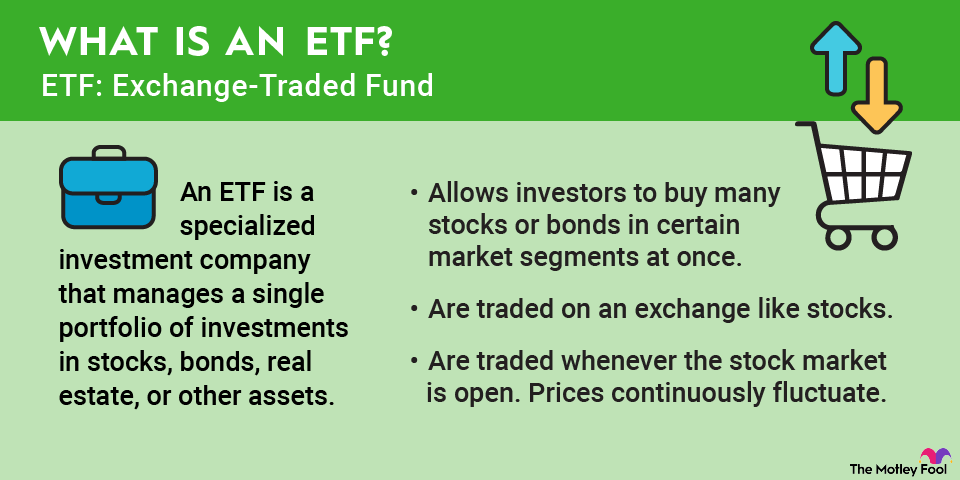
The best dividend stock exchange-traded funds (ETFs) have a few things in common. They tend to invest in well-established, financially healthy companies with strong balance sheets. They usually deliver dividend yields above average to their investors. And because they tend to focus on value-oriented stocks, dividend ETFs likely experience less volatility when the rest of the stock market gets choppy.
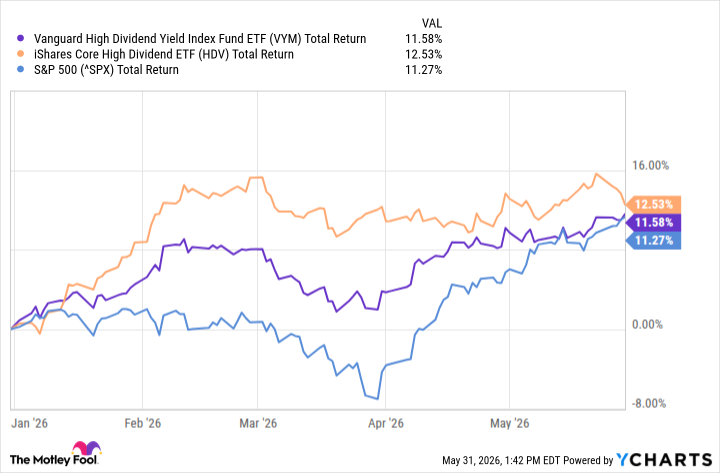
But before you buy a dividend stock ETF, it's important to review its holdings and understand why it's a good choice for your investment strategy. Two top-ranked dividend ETFs, the Vanguard High Dividend Yield ETF (VYM +0.17%) and the iShares Core High Dividend ETF (HDV +1.49%), have slightly outperformed the S&P 500 index year to date.
VYM Total Return Level data by YCharts
Both have strong advantages and can be a good choice for dividend-focused investors. But they take slightly different approaches to portfolio construction. One big difference might make one fund a better buy.
Let's take a closer look at these two popular dividend stock ETFs.

Image source: Getty Images.
Vanguard High Dividend Yield ETF (VYM): 608 stocks, 11.5% annualized returns in the past five years
The Vanguard High Dividend Yield ETF is a well-regarded Vanguard fund that lets you own 608 stocks of U.S. companies that are expected to pay better-than-average dividend yields. Some of the top stock holdings include Broadcom (8% of the fund), JPMorgan Chase (3.3%) and ExxonMobil (2.7%). The fund's trailing 12-month dividend yield is 2.24% and its expense ratio is an ultra-low 0.04%.
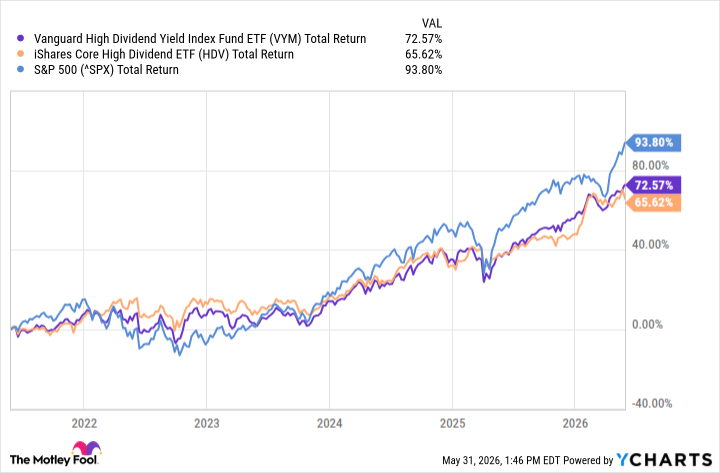
This Vanguard ETF has delivered annualized returns (by net asset value) of 11.5% over the past five years, 19.6% over the past three years, and 26.5% over the past year. It has underperformed the S&P 500 during the past five years.
VYM Vanguard High Dividend Yield ETF
NYSEMKT · As of 4:00 PM ET 10/16/26
Although the Vanguard High Dividend Yield ETF doesn't always beat the S&P 500, its portfolio of 608 stocks provides more diversification. The S&P 500 index has recently grown top-heavy with major tech names -- as of May 28, technology stocks accounted for about 38% of the index's weight.
But if you look at the top five sector holdings of the Vanguard High Dividend Yield ETF (as of April 30), technology stocks make up much less of the portfolio:
- Financials (20.2% of the fund)
- Technology (14.8%)
- Industrials (14.2%)
- Healthcare (11.8%)
- Consumer staples (8.2%)
If you're worried that tech stocks are overvalued or you want to avoid making too much of a concentrated investment in the artificial intelligence (AI) boom, the Vanguard High Dividend Yield ETF can help you diversify into other parts of the stock market.
iShares Core High Dividend ETF (HDV): 74 stocks, 11.4% annualized returns in the past five years
The iShares Core High Dividend ETF is another top-ranked dividend fund, but it's much less diversified than the Vanguard ETF. The iShares fund (as of May 29) holds only 74 stocks. Its top stock holdings include ExxonMobil (8.1% of the fund), Chevron (6.2%), and healthcare stock AbbVie (5.7%).
The fund's trailing 12-month dividend yield is 2.88% (better than the other ETF), and its expense ratio is 0.08% (slightly higher than the Vanguard fund's, but still low-cost). The iShares Core High Dividend ETF has delivered annualized returns (as of April 30) of 11.4% over the past five years, 14.04% over the past three years, and 23.1% over the past year.
HDV iShares Trust - iShares Core High Dividend ETF
NYSEMKT · As of 4:00 PM ET 10/16/26
Despite barely outperforming the Vanguard fund and the S&P 500 year to date, the iShares Core High Dividend ETF has significantly underperformed both of them over the past five years.
Why buy VYM instead of HDV?
Although the Vanguard High Dividend Yield ETF and the iShares Core High Dividend ETF rank among the best dividend index funds, I don't own either. That's because my investment strategy doesn't include dividend ETFs. Both of these funds have underperformed the S&P 500 over the past five years.
VYM Total Return Level data by YCharts
I prefer to aim for higher growth from my stock holdings, rather than settling for lower, but steadier, returns. Buying an S&P 500 ETF might be a better choice than either of these dividend funds. However, if I were going to buy one of these funds, I would choose the Vanguard High Dividend Yield ETF.
There's one big reason: This fund is much more diversified than the iShares ETF. The Vanguard fund holds 608 stocks instead of 74. If I were a dividend-focused investor, I would want broad diversification, instead of relying on a relatively small number of stocks that might underperform the rest of the market.