Nvidia (NVDA -0.52%) has become a staple investment amid the artificial intelligence (AI) build-out. Its returns have made many investors richer, and the company's future still looks bright. However, now and again, a shiny new toy comes along that makes investors look away, and recently, that has been Sandisk (SNDK -1.72%). The memory-chip maker has delivered unbelievably high returns in a short time frame, rising 4,500% in the past year. That's about the same total return that Nvidia has provided since 2020.
The question is, has Sandisk been a flash in the pan, or is it a real, long-term alternative to investing in Nvidia?

Image source: Getty Images.
Nvidia's business is more stable
Nvidia makes graphics processing units (GPUs), which have been widely deployed throughout the AI build-out. GPUs are highly flexible parallel processors, capable of efficiently handling workloads that involve massive amounts of data, and that makes them fantastic for training and running AI models. Nvidia's position at the top of the AI accelerator food chain has transformed it into the world's largest company, and there are few signs that its dominance will fade.

NASDAQ: NVDA
Key Data Points
Sandisk makes NAND memory, which is primarily used in solid-state drives (SSDs) in data center applications. There are other uses for NAND memory, but soaring data center demand is what's causing the stock to outperform. Essentially, there is a massive demand for SSDs and other types of products that utilize memory chips. It takes a few years to build new memory-chip foundries, so production hasn't yet caught up with demand, and memory prices have soared as a result. Sandisk's revenue and profits have as well, turning the stock into an absolute rocket ship.

NASDAQ: SNDK
Key Data Points
The question is, how long will these levels of memory and GPU demand last? That's an impossible question to answer, and makes the future somewhat uncertain.
However, Sandisk doesn't control its destiny. Its future is entirely tied to how much companies are willing to pay for memory. There isn't a whole lot of difference between one company's SSDs and a competitor's, so there isn't as much incentive to innovate, and memory is largely treated as a commodity. By contrast, Nvidia can continue to create competitive advantages for its processors and keep its products priced at a premium relative to rival chips, so it has an edge here.
Winner: Nvidia
Sandisk's growth is easily outpacing Nvidia's
The winner of the growth category should come as no surprise: Sandisk. A stock doesn't rise 4,500% in a year without outstanding top-line growth, and that's exactly what it has delivered.
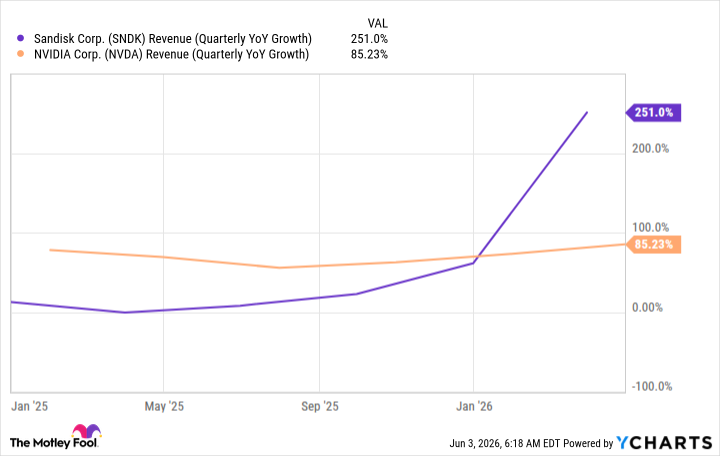
SNDK Revenue (Quarterly YoY Growth) data by YCharts.
Next quarter, Wall Street analysts expect 332% year-over-year growth, a further acceleration from its previously impressive levels. Few investors will complain about Nvidia's recent 85% growth rate or the 96% projected by analysts for next quarter. But it just cannot compete with Sandisk.
Winner: Sandisk
Valuing Sandisk's stock is tricky
How do you value a company that's putting up strong growth, but that could easily contract in response to shifts in the supply-and-demand balance? Most of the time, cyclical businesses trade at significant discounts to more stable sectors because of the unpredictability of market demand. This is part of why Sandisk soared so much over the past year, as it started its climb from a low valuation -- in spring 2025, it traded at price-to-earnings ratios in the 14 to 17 range, around half what the tech-heavy Nasdaq-100 was going for at the time. But that discount is gone now. Sandisk trades for 60 times trailing earnings versus Nvidia's 34 times.
Trailing earnings metrics are often useful, but they lose relevance when it comes to stocks that are projected to grow so much. Additionally, Nvidia's and Sandisk's fiscal years end almost six months apart from each other, so some of their forward earnings metrics offer less direct comparisons.
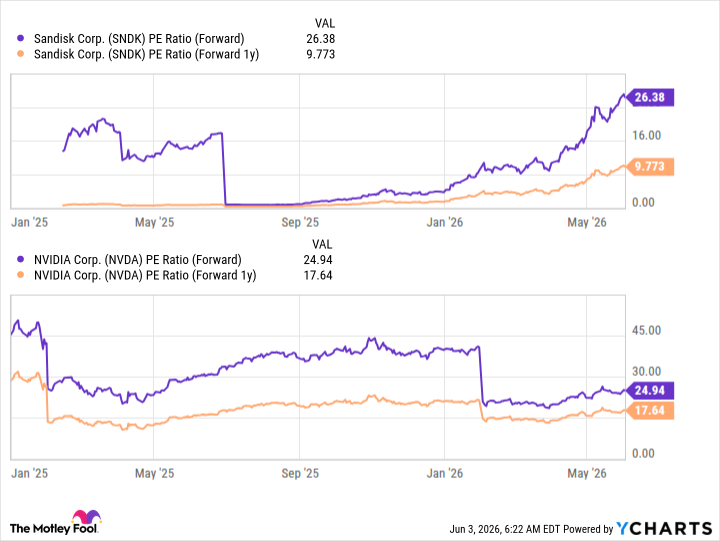
SNDK PE Ratio (Forward) data by YCharts.
Sandisk trades for about 10 times its expected earnings for its fiscal 2027, which ends June 2027. Meanwhile, Nvidia trades for about 25 times its expected earnings for the 12-month period ending January 2027. There's a sizable gap there, but the question is how much of a gap is valid due to the cyclical nature of Sandisk's business? Also worth considering is that, to a degree, Nvidia's business is cyclical, too, and this boom cycle could end after the heavy phase of AI build-out wraps up, which some are projecting will occur around 2030.
This is difficult to call, but I'm still a bigger fan of Nvidia, as it can do more to control the prices on its products.
Winner: Nvidia