Space Exploration Technologies (SPCX +1.25%), known as SpaceX, began trading on June 12 in a much-anticipated initial public offering (IPO). The IPO priced at $135, and the stock headed above $175 during that first trading day before closing at $160.95. Still, that provided a one-day gain of more than 19%. As of 1:30 p.m. Monday, the stock was still trending upward, trading in the neighborhood of $183.

NASDAQ: SPCX
Key Data Points
Clearly, Wall Street remains enthusiastic so far. However, it's important for investors to look beyond the hype and try to figure out what will happen to the stock over an extended period. Many investors hope Chairman and CEO Elon Musk can produce similar gains with this company to those achieved by another of his companies, Tesla. Over the last 10 years, through June 12, Tesla's shares gained 2,690%. That dwarfed the S&P 500 index's 319.7% total return over the same period.
To predict how much your stake might be worth in a year if you bought SpaceX stock today, investors need to examine the company closely before making some calculations.
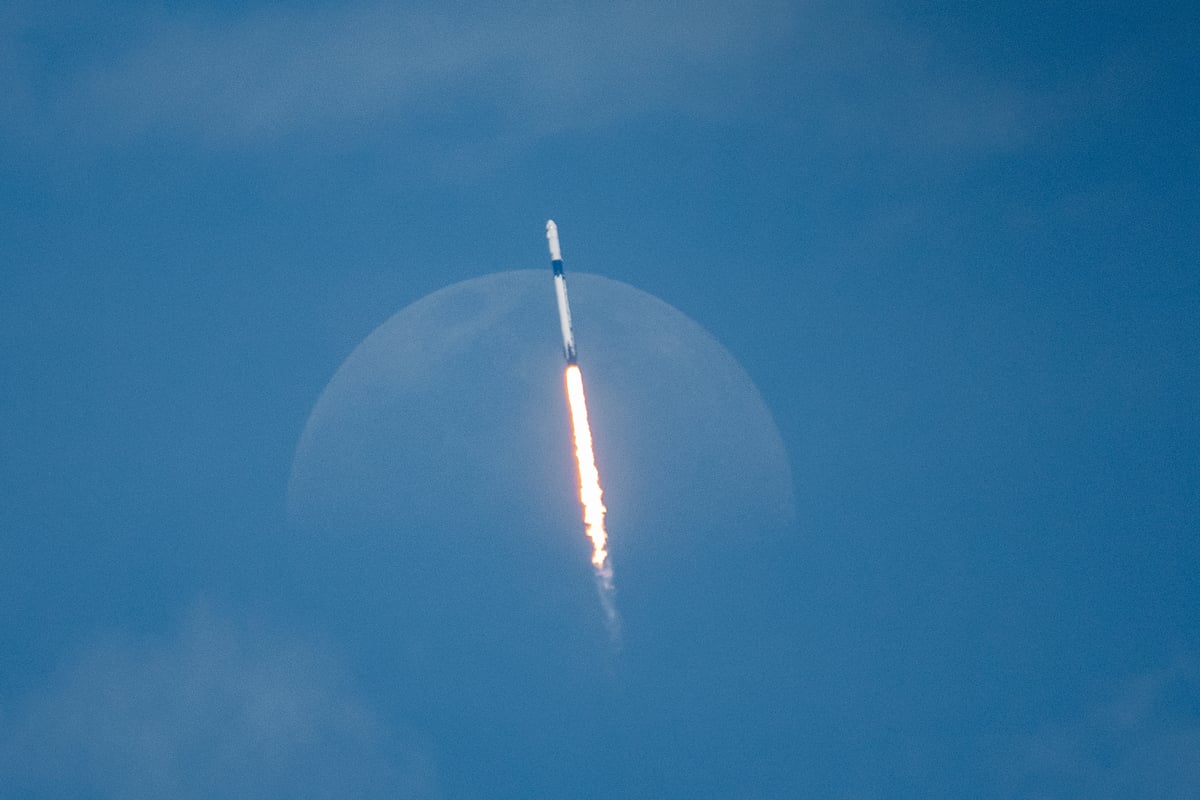
Image source: Getty Images.
A look at the fundamentals
SpaceX consists of several businesses, especially after it merged with another Musk-owned company, xAI (which had previously acquired another Musk-owned entity, X, formerly Twitter). Its businesses span building and launching rockets that transport astronauts and satellites (among other things), operating a broadband data network via Starlink, an artificial intelligence company (xAI), and a social media site (X). Management has organized the business into three segments: space, connectivity, and AI.
The entire company is losing money. Its first-quarter loss widened to $4.3 billion from $528 million a year ago. However, its revenue did grow 15.4% year over year to $4.7 billion.
Revenues for its largest and most profitable business, connectivity, rose 31.6% year over year to $3.3 billion, and operating income rose 15% to $1.2 million. The space business had a a 28.4% year-over-year revenue decline to $619 million, and the AI business's top line experienced a 12.5% increase. They both lost money, however.
Applying multiples
With the company currently producing losses, it's impossible to use the traditional price-to-earnings (P/E) ratio as a valuation metric for it. But one can measure it by its price-to-sales (P/S) ratio.
In 2025, its revenue grew more than 33% to $18.7 billion. If 2026's growth rate is consistent with its first-quarter pace, SpaceX's revenue will increase to $21.5 billion.
The company had an $1.8 trillion valuation at the time of its IPO, or an eye-popping 94 times sales. As of 1:30 p.m. Monday, its market cap was about $2.4 trillion, or an even more lofty 128 times 2025 sales. By comparison, the S&P 500 trades at a P/S multiple of 3.7.
Trying to predict what SpaceX's future multiple might be is tricky. But using the estimated $21.5 billion revenue figure and applying that earlier 94 P/S multiple results in roughly a $2 trillion valuation -- about 73% of where it's already trading today.
In other words, the market appears to have priced in that level of sales growth for next year, and then more growth beyond it. Hence, if you invested $5,000 today and held on for a year, assuming that revenue grew by 33% and that its P/S multiple reverted to 94, you could expect your stake to be worth less than it is now. And if the price-to-sales multiple the market is willing to pay for the stock fell by half from its IPO level to a still high 47, your $5,000 stake would have shrunk in value to around $1,840 after a year.
SpaceX's early valuations are pricing in high growth expectations and eventual profits. If the company fails to deliver, the stock could leave investors disappointed.