For Nvidia (NVDA -0.52%) to hit $10 trillion by 2030, it would need to more than double its market cap (about $4.7 trillion) over the next four-ish years. That works out to an annualized return of about 18%, which would price the stock at about $410 per share, assuming Nvidia's share count stays roughly unchanged (i.e, no dilution).
For almost any company, adding $5 trillion or more in market value would sound unrealistically demanding. For the world's most dominant supplier of AI accelerators, however, the growth required isn't as outrageous as it might seem. Let's take a look.

NASDAQ: NVDA
Key Data Points
The math behind Nvidia's path to $10 trillion
The first thing working in Nvidia's favor is that its underlying market is growing rapidly.
The research firm Gartner, for instance, forecasts worldwide spending on artificial intelligence (AI) will hit about $2.6 trillion in 2026, a 47% increase since last year. What's more important for Nvidia is that Gartner predicts spending on AI-optimized servers will also triple over the next five years. Many of these servers are built around graphics processing units (GPUs) like Nvidia's, along with the networking equipment needed to link them. It follows, then, that if spending on AI servers increases over the next five years, Nvidia's total addressable market (TAM) would likely expand substantially with it.
Image source: Nvidia.
Some back-of-the-envelope calculations can make clear what Nvidia needs to do to support a $10 trillion market valuation. At a price-to-earnings (P/E) ratio of 30, which is about what it trades at today, Nvidia would need to generate about $333 billion in profit to support a $10 trillion market cap. A more conservative multiple of 25 times earnings would put the figure closer to $400 billion.
For perspective, Nvidia's net income in fiscal 2026 was about $120 billion. Its total revenue was about $216 billion, with a net margin of about 56%.
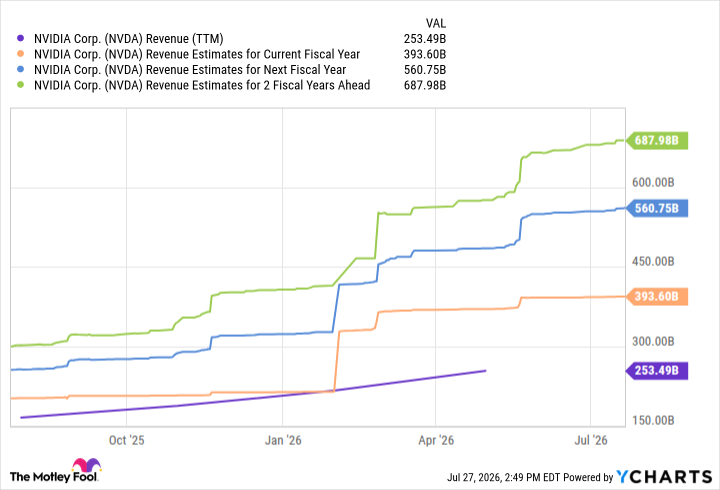
On that note, take a look at Wall Street's revenue predictions for Nvidia over the next two fiscal years.
Data by YCharts
As you can see in the chart, analysts expect Nvidia's revenue to grow at an annualized rate of about 32% from a fiscal 2027 estimate ($393 billion) through fiscal 2029 ($688 billion). If Nvidia were to generate around $688 billion in fiscal 2029 and convert 50% into net income, it would earn about $344 billion. Put a 30-times earnings multiple on that $344 billion in profits, and you get a market cap of $10.3 trillion.
Should you buy Nvidia at today's price?
Of course, these are estimates, not definite numbers. A lot can change in four years, and there's no guarantee Nvidia will beat competitors and remain as dominant as it is now.
Still, I think Nvidia looks attractive for investors willing to hold for at least five years. If the AI infrastructure market grows as predicted and Nvidia remains its predominant chip supplier, annualized returns in the high teens seem pretty doable. The stock might not deliver quadruple gains like it has over the past few years, but doubling by 2030 seems achievable to me.