Is the housing market going to make a rebound? Berkshire Hathaway (BRKA +0.40%)(BRKB +0.38%) and JPMorgan Chase (JPM +0.39%) think so. Both of them recently made significant investments in the housing industry, which means that companies with two of the biggest balance sheets in the country are putting their money to work in housing. Here's what that means for the companies and the market.
Preparing for a housing comeback
The housing market has been under pressure since interest rates were raised between 2022 and 2023, and the current fixed 30-year mortgage rate is 6.65%. That's not meaningfully lower than recent averages, but historically, these are not high rates.
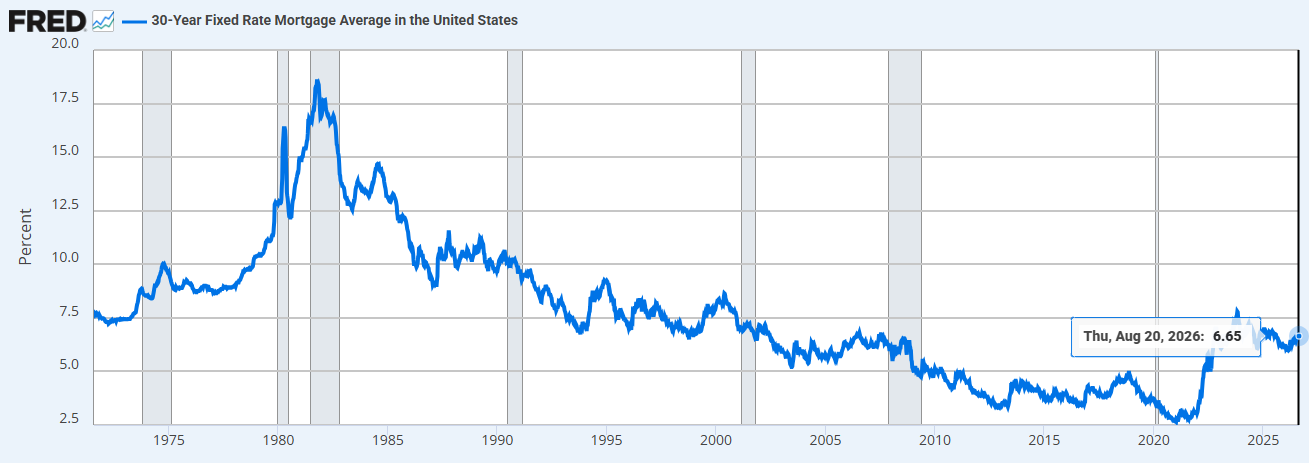
Image source: Freddie Mac via Federal Reserve Bank of St. Louis.
As they've been rising over the past three years, the market has largely stalled. However, it's not clear that rates are going to come back down anytime soon; the Federal Reserve is expected to hike interest rates again as inflation remains stubbornly high.
There are some signs of a rebounding housing market as the high rates drag on and potential homebuyers see no light at the end of the tunnel. According to the latest housing data, the real value of homes fell in June as inflation outpaced home price increases, and home sales increased 4.5% year over year.
Image source: JPMorgan Chase.
How Greg Abel and Berkshire Hathaway are playing this
Berkshire Hathaway has been planning for a housing rebound since the peak highs in 2023, when it invested in D.R. Horton, NVR, and Lennar. It has been buying and selling these stocks since then, and as of the 2026 second quarter, it has small positions in all three, including a renewed tiny position in D.R. Horton of only 3,564 shares.
What was more interesting was the closing of its acquisition of homebuilder Taylor Morrison on July 24. Berkshire paid $6.8 billion for the business, which it will incorporate into its already substantial site-built construction business, Clayton Properties Group. Combined, the homebuilders delivered 23,000 closings in 2025 in 21 states.

NYSE: BRKB
Key Data Points
The market noted that with the purchase, Greg Abel is finally spending some of the company's massive cash pile. It was nearing $400 billion at the end of the first quarter, and it's now down to $365 billion, which is still well above the norm.
Adding another national homebuilder to Berkshire's collection is more than a bet on a housing recovery, though. streamlining operations among the various groups puts more fixed costs to use and can lead to improved margins for the entire business.
There's conflicting data about new construction. Housing starts fell 12.4% in July to 1.24 million when economists were expecting them to fall 6.1% to 1.35 million. However, residential permits were up 5%. While new builder sentiment remains weak, according to The National Association of Home Builders, this move can alleviate some of the margin pressure associated with higher construction costs while it expands Berkshire's dominance in this arena.
JPMorgan Chase's play
JPMorgan Chase is the country's largest multifamily lender and residential bank mortgage lender, and it recently announced that it's going to deploy $750 billion through 2035 to "help build or preserve 1,000,000 affordable housing units and help 500,000 customers purchase homes." That's 40% more than its previous commitment, and a strong bet on new housing. It's spreading the investment across "streamlined zoning, building codes, permitting, expanded tax credits, and public-private partnerships."

NYSE: JPM
Key Data Points
High mortgage rates are a double-edged sword for lenders. High rates imply higher payments, but they also slow originations and raise default rates. In the 2026 second quarter, JPMorgan Chase's revenue from home loans increased 3% over last year, the lowest rate of its consumer loan categories.
Investing in more affordable housing, regardless of the housing environment, can help boost originations and lower default rates while maintaining the higher payments, which is the best outcome for the bank. Another benefit would be to boost home construction, and a higher supply could suppress prices and help make home ownership more affordable, leading to a general boost in the housing market. That should in turn boost the bank's home lending business.