With the S&P 500 (^GSPC -0.47%) currently yielding around 1%, investors can find far better income opportunities in individual stocks. Three unstoppable businesses with durable competitive moats yielding 1.6% to 5.5% are Kimberly Clark (KMB +1.31%), FedEx (FDX +0.93%), and Realty Income (O +1.54%). These companies provide products and services people rely on every day, which can support dividends for years to come.

Image source: Getty Images.
Kimberly-Clark: Paying dividends from everyday brands
Consumer staples companies that sell everyday essentials can make excellent dividend stocks. Kimberly-Clark owns Cottonelle, Kleenex, and Huggies, along with other recognizable personal care brands. People buy these products in good times and bad, helping the company deliver steady financial results that can fund a growing dividend.
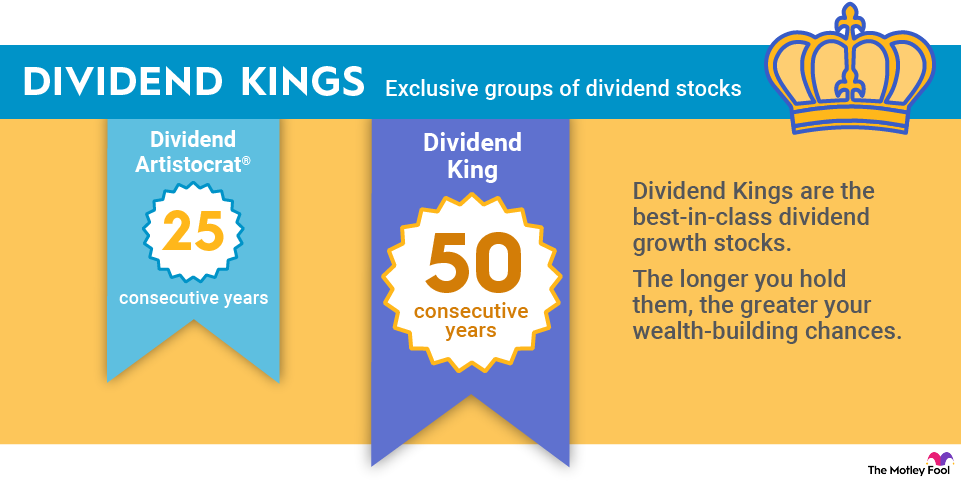
The company's current quarterly dividend stands at $1.28 per share, or $5.12 annualized. That puts the forward yield at about 5.2%. That's attractive for a business that has increased its dividend for 54 years, making Kimberly-Clark one of the elite Dividend Kings that have increased their dividends for at least 50 years.
The dividend has grown at a 3.3% compound annual rate over the past five years. While the payout is elevated -- about 86% of earnings and 92% of free cash flow -- analysts expect earnings to grow at roughly 2% annually in the coming years, which should support the company's dividend-growth streak.
Kimberly-Clark has held up well in a challenging consumer spending environment. It reported a slight increase in sales last quarter despite headwinds in China. The company is also investing in its alternative fiber program, designed to improve product performance, drive long-term growth, and reduce sensitivity to commodity cost swings, thereby strengthening margins and supporting the dividend.
With the stock recently dipping, investors have a chance to buy a high-quality consumer staple at an unusually high yield.

NYSE: FDX
Key Data Points
FedEx: Scale and free cash flow fund growing dividends
FedEx is one of the leading carriers, with a massive scale that helps generate strong cash flow. It produced $5.1 billion in trailing free cash flow on $95 billion of revenue. FedEx pays a quarterly dividend of $1.22, or $4.88 annualized, for an above-average forward yield of about 1.6%. Over the past five years, it has grown the dividend at a 17% annual rate, and given its relatively low payout ratio of 27% relative to free cash flow, it has plenty of room to grow it.
FedEx operates in a competitive industry, but its moat comes from its highly efficient global network, which moves roughly $2 trillion worth of commerce every year. Its scale across package sortation, air and ground fleets, and international shipping is difficult and expensive to replicate.
There's also clear momentum. Management expects earnings growth to accelerate in the second half of the year, driven by the consolidation of Express and Ground into a single operation -- an initiative that should be 62% complete by the end of 2026. This initiative can reduce costs and lift margins, thereby supporting continued dividend growth.
Analysts expect earnings to grow at a 11% annualized rate in the coming years. With a reasonable forward price-to-earnings multiple of about 17.5x, the stock's valuation and dividend profile could make FedEx a rewarding long-term holding.

NYSE: O
Key Data Points
Realty Income: Paying monthly dividends for 57 years
Realty Income is a quality real estate investment trust (REIT) that has paid a monthly dividend for 57 consecutive years and increased its dividend for 29 years. The current monthly payment is $0.2715 per share, or $3.26 annualized, bringing the forward yield to about 5.5%. And that dividend has grown at a 2.9% annualized rate over the past five years.
The company owns a diversified portfolio of about 15,500 properties across all 50 states, the U.K., and eight other European countries. Its dividend record reflects disciplined underwriting -- management focuses on acquiring properties that meet return targets and are positioned to benefit from secular tailwinds that can support durable cash flows.
Right now, management sees opportunities in digital infrastructure and industrial demand. On June 30, it announced a $6 billion data center joint venture with Cloud Capital. Management believes the investment can produce attractive long-term returns as demand for data center capacity continues to outpace supply.
Year to date, adjusted funds from operations are up 5% year over year, and portfolio occupancy is near 99%. With a long history of paying (and steadily increasing) monthly dividends from a diversified property base, Realty Income looks positioned to continue rewarding long-term income investors.