The stock market has once again proven its resilience. Nothing it seems can derail this bull market, not sticky inflation, nor geopolitical conflict, nor fears of AI (both as an investing bubble and a threat to humanity, nor rising oil prices, nor even the Fed's first interest rate hike in three years.
The S&P 500 (^GSPC -0.12%) has risen by double digits in 2026, and if the gain holds, this will mark four straight years of double-digit returns, a streak the index hasn't pulled off since the late 1990s.
That said, if one time-tested valuation metric is any guide, the market may be more vulnerable than it looks.
The market's valuation is close to dot-com bubble territory
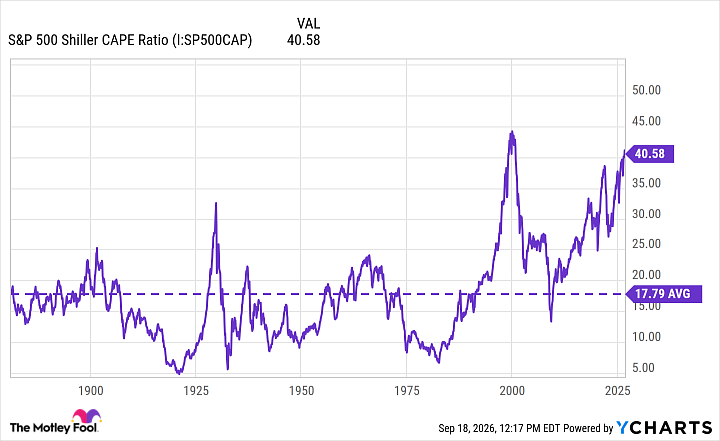
The S&P 500 Shiller CAPE Ratio is a nifty metric that gauges how expensive the broader market is relative to its long-term earnings. It doesn't predict market crashes. But when it reaches a certain extreme, it could be a warning that future returns will be harder to get. The average CAPE is about 18, and right now it is above 40.
Data by YCharts
It's worth noting two periods on the chart above. In the late 1920s, the CAPE figure rose quickly in a short period, before peaking in 1929. Something similar happened in the late 1990s, when the CAPE peaked at 44. Both periods were punctuated by two of the worst market crashes in history.
Since late 2022, the CAPE has been marching upward. Although that doesn't mean a crash is imminent, it does make the broader stock market the most expensive we've seen since the dot-com era. There's far less room for disappointment; in effect, there could be more volatility if expectations aren't met.
Image source: Getty Images.
How investors can prepare themselves for what comes next
If history repeats itself, then today's lofty valuation could mean that a bumpy road lies ahead. The market may not crash, but a correction or pullback seems likely. That doesn't mean sell everything and wait for the crash to be over. Timing the market is virtually impossible, and investors who try often end up with weaker returns than if they'd simply stayed invested.
That's why the best thing investors can do right now is to stay put. Most investors will live through several bear markets in their lifetimes, and though they are never easy emotionally, they never last long enough to derail a long-term investing plan. Bull markets, according to research by Charles Schwab, last, on average, 1,866 days and see the S&P 500 rise by 180%. In contrast, bear markets last just 409 days and see a 36% loss.
If you want to do some normal maintenance right now-- rebalance your investments, or diversify -- that's fine. But liquidating in anticipation of a bear market that might take longer to emerge isn't necessary. It might sound like lazy advice, but sometimes the wisest thing an investor can do is simply nothing at all.