Since spinning off from Western Digital in February 2025, Sandisk (SNDK -0.61%) has become one of the biggest beneficiaries of the artificial intelligence (AI) infrastructure boom. Over the past year, Sandisk stock has soared 1,100%. In 2026 alone, its gain of 570% makes it the second best performer in the Nasdaq-100.
Yet despite its extraordinary price appreciation, Sandisk trades at a modest valuation. With memory shortages potentially extending through 2028, could Sandisk's valuation actually be too conservative?
Image source: The Motley Fool.
How the memory shortage is benefiting Sandisk
Sandisk specializes in NAND flash memory, a technology used to power solid-state drives, smartphones, computers, and storage systems. While Nvidia GPUs receive most of the attention surrounding AI chips, the enormous amounts of data generated by those accelerators must be stored somewhere. That's creating a powerful tailwind for storage suppliers.
During its late September earnings report, Micron Technology indicated that memory supply bottlenecks could persist through 2027 and 2028. This commentary aligns with Sandisk's management, which has previously highlighted how strong customer demand is limiting supply.
So far, the memory boom has made a dramatic financial impact on Sandisk. The company generated $20.3 billion in revenue during fiscal 2026, representing 175% year-over-year growth. Meanwhile, Wall Street expects fiscal 2027 revenue to approach $49 billion, more than doubling again. For a historically cyclical industry, these are encouraging growth numbers.
SNDK Sandisk
NASDAQ · As of 4:00 PM ET 10/15/26

Sandisk's valuation still has room to expand
Wall Street expects Sandisk to generate approximately $215 in earnings per share during fiscal 2027. At a share price around $1,585, that translates into a forward price-to-earnings ratio of just 7.4. That looks inexpensive given the company's explosive revenue and profit growth.
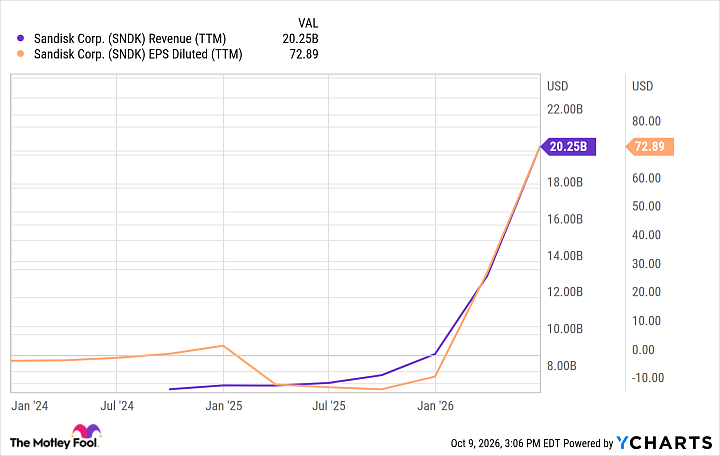
SNDK Revenue (TTM) data by YCharts
It's important to note that memory manufacturers have historically traded at lower multiples because their profitability is more sensitive to supply and demand dynamics. When memory prices fall, earnings can erode surprisingly quickly.
But what if this AI-driven cycle is different? If AI infrastructure demand continues accelerating while NAND production remains constrained, Sandisk should enjoy unusually strong earnings for several years. This is what makes the company's shift toward multi-year customer agreements so savvy, as they provide more predictable revenue and earnings potential. In turn, growth investors could begin to assign Sandisk stock a higher valuation multiple.
Where could Sandisk stock trade by December?
In a downside scenario, investors may become concerned about weakening NAND prices or an eventual supply glut. If Sandisk were to trade at 5.5 times projected earnings, shares could retreat toward $1,182, representing about 25% downside to today's prices.
What I think is most realistic is Micron's supply outlook will prove accurate following Sandisk's upcoming earnings report on Oct. 29. At that time, investors could become more comfortable expanding the multiple. At nine times forward earnings, Sandisk would trade at approximately $1,935, implying 22% upside.
In a particularly bullish scenario, Sandisk's guidance could trigger both upward earnings revisions and multiple expansion. At 11 times projected earnings, Sandisk could approach $2,365, representing roughly 49% upside.
All told, I see a reasonable path toward $1,900 by year's end. Smart investors understand that Sandisk's modest valuation profile could reflect peak-cycle earnings rather than a genuine bargain. Nevertheless, secular tailwinds suggest Sandisk will continue benefiting from AI infrastructure demand and constrained memory supply. Against this backdrop, Sandisk looks like a compelling semiconductor stock to buy and hold as AI infrastructure continues to accelerate.