Progressive (PGR +1.41%) is one of the largest insurance companies in the U.S., and while insurance companies aren't typically known for being growth stocks, Progressive stock has turned $10,000 into $90,000 over the past 10 years. That's double the S&P 500's return over the same time.
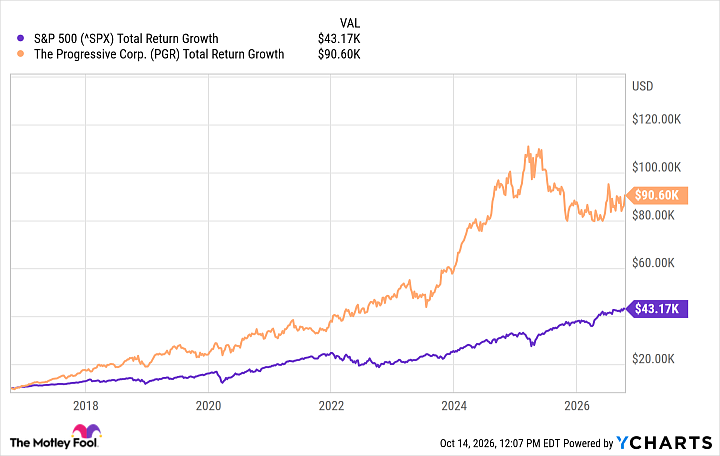
Progressive stock fell 7% after its third-quarter report on Wednesday, but it has a dominant position in U.S. insurance. Let's take a look at the business and whether or not it can still achieve high growth over the next 10 years.
A major player in U.S. insurance
Progressive has a massive insurance business with auto insurance at the center, but it also offers multiple kinds of policies, including property and casualty. According to the National Association of Insurance Commissioners, it's the second-largest auto insurer in the country, with 18.6% of the market. However, other research points to it moving into first place.

Image source: Getty Images.
Progressive has flourished over the past 10 years through a largely strong economy that's been beneficial for its business. It has a target combined ratio of 96%, and it has beaten it every year over the past decade. The combined ratio combines the loss ratio, or how much the company pays out as claims, and the expense ratio, which measures how much of revenue goes to expenses.
The lower the better, and under 100% implies that the company is profitable. It came in at 87.4% in 2025, coming after what management called its "most successful year in the history of Progressive" in 2024. It was 88.7% in the third quarter, 0.8 percentage points lower than last year.
Insurance companies rewrite their policies all the time based on algorithms that account for natural disasters, consumer behavior, and all sorts of other factors that are constantly changing. After the beginning of the pandemic, insurance companies had to rewrite policies to catch up to changing dynamics, and with the following inflation, rising costs. That led to the recent outstanding performance.
However, it's not so easy to keep surpassing its high levels, which has led to a recent decline in the stock price.
PGR Progressive
NYSE · As of 2:39 PM ET 10/15/26

Is progressive a good value?
Management says that it recently slowed growth to address profitability issues. Having both problems at the same time hasn't been good for its stock, but it could be a buying opportunity. Progressive shares trade at a trailing P/E ratio of under 11 and a price-to-book value ratio of 3.5. Its book value is much higher than it was 10 years ago, while its P/E ratio is lower. Both are lower than their 10-year averages.
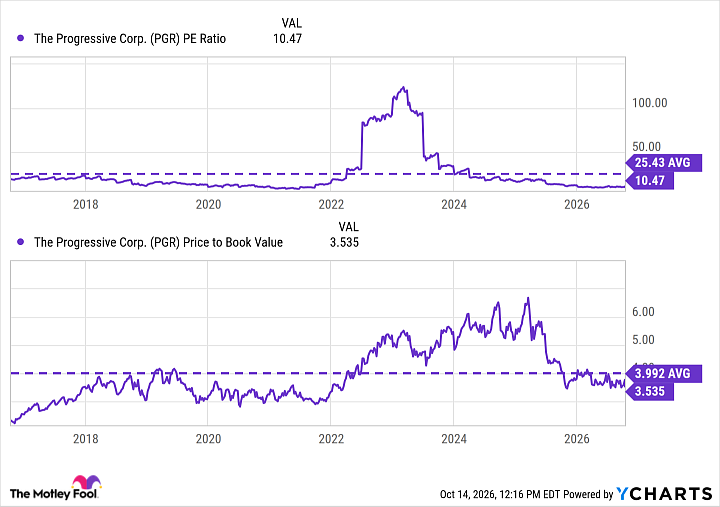
PGR PE Ratio data by YCharts
The current lower price could present a value for investors. However, its decline may not be over while the issues are still being addressed. At the same time, it sees a huge addressable market in new customers who have longer lifetime values, and its track record as a well-established industry giant can boost investor confidence.
It may not have bottomed out yet after another decline on third-quarter earnings, but you can't time the market, and this could be a good time to buy before it heads back up. It's both a value and a protective stock, which could cushion your portfolio if there's a market correction on the way,