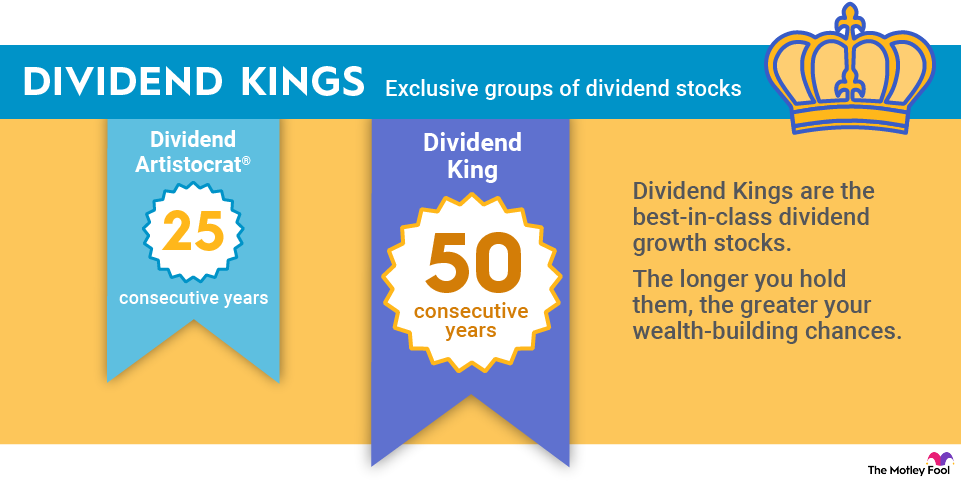
Black Hills (BKH +1.00%) is a regulated utility with an impressive 56-year track record of dividend growth. This makes it a Dividend King, or a company that has raised its payout for 50 consecutive years or more.
Regulated utilities have historically been a sleepy part of the stock market because of their low volatility and stable cash flows, but lately they have been making headlines for long-term agreements with major technology companies. On Oct. 6, Black Hills announced multiple agreements with Alphabet's Google to provide energy infrastructure and services for its hyperscale data center campus in Cheyenne, Wyoming. The agreement runs through 2048 and builds on Black Hills' position as the region's top energy provider for hyperscalers.
Here's what investors need to know.
Image source: Getty Images.
Breaking down Black Hills' deal with Google
As part of its arrangement with Google, Black Hills will deliver 2.7 gigawatts (GW) of power for Google's data center campus. This includes 590 megawatts (MW) of utility grid-connected service and another 2.1 GW of privately managed, third-party-contracted resources operating as an off-grid microgrid, and boosts Black Hills' position in the region.
Energy services are projected to begin in late 2027 and ramp up to peak operational load by 2030. At that point, Black Hills projects the deal will deliver $150 million in annual net income and $2.4 billion in unlevered free cash flow through 2048.
Under the deal, Black Hills will invest $1.8 billion in capital expenditures to build 564 MW of natural gas power generation between 2027 and 2029. Google provided $399 million in refundable advances for long-lead equipment procurement, which Black Hills plans to reimburse by next year.
BKH Black Hills
NYSE · As of 4:00 PM ET 10/16/26

Wyoming is emerging as a data center hub
The move helps Black Hills build on its strong regional position. It operates across eight states, including Wyoming, Colorado, Montana, and South Dakota. Cheyenne, Wyoming, has emerged as a data center hub thanks to favorable regulatory policies, a cool climate, and major grid investments.
Wyoming Electric has seen peak electric loads grow over two decades since Black Hills acquired the utility, and its system peak reached a record of 439 MW in July 2026, up 16% from 2025.
Black Hills has partnered with Microsoft in Cheyenne for over a decade and continues to build on that collaboration. In April, Microsoft announced it would acquire 3,200 acres in the area for a new data center capacity under the state's Large Power Contract Service (LPCS) tariff. In addition, Meta Platforms is another hyperscaler building a data center in the region, which is scheduled to open in 2027.
What this means for Black Hills' outlook
The influx of hyperscalers into Wyoming is boosting Black Hills, which is evolving from a sleepy, defensive utility to a key energy infrastructure provider for AI data centers in the region. Its baseline forecast (before its Google deal) includes 600 MW of large data center load through 2030, anchored by Microsoft's and Meta's data centers.
Its deal with Google builds on its strong position, and the $150 million in added net income is massive for the company, which had $292 million in net income in 2025. The company is also a strong dividend stock, with 56 years of raises and a 3.6% yield.
As Wyoming's data center market grows and energy demand surges, Black Hills stands out as an appealing utility stock to capitalize on this growth.