With incredible gains of 350% over the past year, shares of Micron Technology (MU +2.46%) have easily outpaced the 68% jump in the PHLX Semiconductor Sector index. However, Micron stock has been in the doldrums of late, sliding 25% from the 52-week high it reached in June this year.
Micron's pullback is driven more by broader market sentiment than by the company's financial performance. Investors have been booking profits in Micron stock amid concerns about the viability of the huge investments in artificial intelligence (AI) infrastructure due to higher interest rates. So, I won't be surprised if Micron management opts for a stock split to boost investor confidence.
Let's see why a stock split could be beneficial for this memory specialist.

Image source: Micron Technology.
Here's why Micron could opt for a stock split
The last time Micron management undertook a forward stock split was in 2000. However, the stock's phenomenal rally in recent years could encourage management to make such a move once again. That's because a forward stock split will lower Micron's share price while increasing the number of outstanding shares, making the stock more accessible to a wider investor pool.
MU Micron Technology
NASDAQ · As of 4:00 PM ET 10/23/26

So, while a stock split is simply a cosmetic move that doesn't change a company's fundamentals or prospects, a lower share price can spur demand for a stock and favorably impact its price. With each share of Micron now trading at around $900, the time seems ripe for management to go for a stock split.
However, if your brokerage allows you to buy fractional shares, or you have enough cash to purchase Micron stock, doing so could be a profitable move for the long run. That's because the memory market is poised to keep growing at a steady pace over the long run, driven by strong demand from data centers, smartphones, and personal computers (PCs).
Micron remains a buy irrespective of a stock split
Micron trades at just 13 times earnings. The iShares Semiconductor ETF, which tracks the semiconductor industry, has a price-to-earnings ratio of 45. That's a massive discount considering that Micron's earnings per share (EPS) are expected to jump nearly 134% in the current fiscal year to $176.55. What's more, analysts have increased Micron's EPS targets for the current and the next two fiscal years over the past three months.
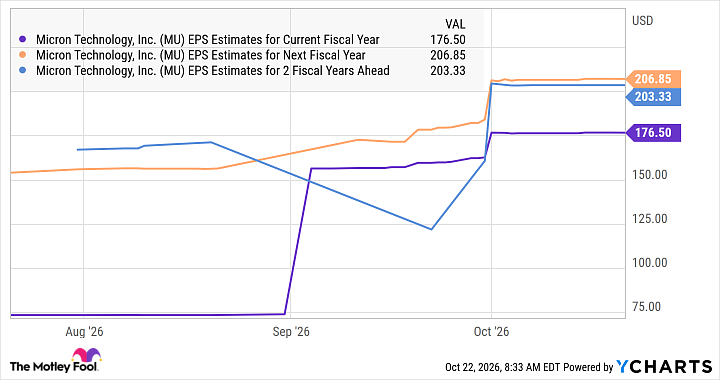
Data by YCharts
As a result, Micron stock could regain its mojo and soar higher. In fact, the stock's 12-month median price target of $1,550 implies 70% upside from current levels. Even better, 53 of the 57 analysts covering Micron rate it as a buy.
Given that the global memory market's revenue is expected to jump from $889 billion in 2026 to $1.28 trillion next year, according to TrendForce, I won't be surprised to see Micron delivering the impressive gains that Wall Street is anticipating from it.
After all, Micron is a key player in the global memory market, controlling nearly a quarter of the dynamic random-access memory (DRAM) space and 15% of NAND flash memory, according to Counterpoint Research. So, investors looking to buy a top growth stock trading at an attractive valuation can consider adding Micron to their portfolios, regardless of a stock split, given its strong growth prospects.