Investing in growth stocks can be a powerful way to build long-term wealth -- but it’s not always a smooth ride. Growth stocks tend to outperform when the market rewards future potential, but they can fall hard when investors grow more cautious.
That’s exactly what we’ve seen in recent years. Growth stocks surged in 2025 (the S&P 500 Growth index gained 21.4% versus 11% for the S&P 500 Value index), but they were crushed in 2022 (down 30% versus 19% for the S&P 500 overall).
The upside is real. So is the volatility. The goal is to invest in growth companies that can keep compounding through good markets and bad, and to build a strategy that helps you stick with them.
What is a growth stock?
A growth stock is a company expected to increase revenue and earnings faster than the broader market (or faster than most peers). Many growth companies win by doing at least one of the following:
- Taking a share of a large existing market.
- Expanding into new markets.
- Creating a new product category altogether.
Because investors are paying for future potential, growth stocks often trade at higher valuations than the average stock. That doesn’t mean they’re “overpriced,” but it does mean expectations are high, and the stock can drop quickly if growth slows.
Why they can be volatile: Growth stocks are especially sensitive to interest rates and inflation because more of their value is tied to earnings expected years in the future. That’s why downturns can hit them harder.
Top growth stocks to consider
| Company name | Company ticker | Market cap | Industry |
|---|---|---|---|
| Meta Platforms | NASDAQ:META | $1.6 trillion | Interactive Media and Services |
| Shopify | NASDAQ:SHOP | $160.4 billion | IT Services |
| Uber Technologies | NYSE:UBER | $150.9 billion | Road and Rail |
| Block | NYSE:XYZ | $35.8 billion | Diversified Financial Services |
| MercadoLibre | NASDAQ:MELI | $84.7 billion | Multiline Retail |
| Nvidia | NASDAQ:NVDA | $4.4 trillion | Semiconductors and Semiconductor Equipment |
| Netflix | NASDAQ:NFLX | $402.4 billion | Entertainment |
| Amazon | NASDAQ:AMZN | $2.2 trillion | Multiline Retail |
| Salesforce | NYSE:CRM | $178.0 billion | Software |
| Alphabet | NASDAQ:GOOG | $3.6 trillion | Interactive Media and Services |
As this list shows, growth stocks come in all shapes and sizes. They can be found in a variety of industries, both within the U.S. and in international markets. Although all the stocks on this list are from larger businesses, smaller companies can also be fertile ground for growth investors.
A great way to invest in a wide variety of small-cap growth stocks is via an exchange-traded fund (ETF), such as Vanguard Small-Cap Growth Index Fund ETF (VBK -0.15%). This fund tracks the performance of the CRSP U.S. Small Cap Growth index, providing investors with an easy way to invest in roughly 560 small-cap growth companies at once.
The Vanguard Small-Cap Growth Index Fund ETF has an ultra-low expense ratio of 0.05%. This means investors will receive almost all the fund's returns, with only a small amount in fees going to Vanguard. (An annual expense ratio of 0.05% works out to only $0.50 in fees per $1,000 invested annually.)
How to find growth stocks
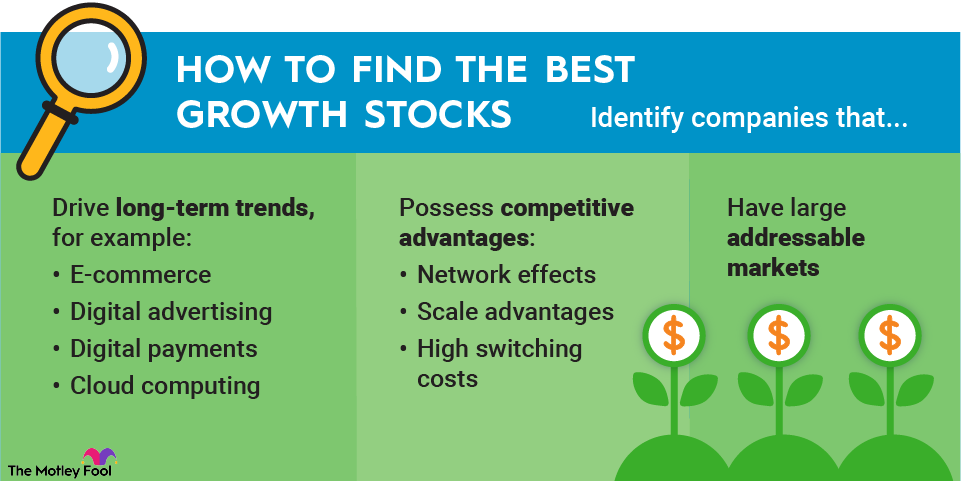
To find great growth stocks, you'll need to:
- Identify powerful long-term market trends and the companies best positioned to profit from them.
- Narrow your list to businesses with strong competitive advantages.
- Further narrow your list to companies with large addressable markets.

Identify trends and the companies driving them
Companies that capitalize on powerful long-term trends can increase their sales and profits for many years, generating wealth for their shareholders along the way. Here are some examples, along with the companies that can help you profit from those trends.
E-commerce
As more people shop online, Amazon (AMZN -0.89%), Shopify (SHOP -2.54%), and Etsy (ETSY +0.06%) are well positioned to profit in the U.S. (and many international markets). MercadoLibre (MELI -0.59%) holds a leading share of the online retail market in Latin America. Despite the consistent presence of brick-and-mortar retail, e-commerce still has significant growth potential.
Digital advertising
Meta Platforms (META -3.77%), formerly Facebook, and Alphabet (GOOG -0.56%) (GOOGL -0.42%), which owns Google, control the lion's share of the digital ad market. The businesses are poised to profit handsomely as marketing budgets shift from TV and print to online channels.
Amazon has built a massive advertising business, which continues to expand into new formats. Even Netflix (NFLX +1.15%) has come around to advertising to increase its subscriber base and boost its revenue.
Digital payments
PayPal (PYPL +1.22%) and Block (XYZ -0.18%) are helping accelerate the global shift from cash to digital payment forms by allowing businesses of all sizes to accept debit and credit card transactions and giving consumers easier access to cashless payments.
Cloud computing
Computing power is migrating from on-premises data centers to cloud-based servers. Amazon and Google cloud infrastructure services help make this possible, while Salesforce (CRM -3.44%) provides some of the best cloud-based enterprise software available. Artificial intelligence (AI) will require vast amounts of computing power that cloud providers are ready, willing, and able to offer.
Streaming entertainment
Millions are canceling their cable subscriptions and replacing them with less expensive and more convenient streaming options. As the global leader in streaming entertainment, Netflix offers a great way to profit from this trend, but it faces growing competition from other media companies.
Electric and autonomous vehicles
The world is shifting from reliance on gasoline to electricity for vehicle power. According to a survey of industry executives, half of all auto sales could be electric vehicles (EVs) by 2030.
Tesla (TSLA -0.88%) has been the leader in the space, with its lineup of vehicles and battery technology. The Chinese company BYD (BYDDY -0.89%) has ascended rapidly to become the world's leading EV maker, thanks to its low-priced vehicles. Both EV makers have also made significant progress in developing self-driving technology for their cars.
However, Alphabet's Waymo has a clear lead in the space, offering a commercial service in several U.S. cities and completing more than 400,000 rides per week. Uber (UBER +0.51%) has emerged as a key partner for autonomous vehicle companies looking to deploy their fleet and maximize their capital utilization. It could be a hidden beneficiary of the growing number of self-driving cars on the road.
Artificial intelligence
Companies have recently poured billions into accelerating their AI development and applying it to their businesses. Nvidia (NVDA -1.56%) has been a major beneficiary, as it designs the chips used to train many large language models, the foundation of generative AI.
Alphabet, Amazon, Microsoft (MSFT -1.57%), and Oracle (ORCL -2.54%) also benefit from growth in AI applications since many run on their cloud computing platforms. Salesforce is leveraging its position in enterprise software to help companies use their own data to create AI-powered agents.
The key is to invest in these trends and companies as early as possible. The earlier you get in, the more you stand to profit. However, the most powerful trends can last for many years -- even decades -- giving you plenty of time to claim your share of the profits they create.
Prioritize companies with competitive advantages
It's also important to invest in growth companies that possess strong competitive advantages. Otherwise, their competitors may pass them, and their growth may not last long. A strong competitive advantage will help companies survive and thrive through market downturns, while those without one will struggle.
If you can identify stocks of companies with strong competitive advantages being sold off along with the rest of the market, it can be an opportunity to generate massive returns as they recover. Some competitive advantages are:
- Network effects: Meta's Instagram is a prime example here. Each person who joins the social media platform makes it more valuable to other members. Network effects can make it difficult for new entrants to displace the current market share leader. Meta's 3.5 billion users across its family of apps certainly make it unlikely that a new social media company will displace it.
- Scale advantages: Size can be another powerful advantage. Amazon is a great example in this category because smaller rivals will find it extremely difficult to replicate its massive global fulfillment network.
- High switching costs: Switching costs are the expenses and difficulties associated with switching to a rival's product or service. Shopify, an online retail platform used by more than 1 million businesses, is a perfect example of a business with high switching costs. Once a company begins using Shopify as the core of its online operations, it's unlikely to go through the hassle of switching to a competitor.
Find companies with large addressable markets
Finally, you'll want to invest in businesses with large addressable markets and long runways for growth still ahead. Industry reports from research firms -- such as Gartner (IT +3.63%) and Insider Intelligence, which provide estimates of industry sizes, growth projections, and market share figures -- can be very helpful.
The larger the opportunity, the larger a business can ultimately become. And the earlier it is in its growth cycle, the longer it can continue to grow at an impressive rate.
Why invest in growth stocks?
- They have high return potential.
- Less demand for immediate capital returns allows management to invest in the future.
- They can add diversification to your portfolio across market segments and sectors.
- Participate in major economic trends.
- One excellent growth stock investment can make up for a handful that don't work out.
Risks of investing in growth stocks
Growth stocks can offer excellent long-term returns, but there are no free lunches in the stock market. The cost of better returns is greater risk.
Growth stocks generally exhibit greater price volatility. That's partly due to their higher valuations. Any changes in expectations for the future are multiplied by a greater factor when valuations are high. As such, investors need to be able to stomach severe drawdowns in the value of their growth stocks.
Individual growth stocks also hold significantly more risk than individual value stocks. By their nature, growth stocks are less predictable, so an individual investment could face setbacks from poor execution, challenges scaling the business, or another company disrupting its product or market. So, growth stock investors should maintain a portfolio of companies across industries and in different phases of growth.
Strategies for investing in growth stocks
Growth stocks can produce market-beating returns, but they can also quickly drag your portfolio lower. A key strategy to successful growth stock investing is to build a portfolio of stocks based on the opportunities and risks presented by each company you're considering.
If two companies are highly correlated (perhaps they're both highly exposed to growing AI spending), you might reduce your exposure to both stocks while increasing your allocation toward another company that's not related to that industry.
You only need a handful of great growth stocks to build a good portfolio. Each stock you add beyond your best ideas could detract from your long-term returns, but if it has the potential to smooth out the ride, it could be worth owning.
Growth stocks versus dividend stocks
While some growth stocks might pay dividends, growth stocks and dividend stocks usually don't overlap. Here are the key differences:
Growth Stocks | Dividend Stocks |
|---|---|
Fast-growing young companies in evolving industries. | Slow-growing mature businesses in stable industries. |
Reinvest profits in expanding the business and growing market share. | Pay out a large portion of profits as dividends for shareholders. |
May produce little or negative free cash flow as management invests in the business. | Steady and predictable growth in free cash flow over time. |
Higher volatility. | Lower volatility. |
The biggest risk is management's execution on the long-term outlook. | The biggest risk stems from mismanaging capital allocation, leading to a dividend cut. |
Typically trade for high valuations. | Typically trade for low valuations. |
Investors can generate great returns from either type of stock. Understanding what to look for when investing in growth stocks or dividend stocks is key to getting the most from either strategy.
How to manage a portfolio of growth stocks
Not every growth stock you buy will pan out. As such, it's best to start with small positions in multiple growth stocks. If a business's financial performance lines up with your investment thesis, you might increase your position in that stock, as you should now have more confidence in its future growth. However, if you start to see evidence that your thesis was wrong, you should start trimming your position, or possibly exit it altogether.
As mentioned, growth trends can last a very long time, so you should avoid selling a stock too early. However, since growth stocks are more volatile than value stocks, it may be smart to limit your biggest positions to a certain percentage of your portfolio. That way, a big swing in the stock price won't crater your whole portfolio.