ChatGPT is transforming much of the business world -- and the travel industry is no different. You might be surprised to learn there are many ways in which artificial intelligence (AI) is being embraced in the travel and tourism industry.
Travel companies (such as airlines and hotels) use AI to predict customer behaviors (like flight and hotel cancellations). Similarly, booking platforms, like Airbnb (ABNB 0.96%), are tapping into ChatGPT to give travelers better, more personalized advice.
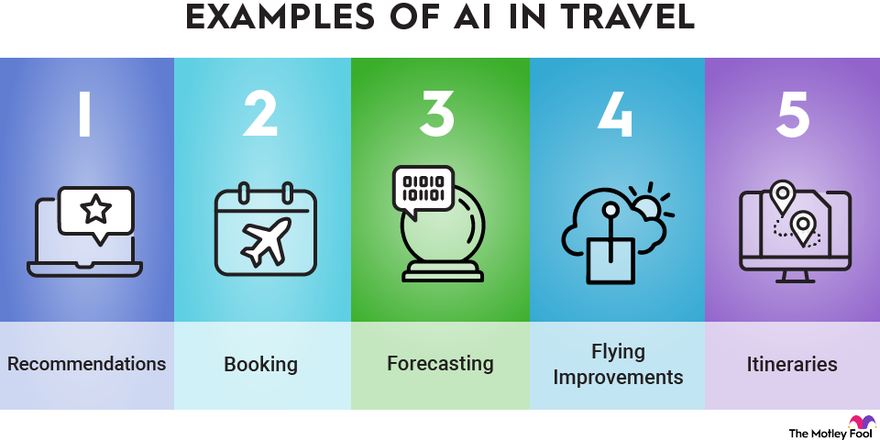
Travel is one of the world's biggest industries and is expected to keep growing as consumers have more discretionary income, remote work allows for more travel, and younger generations tend to prioritize spending on experiences over goods.
Understanding AI
Understanding the basics of AI
Artificial intelligence refers to the ability of computers and machines to do tasks that typically require human intelligence. This can include any form of pattern recognition, including faces and other images readily recognizable to humans.
Machine learning may be the most common form of AI and generally involves computer programs trained with large amounts of data to apply to new data. In the travel industry, this might manifest as recommendations you get on a booking website after choosing a destination. With the launch of ChatGPT, travel companies are also embracing some forms of generative AI to engage with customers and help make recommendations.
Machine Learning
Five uses of AI in travel
Five ways AI is used in travel
Keep reading for a look into how the travel industry is using AI. We'll discuss what AI means in the context of travel, review several AI applications for travel, and look at what's next for AI and the travel industry.
1. AI for recommendations
1. AI for recommendations
ChatGPT has opened a new world of utility in AI and changed how people get information. Unsurprisingly, this has implications for travel because the industry is one of the biggest advertising verticals on Google Search.
On the company's recent earnings call, Airbnb CEO Brian Chesky described his vision for AI at the company, saying it aimed to build the ultimate AI concierge that could give you individualized advice -- unlike chatbots like ChatGPT, which respond to questions the same way no matter who's asking.
Chatbots
Still, getting valuable, personalized advice is one of the most difficult challenges in the travel industry, and being able to do so would give Airbnb a competitive advantage. Airbnb already knows a lot about its guests and hosts, so building an AI travel concierge based on an individual's preference makes sense as an application.
2. AI for travel booking
2. AI for travel booking
The internet disrupted traditional travel bookings, making human travel agents obsolete as travelers elected to book flights and hotels through travel sites like those owned by Expedia Group, Inc. (EXPE 0.03%). However, AI could provide the next advance in travel bookings. Chatbots and AI assistants are now being deployed through social media sites like Facebook Messenger, Skype, and WhatsApp.
Larger online travel agencies, like Booking.com and Expedia, are also starting to use chatbots to provide customers with real-time suggestions, such as the cheapest flights available. And other AI apps will build travel itineraries for you based on your interests, budget, who you're traveling with, and the purpose of your trip.
3. AI for travel forecasting
3. AI for travel forecasting
Traveling isn't cheap, so it's no surprise that there are plenty of tips for saving money on your next trip. Countless niche websites advise users on when to buy airline tickets to get the best deals.

Hopper, for example, uses machine learning algorithms to predict where airline prices are headed so users know when to buy. Its database uses trillions of historical flight prices to guide its predictions. And other sites, like Kayak, also use algorithms to let users know whether they should buy tickets then or wait.
Hotels and airlines use similar technology to adjust their prices according to demand and better predict customer needs, such as changes in flight plans. Additionally, airlines use AI for predictive maintenance, reducing the risk of mechanical problems.
4. AI to improve flying
4. AI to improve flying
The conventional wisdom on air travel as a consumer experience is that it's consistently worsened over the last year or two. There's generally less legroom, fewer meals, and not as much attention on customer service and accommodating individual requests.
However, AI tools can improve the traveler experience. Few industries are impacted more by the weather than airlines, as flight disruptions can result in millions of dollars in losses. But new sensors, satellites, and modeling are better equipping airlines to deal with erratic weather.
IBM's (IBM -1.28%) Watson AI is one of the programs that can perform this kind of analysis, integrating data from 100 models and incorporating information from 250,000 weather stations worldwide.
5. AI for travel itineraries
5. AI for travel itineraries
The holy grail of generative AI and travel is to have a chatbot assistant plan and book a trip for you with just a few commands. For instance, you could tell it you want to go to Miami for three days and stay at a hotel with an infinity pool, and then tell it to make restaurant reservations and other plans for while you're there.
That vision isn't a reality yet. AI systems must improve to have up-to-the-minute information to make travel bookings at the best prices, but plenty of companies, like Expedia, are working to make this possible. OpenAI has provided much of the initial infrastructure onto which online travel agencies can layer their data. While we're probably years from this sort of feature, it's clear that this is where AI in travel is headed.
Will AI revolutionize travel?
Will AI revolutionize travel?
AI is already opening new opportunities in travel, and the major players are eager to experiment with ChatGPT and other forms of generative AI. Of course, AI can't replace travel, but it can make it easier by allowing for seamless booking and personalized recommendations. Such features will only accelerate the industry's growth as it lowers the barriers to travel, meaning AI is set to be a boon for the industry.
Consider some of the stocks mentioned if you're looking for investment opportunities in AI and travel. You could also check out this list of AI stocks, consider an AI ETF to offer broader exposure, or research other options in the travel industry. Based on the growth of AI in travel, the intersection of the two should present some significant growth opportunities in the coming years.
FAQs
AI in travel FAQs
How is AI changing the world of travel?
AI is quickly leading to a variety of new developments and opportunities across the travel industry. From utilizing AI as a recommendation engine, to travel booking, to improving flights and itineraries, there are a number of ways that AI is set to be a dominant force across the industry.
What are the benefits of AI in travel?
One of the biggest benefits of AI in travel is the increased efficiency for tasks such as booking, inquiries, and customer service. The use of AI across the industry has created an opportunity for customers to quickly identify what it is they want from their trip and resolve any issues that arise throughout the process faster than before.