As the building blocks of modern computing evolve, investors often weigh the giants of manufacturing against the specialists in connectivity. Should you bet on the equipment that makes chips, or the silicon that powers data centers?
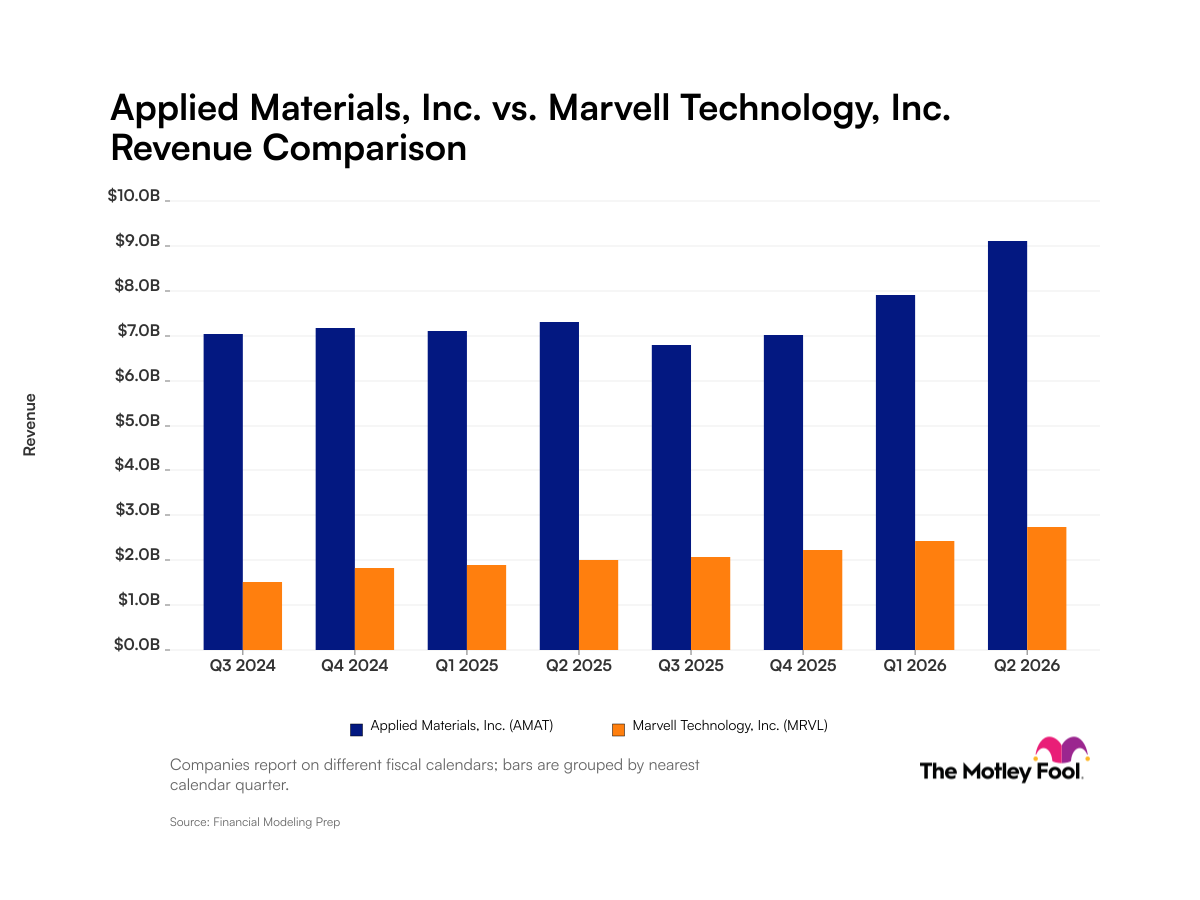
Applied Materials (AMAT -2.13%) provides the essential tools required to fabricate complex microchips, while Marvell Technology (MRVL -3.52%) designs high-speed networking and custom silicon for the cloud. Both companies are critical to the hardware ecosystem, but they offer distinct exposure to the chip market. This comparison explores which stock better aligns with your goals for 2026.
The case for Applied Materials
Applied Materials sells specialized tools and factory automation software to the world's largest chipmakers. The company remains a titan among semiconductor stocks by providing the equipment required to produce advanced microchips. Customer concentration like this adds a layer of risk, as two clients accounted for nearly 19% and 15% of revenue in its latest annual report.
In the fiscal year ended Oct. 26, 2025, revenue reached approximately $28.4 billion, an increase of nearly 4.4% compared with the prior year. Net income was close to $7 billion, yielding a net margin of 24.7%. This steady growth followed several years of rising demand for materials engineering in the chip sector.
As of its October 2025 balance sheet, the debt-to-equity ratio is roughly 0.3, representing total debt divided by shareholder equity. The current ratio, which measures current assets against liabilities, is approximately 2.6. Free cash flow, which is calculated as cash flow from operations minus capital expenditures, was nearly $5.7 billion.
The case for Marvell Technology
Marvell Technology designs and sells data infrastructure semiconductor solutions, focusing on networking and storage. It serves major cloud providers and maintains a long-term partnership with Alphabet (GOOGL -0.63%) (GOOG -0.72%) for custom silicon solutions. Customer concentration is high, as its 10 largest clients accounted for nearly 82% of total revenue in its latest annual report.
In the fiscal year ended Jan. 31, 2026, revenue reached approximately $8.2 billion, representing year over year growth of roughly 42.1%. This performance led to net income of nearly $2.7 billion and a net margin of 32.6%. The surge in demand for AI-optimized data center hardware significantly boosted results compared with the prior fiscal year.
According to Marvell’s January 2026 balance sheet, its debt-to-equity ratio is approximately 0.3, while its current ratio is close to 2.0. Free cash flow reached roughly $1.4 billion. Note that stock-based compensation represented roughly 33.8% of operating cash flow, which inflates reported cash generation since SBC is a non-cash expense added back in the cash flow statement.
AMAT & MRVL: Performance Comparison


Key Financial Metrics
Risk profile comparison
Applied Materials is vulnerable to U.S. export controls, particularly those limiting sales to China. These restrictions can force the loss of market share to rivals like KLA (KLAC -0.06%). Earlier this year, the company settled for nearly $252 million with the U.S. Department of Commerce due to previous export violations. Furthermore, the industry remains subject to historical cyclicality.
Marvell faces risks tied to the sustainability of AI infrastructure spending. If cloud providers reduce capital expenditures or successfully design more of their own chips, the company could lose market share. Competition from giants like Broadcom (AVGO -4.35%) and Nvidia (NVDA -2.94%) remains intense, and reliance on manufacturing partners in Taiwan exposes the business to regional trade tensions.
Valuation comparison
Applied Materials appears more conservatively priced based on its forward P/E and P/S ratio, while Marvell Technology carries a higher premium for its growth.
| Metric | Applied Materials | Marvell Technology |
|---|---|---|
| Forward P/E | 35.4 | 55.9 |
| P/S ratio | 12.7 | 25.1 |
Valuation metrics sourced from Financial Modeling Prep (FMP) and may differ from other data providers.
Which stock would I buy in 2026?
Comparing the stock charts for Marvell and Applied Materials over the most recent five- and 10-year periods, an obvious trend emerges: Up until very recently, they've been trading pretty closely, reflecting the cyclicality of the industry they're in.
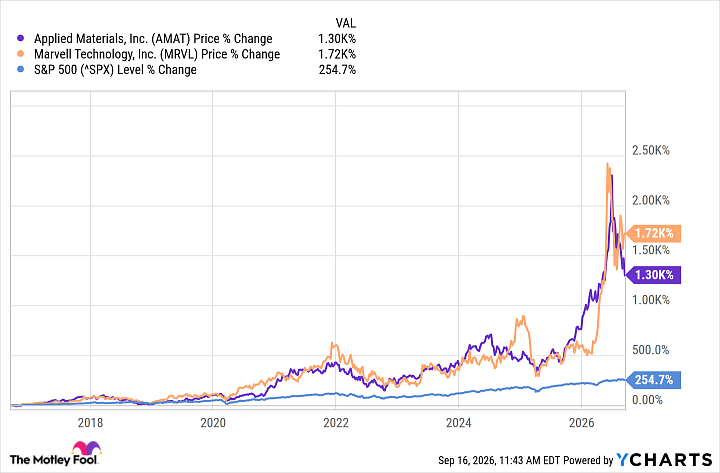
Marvell, in and of itself, is not a terribly attractive investment to me purely because of how much exposure it has to the artificial intelligence boom. For one thing, it faces fierce competition from multitrillion-dollar chip giants like Nvidia and Broadcom. Additionally, the big tech titans have been pouring resources into AI investments, but thus far haven't had a lot to show for it, leading some to speculate they may start pulling back. Any slowdown in that spending (even if it's somewhat circular) would hit Marvell hard.
Applied Materials isn't posting bonkers-level growth, but it's also not as expensive as Marvell, and I think the company is a less-risky bet if you're seeking exposure to the semiconductor industry.