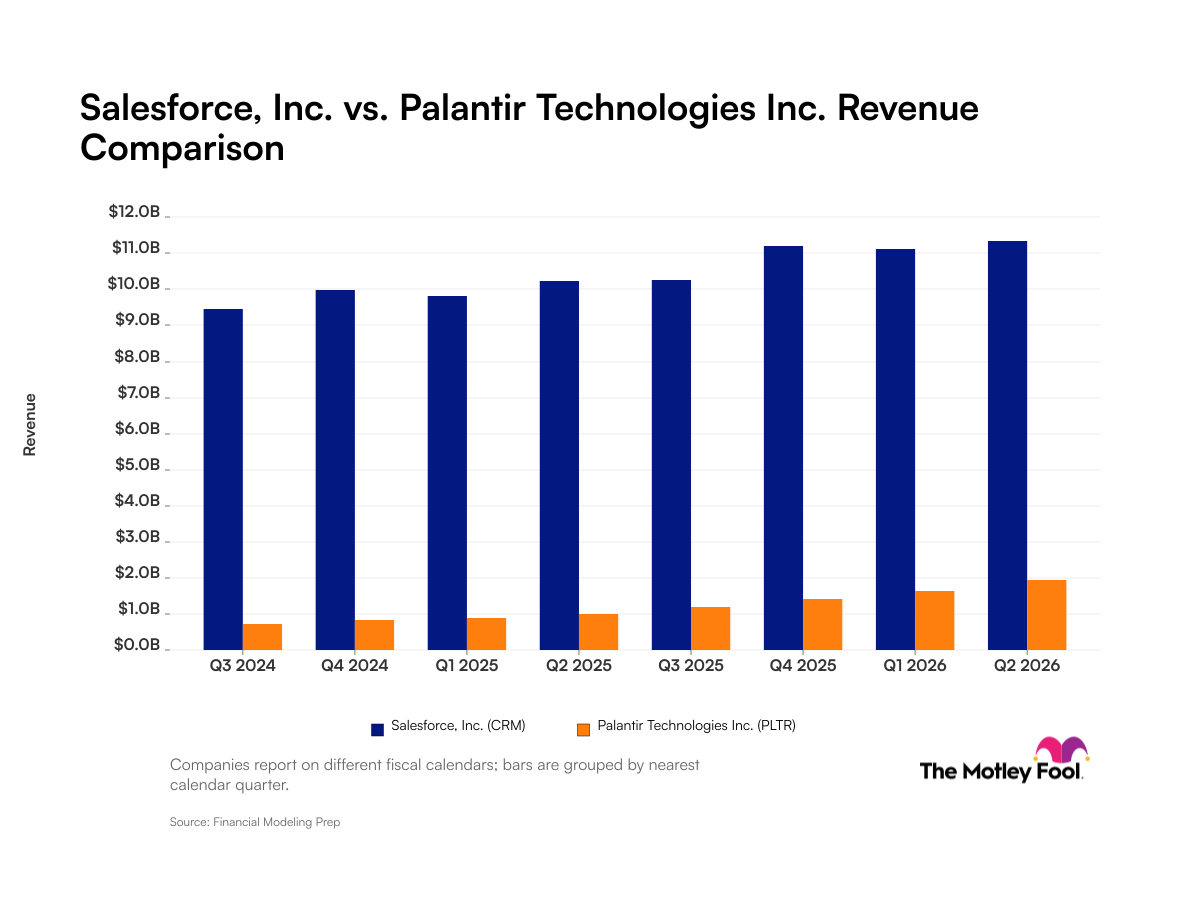
As the software market shifts toward products driven by artificial intelligence (AI), investors comparing enterprise software names may find themselves choosing between Salesforce (CRM -0.84%) and Palantir Technologies (PLTR -0.68%). This comparison looks at which company offers the better balance of value and growth.
Salesforce describes itself as a global leader in customer relationship management (CRM) technology and is now focused on Agentforce, its line of autonomous AI agents. Palantir sells software platforms that governments and companies use to integrate their data and apply AI to daily operations. For investors researching AI stocks to buy, the two companies present very different financial profiles.
CRM & PLTR: Performance Comparison
Key Financial Metrics


The case for Salesforce
Salesforce sells cloud-based software that helps businesses manage customer relationships and sales pipelines. Its annual report for fiscal 2026, which ended on Jan. 31, 2026, lists 83,334 employees and states that the company sells to businesses across almost every industry. On Aug. 26, 2026, Salesforce said annual recurring revenue from Agentforce had passed $1.5 billion. It completed its acquisition of Fin, an AI customer agent company formerly known as Intercom, on Sept. 10, 2026.
In fiscal 2026, revenue reached approximately $41.5 billion, up 9.6% from the prior fiscal year. Net income was nearly $7.5 billion, and net margin rose to 18% from 16.4%. About $1.0 billion in net gains from strategic investments contributed to that improvement, compared with a small net loss on those investments a year earlier.
As of Jan. 31, 2026, Salesforce had about $14.4 billion in total debt and $59.1 billion in shareholder equity, a debt-to-equity ratio of about 0.2x. Its current ratio, which compares current assets with liabilities due within a year, was roughly 0.8x.
The debt picture has changed since then. Salesforce issued about $25 billion in debt in the quarter that ended April 30, 2026, to fund an accelerated share repurchase, and its July 31, 2026, balance sheet shows $39.3 billion in debt against $38.4 billion in equity, a ratio of about 1.0x.
Free cash flow, defined as operating cash flow minus capital expenditures, was about $14.4 billion in fiscal 2026. Stock-based compensation (SBC) equaled roughly 23.4% of operating cash flow, which is worth noting because SBC is a non-cash expense that is added back in the cash flow statement.
The case for Palantir Technologies
Palantir develops software platforms that help organizations integrate their data and operations, and it sells them to government agencies and commercial customers.
Government customers supplied 54% of its 2025 revenue. Palantir also works with other companies that investors follow as tech stocks, including a collaboration with Nvidia (NVDA +1.34%) announced on Sept. 10, 2026, and a global partnership with Fujitsu (FJTSF +0.97%). Its commercial customer count reached 870 for the 12 months ended June 30, 2026, up 26% from a year earlier.
In the fiscal year ended Dec. 31, 2025, revenue reached roughly $4.5 billion, a 56.2% year-over-year increase. Palantir reported net income of about $1.6 billion. Net margin was about 36.3%, up from 16.1% in 2024.
Palantir had no debt outstanding as of Dec. 31, 2025, resulting in a debt-to-equity ratio of 0.0x. Its current ratio at that date was approximately 7.1x, indicating ample liquid assets to cover short-term liabilities. Free cash flow, calculated the same way as for Salesforce (operating cash flow minus capital expenditures), was about $2.1 billion.
Palantir's own adjusted free cash flow, which adds back employer payroll taxes tied to stock-based compensation, was about $2.3 billion. SBC equaled roughly 32% of operating cash flow.
Risk profile comparison
Salesforce competes with established enterprise software vendors and AI-native start-ups in a market that its annual report calls highly competitive. Salesforce and its Slack unit sued Microsoft (MSFT +0.92%) in London's High Court in April 2026, alleging that the tying and bundling of Teams harmed competition.
Microsoft has said the case lacks merit, and the outcome is uncertain. Salesforce must also integrate large acquisitions such as Informatica, which closed in fiscal 2026, and Fin, and it now carries far more debt than it did at the start of the fiscal year. On Sept. 29, 2026, it also agreed to acquire Listen Labs, an AI customer research company, in a deal it expects to close in the fourth quarter of fiscal 2027.
Palantir's annual report flags a limited number of customers that account for a substantial portion of its revenue, with the top three supplying 16% of 2025 revenue, and a sales cycle it calls long and unpredictable.
The company depends on third-party computing infrastructure. It also warns that news coverage or other outside scrutiny of the company or its leadership could harm its reputation. A shareholder lawsuit that a federal court dismissed in April 2025 was still on appeal as of June 30, 2026.
Valuation comparison
Salesforce trades at a much lower forward P/E, which compares the stock price to future earnings estimates, and a much lower P/S ratio, which measures price relative to sales over the past 12 months.
| Metric | Salesforce | Palantir Technologies |
|---|---|---|
| Forward P/E | 14.4x | 85.5x |
| P/S ratio | 4.5x | 71.4x |
Valuation metrics include sourcing from Financial Modeling Prep (FMP) and may differ from other data providers.
Which stock would I buy in 2026?
Salesforce looks like the better buy to me, with the caveat that it's a slower-growing and more indebted company than the fiscal 2026 figures above suggest. On Aug. 26, 2026, management guided for revenue growth of 11% to 12% in fiscal 2027, which ends in January 2027.
By its own math, more than a quarter of that growth comes from the Informatica acquisition. Salesforce also borrowed heavily earlier this year to fund its accelerated share repurchase. Its debt has more than doubled since January and roughly equaled shareholder equity at the end of July. The appeal is the price.
A business that turns about a third of its revenue into free cash flow, at a forward P/E in the mid-teens, leaves room for Agentforce to grow slowly without the investment case falling apart.
Palantir is growing far faster. Its revenue nearly doubled in the second quarter, and on Aug. 3, 2026, management raised its full-year outlook. The catch is a forward P/E ratio more than five times Salesforce's, which leaves the stock with little cushion if growth cools.
Growth rates this high are also hard to sustain as a company gets bigger. I'd rather hold Palantir as a small position in a diversified portfolio than pay that premium for a large one. Even so, a company expanding this quickly with no debt has earned a spot on a growth investor's watch list.