Littelfuse: Evaluating Recent Revenue
Littelfuse (LFUS -0.30%) generates revenue primarily by designing and manufacturing electronic components and circuit protection technologies for various transportation and industrial applications.
It outlined its strategic long-term objectives at a May 2026 investor event, and it reported about an 11% net income margin for the quarter ended March 28, 2026.

NASDAQ: LFUS
Key Data Points
Corning: Evaluating Recent Revenue
Corning (GLW -0.21%) earns revenue largely by producing specialty glass, optical fiber, and ceramic substrates for telecommunications, displays, and vehicles.
While entering a multiyear commercial partnership to expand domestic manufacturing capacity in May 2026, it recorded an approximately 15% EBIT margin for the quarter ended March 31, 2026.
Why Revenue Matters for Retail Investors
Revenue here refers to the data provider's standardized income-statement revenue line item, providing investors with a fundamental measure of the total money a business brings in before any expenses are deducted.
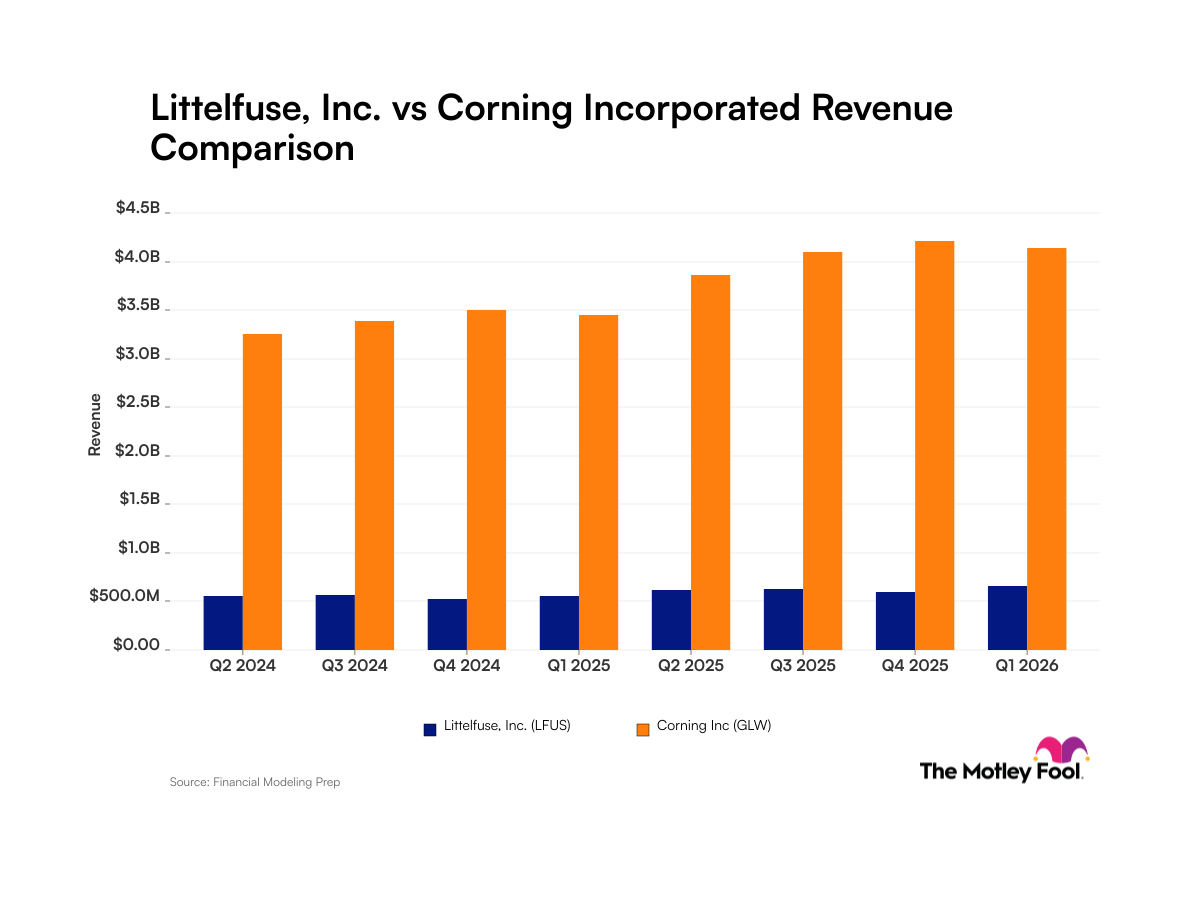
Quarterly Revenue for Littelfuse and Corning
| Quarter (Period End) | Littelfuse Revenue | Corning Revenue |
|---|---|---|
| Q2 2024 (period ended June 2024) | $558.5 million | $3.3 billion |
| Q3 2024 (period ended Sept. 2024) | $567.4 million | $3.4 billion |
| Q4 2024 (period ended Dec. 2024) | $529.5 million | $3.5 billion |
| Q1 2025 (period ended March 2025) | $554.3 million | $3.5 billion |
| Q2 2025 (period ended June 2025) | $613.4 million | $3.9 billion |
| Q3 2025 (period ended Sept. 2025) | $624.6 million | $4.1 billion |
| Q4 2025 (period ended Dec. 2025) | $593.9 million | $4.2 billion |
| Q1 2026 (period ended March 2026) | $657.0 million | $4.1 billion |
Data source: Company filings. Data as of July 13, 2026.
Foolish Take
Revenue figures can give investors a snapshot of a company’s overall financial health, trajectory, and valuation. The data above can tell us a few things. The most obvious is that Corning is a much bigger business than Littelfuse. Indeed, it sports a $134 billion market cap, compared to Littelfuse’s $10.5 billion. Both companies are also growing their revenue: For the time period in question, Littelfuse’s revenue increased by 17.6%, while Corning’s increased by 24%. What’s remarkable about that is that Corning is showing more revenue growth despite being a much larger company.
Corning is benefiting from the current AI data center boom and boasts partnerships with Nvidia, Broadcom, Meta Platforms, and Amazon, in addition to its long-standing relationship with Apple to supply the glass for iPhones. That’s a pretty impressive moat that captures both ongoing stability and current market trends.
Yet Littelfuse posted a revenue gain in Q1, while Corning’s revenue declined. One quarter of reporting doesn’t make a trend, but interested investors may want to do a deeper dive into the companies’ quarterly results for specifics. If Littelfuse can accelerate its revenue growth and continue to close the gap with Corning, it could be a worthy investment, despite its smaller size.
Both Corning and Littelfuse could be affected by cyclicality in the technology, transportation, and industrials markets, which are affected by economic cycles, tariffs, oil prices, and other macroeconomic factors. Investors should consider both companies’ net income margins, which indicate how much of each dollar earned converts into profit after expenses, taxes, and interest. Ongoing and future partnerships will also be something to watch here, as they can give investors visibility into future revenue as well as overall market demand.