

BigBear.ai: Seeking Stability After Earlier Quarterly Revenue Declines
BigBear.ai (BBAI +6.88%) generates most of its revenue by delivering complex artificial intelligence and machine learning decision support tools, focusing heavily on cyber engineering, cloud infrastructure management, and large-scale data processing solutions for a highly specialized client base, particularly the U.S. government.
It recently secured Dutch national regulatory approval for its Pangiam airport security screening software, and it simultaneously launched an expanded generative artificial intelligence platform designed specifically for use by government defense teams operating in classified network environments.
IONQ: Recording Consistent Upward Revenue Trajectories
IONQ (IONQ +9.32%) primarily earns its revenue by constructing general-purpose quantum computing systems and selling commercial access to those computers, facilitating this access both directly and through prominent third-party cloud computing platforms.
It formally finalized its acquisition of the domestic semiconductor foundry SkyWater Technology, while simultaneously launching its sixth-generation commercial quantum computing platform and securing a contract extension for a specialized defense research program focused on developing scalable atomic clocks.
IONQ & BBAI: Performance Comparison
Key Financial Metrics


Why Revenue Matters for Investors
Revenue helps market participants understand the baseline commercial demand for a particular business's core technological products and consulting services over consecutive operating periods. It reveals whether a company is successfully attracting customers and growing its overall business volume over time.
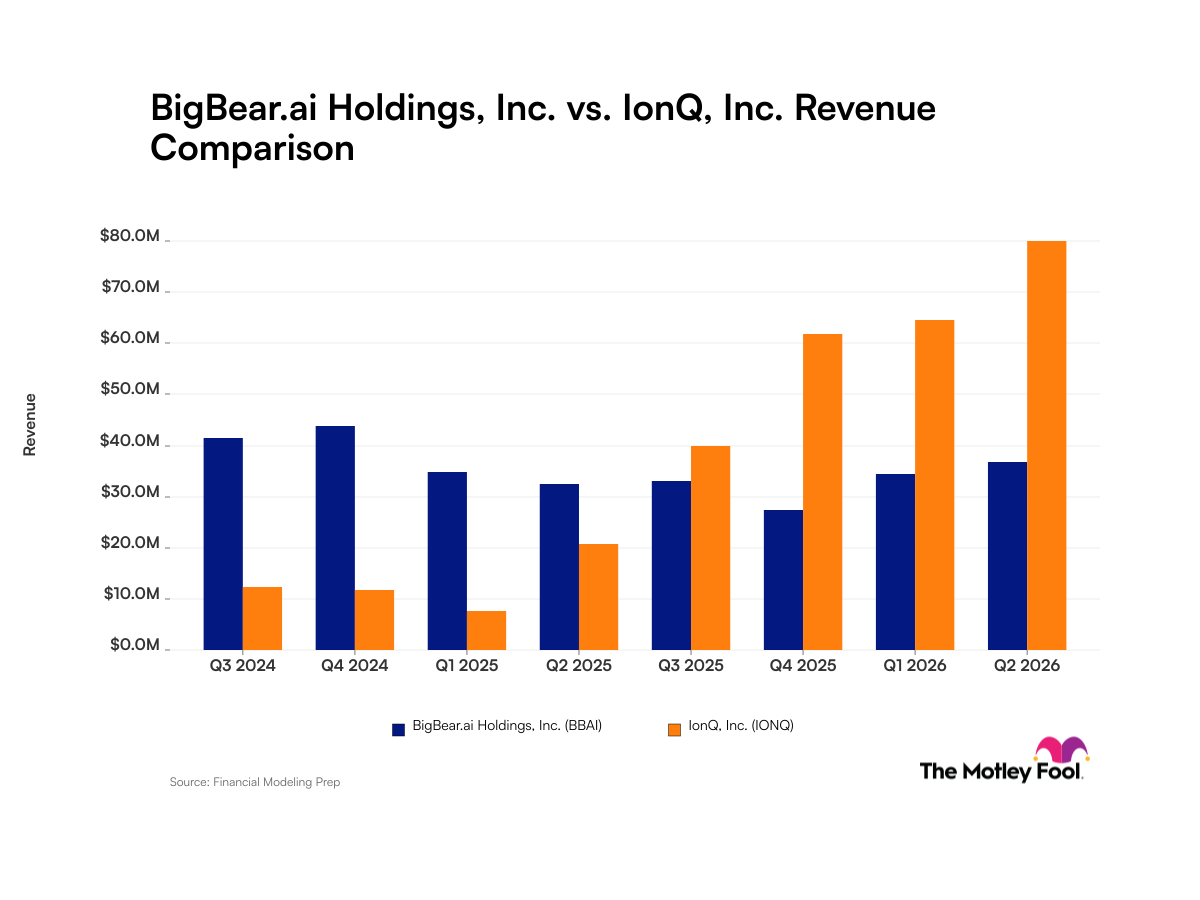
Quarterly Revenue Performance for BigBear.ai and IONQ
| Calendar quarter | BigBear.ai Revenue | IONQ Revenue |
|---|---|---|
| Q3 2024 | $41.5 million (quarter ended Sept. 30, 2024) | $12.4 million (quarter ended Sept. 30, 2024) |
| Q4 2024 | $43.8 million (quarter ended Dec. 31, 2024) | $11.7 million (quarter ended Dec. 31, 2024) |
| Q1 2025 | $34.8 million (quarter ended March 31, 2025) | $7.6 million (quarter ended March 31, 2025) |
| Q2 2025 | $32.5 million (quarter ended June 30, 2025) | $20.7 million (quarter ended June 30, 2025) |
| Q3 2025 | $33.1 million (quarter ended Sept. 30, 2025) | $39.9 million (quarter ended Sept. 30, 2025) |
| Q4 2025 | $27.3 million (quarter ended Dec. 31, 2025) | $61.9 million (quarter ended Dec. 31, 2025) |
| Q1 2026 | $34.4 million (quarter ended March 31, 2026) | $64.7 million (quarter ended March 31, 2026) |
| Q2 2026 | $36.7 million (quarter ended June 30, 2026) | $80.0 million (quarter ended June 30, 2026) |
Foolish Take
Comparing the revenue trends for BigBear.ai and IONQ provide revealing insights. Back in 2024, BigBear.ai's quarterly sales towered over IONQ. This makes sense given the former operates in the hot artificial intelligence sector while the latter focuses on nascent quantum computing technology.
Since then, a dramatic transformation has taken place. IONQ's revenue has taken off. In the second quarter, its sales were more than double BigBear.ai's, and the achievement occurred while quantum computers remain an emerging tech. This illustrates the potential for IONQ's business to soar once quantum machines achieve widespread adoption.
The company is making strides here. On Sept. 23, it announced a partnership with AI semiconductor leader Nvidia, where IONQ's latest quantum computer will connect with Nvidia's AI infrastructure to enable "large-scale quantum supercomputers capable of solving the world's hardest problems," according to IONQ.
Meanwhile, BigBear.ai experienced a year-over-year sales decline in 2025 as the federal government cut budgets. In Q2 of this year, the company reported 13% revenue growth over 2025 due to its acquisition of Ask Sage, an AI platform tailored to the needs of governments.


