The Schwab U.S. Small-Cap ETF (SCHA -0.43%) offers lower costs and broader market coverage, while the iShares Core S&P Small-Cap ETF (IJR -0.31%) provides a more concentrated portfolio with higher liquidity.
Both funds serve as low-cost gateways to the smallest corners of the domestic equity market. While they share similar sector exposures, the primary difference lies in their index strategies.
The Schwab fund casts a wide net across nearly the entire small-cap universe, while the iShares fund focuses on a more selective set of companies that must meet S&P's specific financial viability standards. This distinction affects how each portfolio reacts to market cycles.
Snapshot (cost & size)
| Metric | SCHA | IJR |
|---|---|---|
| Issuer | Schwab | iShares |
| Expense ratio | 0.04% | 0.06% |
| 1-yr return (as of May 7, 2026) | 44.0% | 37.1% |
| Dividend yield | 1.0% | 1.2% |
| Beta | 1.10 | 1.04 |
| AUM | $22.4 billion | $102.9 billion |
Beta measures price volatility relative to the S&P 500; beta is calculated from five-year monthly returns. The 1-yr return represents total return over the trailing 12 months. Dividend yield is the trailing-12-month distribution yield.
The Schwab fund remains one of the most affordable options in the category with a 0.04% expense ratio, which minimizes the drag on long-term returns. Although the iShares fund costs slightly more at 0.06%, it may appeal to income-focused investors because it currently provides a higher trailing-12-month dividend payout compared to its Schwab counterpart.
Performance & risk comparison
| Metric | SCHA | IJR |
|---|---|---|
| Max drawdown (5 yr) | (30.8%) | (28.0%) |
| Growth of $1,000 over 5 years (total return) | $1,380 | $1,320 |
What's inside
The iShares Core S&P Small-Cap ETF tracks a more selective index of 640 holdings, focusing on companies that must meet specific market capitalization and profitability criteria. This focus on "quality" in the small-cap space is reflected in its sector exposure, which is balanced between financial services at 16%, industrials at 16%, and technology at 15%. Its largest positions include Viavi Solutions (VIAV +0.48%) at 0.74%, Sanmina (SANM +0.80%) at 0.71%, and Formfactor (FORM +3.66%) at 0.66%. The fund was launched in 2000 and has paid $1.60 per share in dividends over the trailing 12 months.
In contrast, the Schwab U.S. Small-Cap ETF offers much broader diversification through 1,721 holdings, capturing a wider slice of the total market. Its sector tilts favor technology at 18%, followed by financial services and industrials at 16% each. Its top holdings include Sandisk (SNDK -1.82%) at 4.08%, Lumentum (LITE +0.48%) at 1.53%, and Revolution Medicines (RVMD -0.37%) at 0.64%. The Schwab fund was launched in 2009 and has a trailing-12-month dividend of $0.34 per share. By including a larger number of holdings, it provides exposure to more micro-cap names that the more selective iShares fund might exclude.
For more guidance on ETF investing, check out the full guide at this link.
What this means for investors
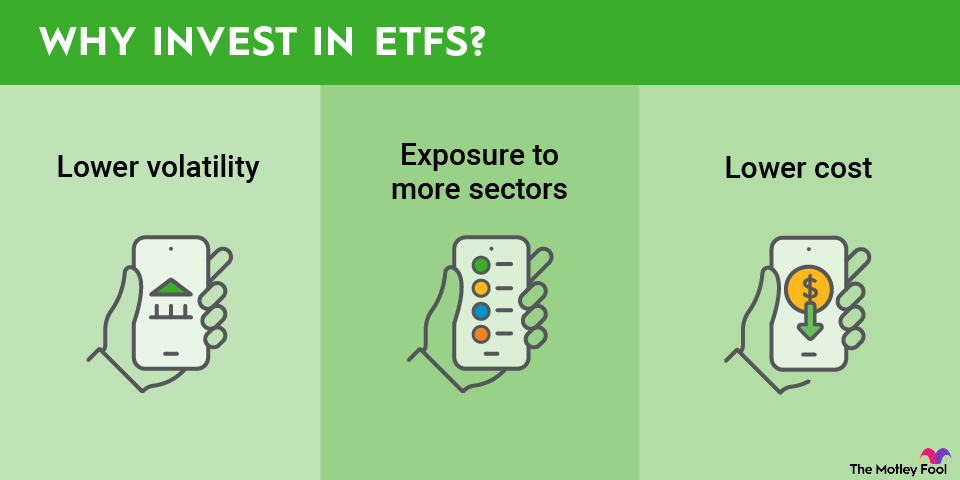
Investing in small-cap stocks is a great way to add diversification to a portfolio and deliver exposure to high-growth companies. Both the iShares Core S&P Small-Cap ETF (IJR) and Schwab U.S. Small-Cap ETF (SCHA) seek to help investors with this. Choosing between the pair comes down to a few factors.
SCHA’s much broader set of holdings, totaling nearly 2,000 equities, is more representative of the small-cap portion of the U.S. stock market. This helped it deliver a greater one-year return. Its share price is also far lower than IJR, with a 2-for-1 stock split performed in 2024 contributing to this.
SCHA’s downsides are its smaller AUM, which means reduced liquidity compared to IJR, and because small-cap stocks are more volatile than larger companies, the ETF’s greater slice of these businesses led to a larger max drawdown and beta. SCHA is better suited for investors who want a fund that’s more representative of the small-cap universe, and are willing to accept the higher risk.
IJR limits its holdings because it screens stocks based on quality filters, such as positive earnings. This lowers the investor risk inherent in small-cap companies, although it means a less diversified portfolio compared to SCHA. IJR also boasts a much bigger AUM, which can appeal to active traders. It is the better ETF for investors concerned with risk and volatility, and are willing to pay a slightly higher expense ratio in exchange for this greater stability.