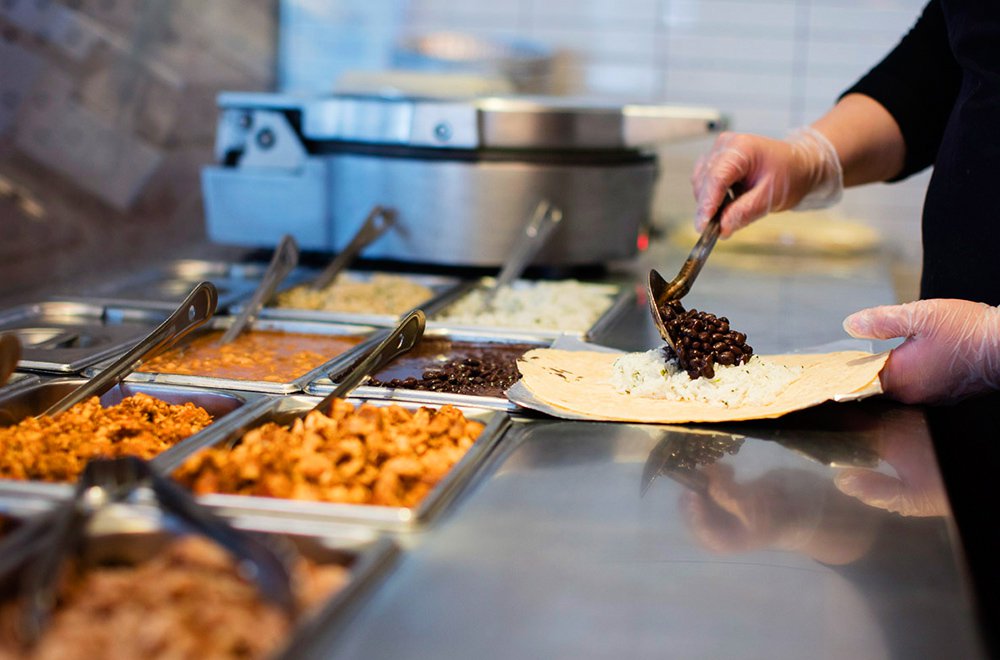
Image source: The Motley Fool.
Date
Wednesday, April 29, 2026 at 4:30 p.m. ET
Call participants
- Chief Executive Officer — Scott Boatwright
- Chief Financial Officer — Adam Rymer
Need a quote from a Motley Fool analyst? Email [email protected]
Takeaways
- Revenue -- $3.1 billion, representing 7.4% growth, driven by positive comparable sales and a return to positive transaction growth.
- Comparable restaurant sales -- Increased by 0.5%, with transactions up 60 basis points and check down by about 10 basis points.
- Digital sales -- $1.2 billion, representing 38.6% of total sales in the period.
- Restaurant-level margin -- 23.7% (adjusted for legal settlements), down 250 basis points year over year; cost increases primarily in beef and freight contributed.
- Adjusted diluted earnings per share (EPS) -- $0.24, a 17% decline year over year.
- New restaurant openings -- 49 restaurants opened, including 42 with Chipotlane, and on target for approximately 350 total openings for the full year, with 80% Chipotlane inclusion.
- Loyalty sales penetration -- Loyalty as a percent of sales reached 32%, up 300 basis points compared to the prior-year period, reflecting higher member engagement and frequency.
- High-efficiency equipment rollout -- Now in over 600 restaurants (250 added sequentially), expected to reach 2,000 by year-end, with installed locations showing 200-400 basis points outperformance in comparable sales.
- Menu innovation impact -- Limited time protein offers and new sauces such as cilantro-lime produced a “few hundred basis points” boost to transactions during promos and sustained partial gains post-campaign per Rymer.
- Share repurchase -- $701 million of stock repurchased at an average price of $36.14, with $1 billion remaining under authorization at quarter-end.
- Cost of sales -- 29.6% of sales, up 40 basis points, mainly from beef and freight inflation, partially offset by favorable avocado and dairy pricing.
- Labor costs -- 25.7% of sales (excluding legal items), increased by 70 basis points, reflecting higher wages and benefits; management expects labor in the low 25% range for next quarter.
- Marketing spend -- Marketing expense rose to 3.4% of sales, up 40 basis points, primarily to support menu innovation and remain top-of-mind with consumers.
- April momentum -- Rymer said, “Part of it was the Easter shift. Easter was about 2 weeks earlier than it was the prior year, but a bigger part of it was the launch of Santer Lime sauce. It's really done an amazing job. It's actually outperforming red chimichurri, which was our most popular sauce up until that point and the incidence is about 2x,” contributing to improved trends.
- Fiscal 2026 guidance -- Same-store sales expected to remain “about flat” for the full year, with Q2 anticipated around +1%; pricing expected in the 1%-2% range for the year.
- Global expansion -- 49 units opened in the U.S. and Canada; added at least one site in Europe with record opening-day sales; new markets in Mexico and South Korea expected this year; Middle East expansion delayed by geopolitical conditions.
Summary
The first quarter marked a sequential return to transaction growth, with positive comparable sales supported by menu innovation, rewards engagement, and operational investments explicitly stated by management. Chipotle Mexican Grill (CMG -3.77%) expanded the rollout of its high-efficiency equipment and digital tools, targeting both cost management and guest experience improvement, and provided detailed updates on loyalty penetration and future menu limited time offers as core drivers. Management highlighted disciplined capital allocation, including an active share repurchase program, and reaffirmed a cautious outlook for the balance of the year given consumer headwinds and inflationary pressures, particularly in commodity and labor costs.
- The new digital makeline interface called Chipotle Kitchen launched in over 100 restaurants and is planned for full fleet deployment by year-end, with management citing early gains in digital accuracy and speed.
- Rymer projected cost of sales inflation in the mid-single-digit percentage for the second quarter, easing to the low to mid-single-digit range in the second half as elevated beef costs are lapped.
- Catering and group occasion programs now represent over 2% of total sales, with pilot expansion into Boston and a broader national rollout targeted for year-end if performance persists.
- Loyalty program overhaul drove a “25% uplift in new members,” with added gamification and rewards flexibility to support sales and engagement initiatives.
- Chief Brand Officer Fernando Machado and Chief Digital Officer Arlie Sisson joined the company to strengthen brand marketing and digital engagement capabilities, respectively, as part of the leadership investment.
- European operations achieved a double-digit margin and a 40% second-year return on investment for new restaurants, with management indicating greater velocity in real estate expansion in key markets such as London and Germany.
- Turnover returned to historical lows in the first quarter following increased attrition in 2025 attributed by management to decreased sales volume and heightened hospitality standards.
Industry glossary
- Chipotlane: Drive-thru or pickup lane format exclusive to Chipotle Mexican Grill units, designed for digital and mobile order convenience.
- Limited time offer (LTO): Short duration menu item or promotion intended to stimulate demand and test innovation.
- Make line: The production counter at fast-casual restaurants where ingredients are assembled to order in front of guests.
- Comp sales / comparable sales: Same-store sales growth metric excluding the impact of new unit openings or closures.
Full Conference Call Transcript
Scott Boatwright: Thank you, Cindy, and good afternoon, everyone. Before we share our first quarter results, I want to begin by recognizing the extraordinary people who bring our purpose to life every day in our restaurants. Last month, we held our all Managers' Conference, bringing together nearly 5,000 restaurant and support center leaders. The energy was incredible as we celebrated their achievements, reinforced our commitment to developing world-class people leaders and sharpened our focus on delivering exceptional food and hospitality. I have seen that same energy in my recent visits with restaurants that are clean, well staffed and run by revenue crew members and executed at a high level with culinary that is outstanding.
This is the standard our guests expect and it is exactly what we intend to deliver everyday across Chipotle. More importantly, it gives me confidence that the work we are doing is taking hold where it matters most, which is in our restaurants. Now turning to our results. Our first quarter performance exceeded expectations, and we are encouraged by the early momentum we are seeing in our Recipe for Growth strategy that is gaining traction and positioning Chipotle to win in any environment. For the first quarter, we delivered revenue growth of 7.4% to $3.1 billion, including positive comparable sales and return to positive transaction growth.
In addition to improvements to in-restaurant execution, this performance was supported by the high protein line, the return of Chicken Al Pastor store and the launch of Cilantro-Lime Sauce, all of which helped drive incremental transactions. We also continue to invest in value for our gas pipe pricing low inflation because we believe reinforcing our value proposition is the right thing to do in this environment. Adam will take you through the financial details, but overall, we are encouraged by the momentum we are seeing, which has continued into April. Our recipe for growth strategy is built around what differentiates Chipotle and where we see the clearest path to stronger restaurant performance and long-term growth.
As a reminder, the five pillars of our strategy include: connecting and strengthening the core by driving operational and culinary excellence to deliver exceptional value for our guests, modernizing our business model with industry-leading technology, including leveraging AI and relaunching our rewards program to elevate the experience for our guests and our teams, evolving the brand messaging and accelerating menu innovation and new occasions that drive demand in our restaurants, cultivating the best talent in the industry, energized and focused on speed and agility and expanding our global reach by scaling with intention to improve company-owned and partner operating markets as well as strategic new regions. Starting with protecting and strengthening the core.
We continue to roll out our high-efficiency equipment package, including the [indiscernible], 3-pant [ rice cooker ] and high-capacity fryer. For crews who are often in as early as 6:00 a.m. to prepare fresh food every day, these tools are a game changer. They help teams complete prep on time and be fully deployed for peak, while also improving the consistency and quality of our culinary and creating more capacity to meet higher levels of demand. The equipment is now in over 600 restaurants, an increase of 250 versus the prior quarter, and we are on track to reach 2,000 by year-end.
For now, we are reinvesting the time savings in the equipment back into our restaurants to strengthen throughput and hospitality. And in markets where it has been rolled out we continue to see benefits translate into hundreds of basis points of improvement in comp sales. Hospitality was a central theme at this year's all-manager conference because we know today's guests are more discerning than ever, and we need to be just as focused on how we make people feel as we are [ on ] the food that we serve. At Chipotle, this means extraordinary food, a clean restaurant, fast and accurate service and fairly teams that make every guest feel local.
As part of this initiative, we are testing a new mystery shopper program to provide an independent view of our operations and validate our efforts. At our all Managers' Conference, we brought our focus on hospitality to life through on-stage competition that recreated the in-restaurant experience using real make lines, real food and guests moving down the line. Each region competed on throughput, accuracy and hospitality, and throughout the competition, we highlight in best practices our leaders could take back in their restaurants. This powerful visual of what rate looks like supports GM Learning in the most meaningful way. I want to congratulate our Mid-Atlantic region, which won the challenge.
More importantly, the energy in the arena of electric and reinforced that our teams came out of AMC energized, ready to execute and committed to providing great hospitality. Turning to our second pillar. We are moving with speed to leverage technology and innovation to improve the experience for both teams and guests. Here are a few examples. First is our new digital makeline display we call Chipotle Kitchen. -- built by Chipotle for Chipotle, it is designed to enhance accuracy, speed and consistency. Unlike our prior text-based display, it uses clear visual cues for ingredients and makes it easier to introduce and integrate new menu items.
This improved interface simplifies execution for our teams and reduces the potential for error during peak demand. It is now live in over 100 restaurants, and we anticipate completing the rollout across all locations by the end of the year. While still early, we are already seeing meaningful improvements in on-time performance, digital order accuracy and customer satisfaction. Second is leveraging AI and our restaurants to further support our teams. Avocado, our AI assistant continues to deliver real benefits by streamlining hiring and freeing up more time for our managers. Now we are expanding [ AVA's ] capabilities to assist our general managers with operational insights, scheduling treat planning and [indiscernible] guidance.
We are also enhancing our facilities capabilities to triage equipment issues more quickly, reducing [ down ] on and improving restaurant performance. These enhanced capabilities received a standing ovation in our all managers conference and we anticipate having them in stage gate at the end of the year. Finally, our zip line pilot for drone delivery is showing encouraging early results, and we plan to expand the pilot for several more restaurants in second quarter. Taken together, these efforts reflect the speed and breadth of innovation happening across the company, all in service of helping our teams perform at their best and give our guests more reasons to choose Chipotle. Moving to our rewards refresh.
We have an all-new look and feel, designed to widen the funnel, deepen our connection with guests and accelerate engagement. In 2025, loyalty ops meaningfully outpaced non-loyalty, reinforcing the power of the platform and the opportunity ahead. This next evolution builds on that momentum through expanded choice increased gamification and enhanced value. One of the [ best ] opportunities to widen the funnel in our in-restaurant business, where only about 20% of transactions are currently linked to rewards compared to nearly 90% of app transactions. This month, we launched an in-restaurant campaign featuring menu panels and QR code signers to make enrollment more seamless and support our goal of driving further engagement.
We also incentivized our team to promote the enhanced program to guests in restaurant. So far, we are seeing strong results with nearly 25% increase in daily [ in ] release. And we are in the process of creating a single scan feature within our mobile app, allowing guests to both earn points and pay in one step further reducing friction. Now shifting to marketing and menu innovation. Our value proposition remains industry-leading and differentiating. Delicious food made with high-quality ingredients, prepared fresh [ using ] classic culinary techniques and served with generous portions of a [ speed ] and price, you can't give anywhere else.
This year, we've increased the cadence of menu innovation, beginning with the high-protein line campaign, which broadened awareness across the full menu and the value we offer. Add-on protein reached nearly 1/4 of all transactions and has remained unleaded, reinforcing Chipotle is the go-to destination for high-quality clean protein. We also recently wrapped up the return of Chicken Al Pastor, the first limited time offerings we plan to launch this year. Our guests were excited to have it back and we saw strong momentum following the launch as it drove incremental transactions.
Last month, we rolled out cilantro-lime sauce which is prepared fresh daily of our stops using chopped jalapenos that are roasted on the [ poncho ] and then blended with cilantro-lime [ sound ] treatment spices to create a creamy, bright soft with citrus and a little bit of a car. It was our first limited time sauce on the make line and the first launched with multiple size options, delivering higher incidents than both Red Chimichurri and a Adobo Ranch. Yesterday, we brought back Chipotle Honey Chicken, fan favorite that delivers a balance of smoky heat from Chipotle Peppers and a touch of sweetness from Pure Honey and is one of the best sellers with the highest order rate.
As we look to the back half of the year, we will have two more LTOs and additional innovation planned around sides and beverages that we feel confident will keep Chipotle top of mind with our guests all year long. Shifting to group occasions. Following encouraging results in our initial Chicago catering pilot, including the launch of a third-party delivery platform, we have expanded the program into Boston. Assuming we continue to see similar guest response and strong execution in the restaurants, we expect to begin a broad rollout toward the end of the year. Build your own Chipotle, our family or group occasion for four to six people continues to resonate with our guests.
Because the occasion has proven highly incremental, we are now testing a sharper pricing architecture and leaning into key marketing moments to build awareness. Today, catering and build-ing-ll Chipotle together represent over 2% of combined sales, yet we continue to believe they could become double-digit percentage of sales over time and a meaningful growth layer for the brand Now to our fourth pillar, our people. We remain focused on strengthening our position as a people-first company by developing world-class leaders and creating opportunities for growth. At the end of the day, our growth story is ultimately a people story. And we continue to see Chipotle change lives in meaningful ways.
At our All Managers Conference, we celebrated a number of inspirational journeys, including one leader who joined Chipotle 17 years ago, looking for a steady job to support her family. He started as a crew member and has developed into a certified training manager. Along the way, she raised her children, built financial stability, including purchasing a home with proceeds for employee stock grants and discover a passion for coaching others. When she talks about why she loves Chipotle, she points to the pride in serving real food she believes in and enjoy in seeing people she train, move into leadership roles. Stories like hers are what makes Chipotle special.
They show that our purpose to cultivate a better world comes to life in a powerful way through serving real food, creating real opportunity and helping grow the next generation of leaders. And because developing strong restaurant leaders is so critical to our success, we remain deeply focused on the general manager role and the pipeline behind it as we improve the role of our GMs and refine our apprentice program. The good news is that general manager turnover remains at historically low levels and stability is at a multiyear high.
Against that backdrop, one of our priorities is ensuring that lunch and dinner each have manager coverage so that our restaurants are positioned to execute at the highest level during the busiest parts of their day. At the same time, we are aligning the apprentice role around a designated focus on hospitality. Our early read shows that this combination is improving execution while also strengthening the bench for the next phase of growth. I want to provide an update on how we are restructuring leadership to support our Recipe for Growth strategy. We are thrilled to welcome Fernando Machado as our new Chief Brand Officer. Fernando is an award-winning globally recognized brand leader.
His experience includes 18 years at Unilever and more than 7 years leading marketing across Burger King, Popeyes and Tim Hortons at Restaurant Brands International, where he helped drive double-digit system sales growth and significant brand value expansion. His proven track record of building iconic brands, driving category-defining innovation and leading customer-centric marketing strategies is exactly what we need as we continue to elevate our brand, deepen guest loyalty, highlight the value of our real food and accelerate our long-term growth. We are also excited to welcome Arlie Sisson to Chipotle in the newly created role of Chief Digital Officer.
Arlie has a strong track record of leading digital, data and loyalty at scale, most recently at Hyatt, where she led a global organization of more than 400 team members and advanced their digital and rewards ecosystem to drive stronger guest engagement and revenue growth. We believe she will play an important role in accelerating our digital platform and strengthening the connection between our guests and our restaurants. Together, this investment in talent will strengthen our leadership team and fuel our strategy. Finally, to our fifth pillar, expanding global access. Starting with our partner-operated restaurants in the Middle East, the well-being of our partners and their teams remain our top priority, and we are grateful that everyone is safe.
Given ongoing geopolitical conditions, we expect some delays related specifically to restaurant openings in the Middle East this year. This may result in fewer partner-operated openings than anticipated. However, our long-term outlook for the region remains unchanged, and we continue to see the potential for hundreds of restaurants in the region over time. Outside of the Middle East, we continue to anticipate partner-operated openings in our new markets in Mexico and South Korea this year, while Singapore will likely open in 2027. In the U.S. and Canada, we opened 49 new restaurants in the first quarter and remain on track to open around 350 for the full year, with approximately 80% including a Chipotlane.
New restaurant economics remain consistent and strong, and we are confident in our ability to reach 7,000 restaurants over time. In Europe, we recently opened a new restaurant at Westfield Stratford, one of U.K.'s busiest shopping destinations, and it delivered our strongest opening day sales in the region's history. We now have 29 restaurants across Europe and anticipate at least one additional opening in Frankfurt this year. Momentum in our European business continued into the first quarter with positive comps across all countries. This performance reflects our ongoing alignment with North American standards across culinary, training, systems and operations.
We are further strengthening our foundation for future growth and continue to believe Europe represents a meaningful long-term opportunity for our company. To close, I want to reinforce the leadership culture that defines Chipotle. Our teams are energized, aligned and ready to execute, and this is showing up in the positive momentum we are seeing in the business. We know what it takes to win, be brilliant at the basics, stay close to our restaurants and guests and deliver exceptional food and hospitality with consistency every day. This is how we strengthen our value proposition and bring our strategy to life one guest, one team member and one restaurant at a time.
I've never been more confident that we have the right team, the right strategy and a very long runway ahead as we continue building Chipotle into a global iconic brand. I will now turn it over to Adam.
Adam Rymer: Thanks, Scott, and good afternoon, everyone. Our first quarter performance is an early indication that our Recipe for Growth strategy has started to translate into real results. We are seeing progress across the initiatives Scott outlined while continuing to manage the business with discipline. Our approach remains clear: reinforce guest value, support transaction-led growth and preserve the long-term strength and flexibility of our economic model. Turning to the quarter. Sales grew 7.4% to reach $3.1 billion, driven by a comparable restaurant sales increase of 0.5%. Digital sales of $1.2 billion represented 38.6% of total sales. Restaurant-level margin adjusted 40 basis points for legal settlement was 23.7%, down 250 basis points year-over-year.
Adjusted diluted earnings per share were $0.24, representing a 17% decline versus last year. And we opened 49 new restaurants, including 42 Chipotlane. As Scott mentioned, our first quarter performance was ahead of our expectations. We saw strength following the high-protein menu launch, the return of Chicken Al Pastor and the launch cilantro-lime. For the whole year, our comp guidance remains about flat. Although we are trending higher than our guidance as our initiatives continue to gain traction, our guidance reflects a conservative outlook given the dynamic consumer environment. As it relates to pricing, we ran just under 1% in Q1 and anticipate pricing will be about 1.5% Q2.
For the full year, we continue to expect it to be in the range of 1% to 2%. Before I walk through the P&L, I want to highlight a few encouraging trends we are continuing to see in menu innovation and rewards. Starting with the menu innovation. Our protein limited time offers typically generate a few hundred basis points of transaction it over the life of the promotion. The biggest benefit occurs during the first few weeks as we see increased frequency as well as more new guests. Also, we sustain part of this comp lift longer term as many of our new guys continue to dine at Chipotle after the limited time offer [ at ].
Sauces are showing a similar path. Beyond the mix benefit, they are effective in attracting new guests and increasing frequency. Taken together, these results reinforce that menu innovation is not simply a short-term sales driver, but a meaningful contributor to building our agent volumes over time and a core pillar of our recipe for growth strategy. And for rewards, we continue to see clear evidence that deeper engagement builds loyalty and drives comps. Loyalty-driven comps have now outpaced non-loyalty comps for several consecutive quarters, and the gap is widening. In the first quarter, loyalty as a percent of sales reached 32%, up 300 basis points versus the first quarter of 2025.
That reflects both growth in active members and higher frequency among existing members, driven by programs like Summer of Extras and the expansion of Free. With the launch of our new rewards features, we are enhancing the benefits our guests already love while working to bring more in-restaurant guests into the program. I will now go through the key P&L line items, beginning with cost of sales. Cost of sales in the quarter were 29.6%, an increase of about 40 basis points from last year. The benefits of lower dairy and avocado prices and menu price increases were more than offset by inflation, primarily in beef and freight as well as higher produce usage.
Relative to our guidance, avocados remained favorable due to better-than-expected crop in Mexico. For Q2, we anticipate cost of sales to step up sequentially to about 30% of sales as the protein mix benefit and modest pricing leverage will be more than offset by higher costs across several items, most notably avocados, dairy and beef. Overall, we anticipate cost of sales inflation to be in the mid-single-digit range in the second quarter and will step down in the low to mid-single-digit range in the second half of the year as we lap elevated beef costs. This results in full year cost of sales inflation of around 4%.
Adjusting for 40 basis points related to non-GAAP legal contingencies, labor costs for the quarter were 25.7%, an increase of about 70 basis points from last year. The increase was driven by wage inflation, lower average restaurant sales volumes and higher benefits expense, including performance-based bonuses, partially offset by the benefit of menu price. For Q2, we expect our labor costs to be in the low 25% range with wage inflation in the low synergy range. Other operating costs for the quarter were 15.6%, an increase of about 120 basis points from last year, primarily driven by higher marketing, utility and delivery costs.
Marketing costs were 3.4% of sales in Q1, an increase of about 40 basis points from last year as we increased our marketing spend in the quarter to support menu innovation and to remain top of mind with our guests. We expect marketing costs to be below 3% sales in Q2 and for the full year. For Q2, we anticipate other operating costs to be in the high 14% range. G&A for the quarter was $204 million on a GAAP basis or $198 million on a non-GAAP basis.
Excluding $3 million related to net restructuring costs associated with our Recipe for Growth strategy and certain legal contingencies and $3 million related to retention and equity awards granted to key executives in August of 2024. G&A also includes $142 million in underlying G&A, $24 million related to noncash stock compensation, $5 million related to payroll taxes on equity vesting and exercises and $27 million related to our All Managers' Conference, which was held in March. We expect G&A in the second quarter to be around $181 million on a non-GAAP basis, which will include $151 million in underlying G&A as we invest in technology and people to support our ongoing growth.
And around $30 million in noncash stock compensation, although this amount could move up or down based on our actual performance. Depreciation for the quarter was $97 million or 3.1% of sales. For 2026, we expect it to remain around 3% of sales. Our effective tax rate for Q1 was 25.4% on a GAAP basis and 25.3% on a non-GAAP basis. For fiscal 2026, we continue to expect our underlying effective tax rate to be in the 24% to 26% range, though it may vary based on discrete items. Our balance sheet remains strong as we ended the quarter with $1 billion in cash, restricted cash and investments and no debt.
During the first quarter, we purchased $701 million of our stock at an average price of $36.14 and at the end of the quarter, we had $1 billion remaining under our share repurchase authorization. To close, I want to reiterate what makes Chipotle a special brand. We are able to invest in the highest-quality ingredients, offer accessible price points and still deliver industry-leading economics, a combination that is very difficult to replicate. Our recipe for growth initiatives further strengthen these advantages by sharpening execution, deepening guest engagement and continuing to build long-term demand for the brand.
With a strong balance sheet, clear priorities and the team energized to win, we believe Chipotle is well positioned to build on that momentum to continue creating long-term value for our guests, our teams and our shareholders. And with that, I feel good up for questions.
Operator: [Operator Instructions] The first question today comes from Danilo Gargiulo with Bernstein.
Danilo Gargiulo: I'd like to start with a quick clarification and then the question. It seems that you have suggested some encouraging trends also in April. So I was wondering if you can help us quantify what you're seeing quarter-to-date in the early weeks. And the real question, maybe, Scott, for you is very exciting that you're hiring Fernando Machado. And I'm wondering what specific elements of his past broad-based QSR experience you're expecting him to bring into Chipotle.
Adam Rymer: Yes, I'll start, and then I'll pass it over to Scott. So Danilo, so yes, it's specific to April, we saw a nice step-up in April. Part of it was the Easter shift. Easter was about 2 weeks earlier than it was the prior year, but a bigger part of it was the launch of Santer Lime sauce. It's really done an amazing job. It's actually outperforming red chimichurri, which was our most popular sauce up until that point and the incidence is about 2x. And then, of course, the rewards relaunch. So we believe all of those things contributed to a nice step-up in April.
Scott Boatwright: Danilo, thanks for the question. As you can imagine, we went on a very comprehensive search for the exact right individual, and we found that in Fernando. And I'll tell you, beyond his deep global brand-building experience, his numerous awards and accolades, what he has accomplished in his career is really unprecedented. And I'll tell you, what I admired most was in my conversations with Fernando, even the earlier conversations we met several times before we made the decision to partner is his thinking of Chipotle, his love for the brand, his affinity for the organization, his love of high-quality fresh food and great culinary.
And he's always been a fan, although be it from a distance of our great brand. And hearing him talk about what he has seen from our advertising historically and where he would take it to the next chapter, if you will, was groundbreaking for me. And so it was an easy decision. Again, he is an incredible marketer, and he will do well here at Chipotle Mexican Grill.
Operator: The next question comes from Lauren Silberman with Deutsche Bank.
Lauren Silberman: I guess if I could just start with -- I know there was a lot of noise during the quarter, I'm going to follow up on the comp side. Any color that you can give in terms of stative trends as you move through the quarter? And really encouraging to hear about the momentum in April. Any color on what your guidance beds for comp in 2Q?
Adam Rymer: Yes. So I'll kind of walk through and then Scott, please add in. And so starting in January, I mean, we caught up on January in the last call. But just to reiterate, I mean, we saw strength in our protein menu and campaign. And it not only drove transactions, but we also saw a double-digit percentage increase in double protein and single tacos. And amazing part about this is it wasn't just during the campaign in January. That increase in double protein and single Tacos has really sustained even through April. And then we saw the weather impact. The weather impact in January was at one point, about half of our restaurants were closed.
So that was about 100 basis points to the quarter. But then as we roll around to February once the weather impact subsided, we really saw our trends improve even further, and that was really around the launch of Chicken Al Pastor. This is the third time that we've had in our restaurants, but the incidence level is actually the highest compared to the first two. So that was really great to see. And then in March, there was a little bit of softening in our trends right around the time where the Iran conflict began, but then we saw the nice step-up in April that I talked about earlier on Danilo's question.
And so when this kind of rolls into April and how we're looking at Q2, we're really anticipating comps probably somewhere in that plus 1% range. And that's kind of what our expense line guidance is based on in my prepared comments. And this comp estimate, I would say, includes a modest increase from Chipotle Honey Chicken, which launched yesterday. But we are excited about the momentum that we're getting so far from our Recipe for Growth initiatives so far this year, but we really just want to remain cautious on our outlook given the dynamic consumer environment. Scott, anything to add?
Scott Boatwright: I think what we should highlight here is what we demonstrated in Q1 was really our ability to engage with our customer base in new ways and drive incremental sales and activate against a broad range of consumer segmentations, whether that's income or age group.
Lauren Silberman: Great. And just a follow-up on loyalty. You talked about loyalty comps outpacing non-loyalty, I believe, in 2025. What kind of growth have you been seeing in membership in recent quarters? And I guess is the revamp of the new loyalty program really focused on bringing in new customers, bringing less customers or trying to drive engagement with the existing membership base.
Scott Boatwright: Yes, I'll jump in here. So the relaunch -- since the relaunch, we've seen about a 25% uplift in new members coming into the funnel. So not only did we widen our main goal was really to enrich our engagement and deepen our engagement with the existing loyalty members. But what we found is we were able to widen the funnel, bring more users into the funnel, reactivate lapsed consumers in a really meaningful way with some of the journeys that we've talked about historically. And we've made great progress of really redesigning a program, removing the friction points that our customers told us existed in 2025.
And the new benefits are obviously the chips & guac welcome offer, 3 monthly Chipotle drops. We heard loud and clear that's what our customers wanted. They want to be able to choose their own rewards. We call it rewards on repeat, and they could choose whatever reward and how they want to use their points. in the loyalty program as well as well as cleaning up some of the UX features that had friction points in them as well. We're able to simplify the in-app experience, so exchange, wallet, extra badges and history are just easier to find and easier to use.
Operator: The next question comes from [ David Balmer ] with Evercore ISI.
Unknown Analyst: I'm just -- I'm wondering how you're thinking about how this year might play out. And one of the things you seem to be saying here is that by doing more frequent LTOs or your protein windows that not only do you get a boost, but that boost sticks around. So the 2-year trend gets a lift each time. And that would certainly imply that with the comparisons we see ahead of you that comp trends would accelerate from here. Is that your base case?
I know you want to be cautious about the underlying environment, but is your base case that seeing what you're seeing in terms of the performance of these LTOs that you will see comps climb through the year if the environment doesn't deteriorate? And I have a quick follow-up.
Scott Boatwright: That's exactly right, David. And so what we learned through our demand map refresh last quarter, I guess, Q4 now is that consumers were looking for menu innovation, and they were screaming for greater innovation at a greater frequency. And we have doubled our cadence of LTO innovation and stage gate processing in our culinary center to solve that challenge, evidenced by what you will see here in 2026. They're also looking for deeper digital engagement, which I think we saw for in the app refresh and relaunch.
And then they were looking for culturally relevant marketing, which we've done some of that in Q1 with a lot of success and expect to do more of that with Fernando joining here in the next couple of weeks. So I think we're targeting the right ways to activate against the core consumer and bring new consumers into our brand.
Unknown Analyst: The other thing I wonder about is how you think about bringing an LTO that was around before, obviously, Chicken Al Pastor and honey chicken, you're bringing them more frequently, but they're familiar. They were successful, but they were stuff that you've done before. I wonder -- to what degree do you feel like doing new, new is going to be more important going forward? Is that something on the horizon? And I'll pass it on.
Scott Boatwright: It absolutely is, David. We have a couple of things that are in process or in test as we speak that are new LTO center-of-the-plate protein items. We have a few more we'll test in the back end of the year that will inform the 2027 strategy. But that's exactly it. We need to come back to tried and true favorites occasionally, not every time and then pepper in new menu items that will drive interest, drive occasion that are on brand and uniquely Chipotle. But that's exactly the strategy.
Operator: The next question comes from Brian Harbour with Morgan Stanley.
Brian Harbour: Adam, can you just talk about the traffic and mix components of same-store sales and kind of what your outlook, at least on the mix side might be?
Adam Rymer: Yes, sure. So with the comp of up 0.5%, transactions were up about 60 basis points and check was a slight decline, call it, about 10 basis points. Price was around 90 basis points and then mix was a drag of about 100 basis points to net to that check. And so when you're looking at mix, it's still driven by lower group size. This is kind of that continual normalization from that really high group size that we saw around COVID.
And then there's also some other elements in there, for example, rewards when people come in and redeem a free entree, that's going to lower your group size as well as other more recent things that we've done around BYOC. For example, there's a little bit of cannibalization, not a lot, but that would be somebody coming in and getting 4 or 5 or 6 entrees previously is now only getting one item. So that's providing part of that drag as well as some of the other menu items like protein cups or single tacos. It's a smaller extent, but we are seeing people come in during like snack occasions to get those items.
So that's also putting some pressure on group size. But on the flip side, we are seeing some nice offsets. So the extra meat, for example, from the protein campaign is providing a nice mix lift as well as sides. I mean, first, it was red chimmychurri kind of earlier in the quarter and then cilantro-lime sauce later in the quarter. And so when you kind of look at these going forward, I would expect mix to be closer to flat in Q2, and that's really thanks to the check benefit from cilantro-lime sauce. And then in the second half, it's really going to depend on a few factors.
Really around LTOs, kind of the protein LTOs and the pricing around that as well as sauces. So we'll keep kind of you guys informed on a quarterly basis as we continue to really flush out our LTO strategy for the rest of the year.
Brian Harbour: Okay. Got it. Scott, I know you've sort of been talking about hospitality for a while and just renewed focus on that. What -- I guess, what is it that's specifically changing? Or like at your conference, what did you kind of zero in on? And is this just -- is deployment something that kind of addresses it best? Or like are there other things that we might see change in the stores? And how would that show up?
Scott Boatwright: Yes. It's kind of a broad answer, so I'll try to be brief. I'll tell you, the customer -- we learned last year that the customer was much more discerning on how they spend their cash and hospitality was a component that they were looking for probably in a more meaningful way than they have since COVID. And so we leaned into it pretty aggressively.
[ Jason Kid ] and his team really rallied around this idea at AMC to deliver not only speed down the line and great culinary, which we do a pretty good job, I'd say a pretty darn good job. down the line, but also this idea to give the guest or treat the guests like a guest in your home. And so we really pushed on it at AMC. The team really bought in, and we saw the benefits of that coming out of AMC manifest in things like better KPIs on staffing, best at model levels we've seen in years, GM turnover at historical lows, taste of food and GSAT scores that are moving up and to the right.
Now it's not to say we don't still have opportunities in pockets around the country. But on balance, I am really proud of our teams and how they've executed in Q1 and how they're leaning into Q2 in a really meaningful way and really driving this idea of great hospitality at Chipotle.
Operator: The next question comes from Gregory Francfort with Guggenheim.
Gregory Francfort: Scott, I think you guys have pretty good price points on your food. And I think the -- maybe you've had a little bit of a pricing perception issue over the last year or 2. I guess as Fernando has come on board, how much do you want to integrate value and price points into the marketing message? And how much are you testing with doing that? And just what could that look like? And how important is that to what he's tasked with?
Scott Boatwright: Yes. It's a great question. Here's what I would tell you is we are open to testing many different ideas, and we won't handicap Fernando with historical thinking or entrenched thinking. But we won't do anything to detract from the overall brand health and brand growth. And I think I've said this many times, I believe we charge a very fair price point for what we offer the consumer, high-quality ingredients, the best ingredients in the world, prepared fresh with classic culinary techniques at a speed and abundance you can't get anywhere else and what I believe to be a great price point.
And so we continue to grow our pricing power by underpricing the industry now for the second consecutive year, which we believe is right for the consumer as we try to protect or drive demand for our organization. We think it's the right thing to do. We're still a 20% to 30% discount to our fast casual peers, and we continue to grow that gap year-over-year. So that gives us pricing flexibility and pricing power that we could pull that lever at some point when the timing is right, whether that's a better entry-level price point like we did with the high-protein menu at $3.50 for a taco or test other innovative ideas.
We're going to have a test here in a couple of weeks in one of our markets where we're testing a happier hour from $2 to $5 with tacos at $2.50. And so we're going to test ideas like that to understand where do we have pricing power elasticity, where may we have a challenged market from a pricing perspective and what levers can we pull to get consumers in our restaurants and feel like they're not getting good value, they're getting extraordinary value.
Operator: The next question comes from Sara Senatore with Bank of America.
Sara Senatore: I guess, data question and then a real question. Have you -- I know in the past, you were talking about perhaps softening younger cohorts also maybe not just lower but also middle income cohorts. I guess your comment about engaging customers across income and age groups, are you seeing the gaps converge there in terms of the transaction growth with those cohorts that had previously been under pressure between those and the rest of your customer base?
Scott Boatwright: Sara, thank you for the question. Here's what I would tell you is in Q1, I think through targeted messaging and really driving culturally relevant moments, we're able to get the younger consumer more engaged with our brand in Q1 than we have historically or over the last year, I should say. And we're seeing an uplift and an uptick across all ages and all income cohorts for Q1. So I think we know at this point, what levers do we pull to ensure we're being thoughtful about engaging all of those individual cohorts the right way to keep moving the needle up into the right.
And so I have a lot of confidence that is built into our Recipe for Growth strategy that does just that, and we'll continue to do that for many months and years to come.
Sara Senatore: And then I guess the real or non-data question is actually about Europe. You mentioned seeing some of the highest volumes in terms of opening -- recent opening in that region. Can you update us on where kind of unit economics stand there or whether it's the AUVs or the middle of the P&L, I think those have been kind of the middle -- those have been kind of sticking points or hurdles to clear before you accelerate unit growth. So any update on that and whether that means perhaps you're at an inflection point where you can start to pick up the pace?
Scott Boatwright: We absolutely are, Sara. So we're now in the double-digit range on margin, and we're seeing 40% restaurant -- new restaurant growth year-over-year -- I'm sorry, 40% return on investment in year 2, forgive me, on the new restaurants we're opening, which gives us a lot of confidence. Not only are we on track, but we need to begin to look for real estate in a more meaningful way in Central London and in Germany. I think we are released to go as quickly as we can go.
Operator: The next question comes from John Ivankoe with JPMorgan.
John Ivankoe: The question is on competition, but I want to go a couple of ways with this, if I can. On the chain basis, which is, I guess, can be tracked. It does seem like a lot of the competition is coming in chicken, Mexican, and I'll just say very broadly but kind of bulls on a top 500 chain basis. But on a local basis, certainly, one could make the argument or at least have the observation that it's very much the same, the same type of concept growth.
So the question is, is there any opportunity to not just think about marketing on a national basis or kind of through the app, but even thinking about competition or marketing different locally to where different markets would have specifically different opportunities and different needs based on where competition is growing is the first part of the question. And secondly, and I don't know if it's fully related, it did look like to us, at least on our calculation that new unit volumes may have been a touch light in the first quarter. So I was wondering if there is some timing or other types of factors that could have influenced that?
Or how the unit volumes were relative to your own expectations as we would have calculated on an implied basis in the first quarter?
Scott Boatwright: Yes, I'll jump in here, and I'll Adam follow up on the second part of your question. We did a deep dive analysis on competition, specifically in New York and Florida, where our main competitors, albeit they're small today, are growing the fastest. And while we see some level of cannibalization when one of those restaurants opens up near a Chipotle in the first 6 months or so, it recovers pretty quickly in month 6, 7 and 8 and then climbs back to industry trends or Chipotle standard trends from there.
So what we're seeing is when one of those competitors open up, they bring more consumers to the retail trade area, which is helping buoy our restaurant performance long term. And so obviously, we think about competition, we are concerned and keeping an eye on competition. But as it stands today, it's low levels of impact. As it relates to marketing spend, we know that our marketing dollars on return on ad spend work the hardest on the national level and to bifurcate that spend to attack something locally would be costly, and I don't know if it's the most efficient use of our dollars.
Adam Rymer: Yes. And then to follow up on the store productivity, John. So we're seeing about 80%, which is where we've been in the last couple of years. So we're really proud of our Q1 openings and really where we've been trending over the last year. What you're probably looking at is you don't have the details on the cadence, so they may have been pushed a little bit later in the quarter versus kind of even spread throughout. But no, we're still kind of in that 80% of our comp restaurants in terms of where they're opening at.
Operator: The next question comes from Jon Tower with Citi.
Jon Tower: Maybe starting, I'm just curious, following up to Greg's question around value perception in the marketplace, I would argue maybe your delivery channel is one area where you get perhaps lower value scores than the in-store experience. So I'm just curious what you're thinking about there with respect to the premium that is currently charged for delivery, if that's an area you're exploring for an opportunity to improve the value scores.
Scott Boatwright: John, yes. So we did some testing on different premiums in delivery across DoorDash and Uber and people use those platforms in different ways. They primarily use Uber as a discount platform and DoorDash as a premium faster order time, faster delivery time platform. So you have to market on those platforms very differently. But I will tell you, our prices even at an elevated NPI on marketplace are still below our peers in the channel. And so we did see another tick up in delivery this -- still in the teens, but another tick up in our delivery performance last quarter.
What I'm most excited about is we surpassed 20% of order ahead in the quarter, which tells us our consumers being more discerning on how they spend those dollars and coming to the restaurant to pick up their orders versus having it delivered. And so that's encouraging for us as we think about the future of delivery long term. We will have Arlie Sisson starting next week, we will take a hard look at our third-party aggregators to see where we are performing well, where might we have opportunity. and really take the learnings from the testing we did last year to inform our go-to-market strategy in the back half of this year.
Jon Tower: Great. And then just maybe on the labor side of the equation, it sounds like you're rolling out quite a few tools at the store level to help obviously GMs in the store -- the hourly employees become more efficient. I think some of the pushback that I consistently hear from investors is stores need better staffing over time. And I'm just curious to get your take on, we think the labor levels at the stores need to settle out if you're kind of fully staffed today? Or is there more opportunity to invest there?
Scott Boatwright: I think there's more opportunity to invest, if I'm being honest. And here's how we're doing that. The heat program throws off an incremental couple of hours of productivity, which we're reinvesting back in the business. Other initiatives like the Chipotle Kitchen, things like the GM Assistant, avocado on the hiring side, all those hours are freeing up the manager and freeing up the team to be more efficient and deliver a better team member experience, which always ladders to a better guest experience. And we are reinvesting that time back into the business and not taking it out to further bolster the consumer experience, which will always lead to value creation.
And we're also taking a hard look at our management complement to ensure that we have the right managers covering peak dayparts all 14 peaks. So think lunch and dinner every day of the week. I think we're challenged there today. Jason and his team have put a plan in place that they're executing against today to ensure that we have the right manager covering lunch and dinner every single day and not give up on Saturday and Sunday to ensure we have the best management coverage, which will lead to a better team member, a better consumer experience.
So there are investments that we are making along the way to free up the manager to be more effective, train better, deploy better and leads to a better customer experience.
Operator: The next question comes from Drew North with Baird.
Andrew North: My question is on the margin trajectory, and I appreciate the color on Q2. But as we look further ahead, Wondering if you have any updated perspective on the shape of the margins as we get to the second half I know the expectation has been for pricing versus inflation and the gap there to narrow as the year progresses. So maybe just any thoughts on how you're thinking about the shape of the restaurant margin or what comp or traffic figure might be needed to see expansion as we exit the year?
Adam Rymer: Yes. Drew, so you're right in the sense that kind of the first half of the year is when margins are going to be under the most pressure on a year-over-year basis. I mean the price that we're running, for example, in Q1 of 0.9% compared to inflation is kind of in that mid-3% range. So that's providing the majority of that dislocation. As we get to the second half of the year, inflation is going to drop down a bit, mostly because we'll start to lap kind of the elevated beef prices from the year before, and we'll continue to see pricing tick up with a slow and measured approach that we're going forward with.
So I would expect towards the end of the year for that dislocation to be minimal based off the trajectory we're on right now. And going forward, at that point and going forward, really the flow-through on being able to get margins higher is going to come through our usual strategy of just utilizing price to offset the impact of inflation and getting margins higher through incremental transactions.
Andrew North: That's helpful. And hoping you could elaborate a bit more on what you're seeing from the high-efficiency equipment package in early days. Scott, I know you mentioned the hundreds of basis points of comps outperformance again. But wondering if that gap has widened versus control for some of the early restaurants with the equipment? And maybe just how to think about the pace of rollout through the year to get to 2,000 at year-end?
Scott Boatwright: Yes. So -- and what we're seeing right now is outperformance on throughput, taste of food, [ OSAT ] and then again, hundreds of basis points of comp lift in those restaurants, and that ranges from [ 200 ] to [ 400 ], depending on the restaurant, I will tell you. We are at 600 restaurants today. We'll be at 2,000 by year-end. This quarter, I think we're at 35 -- 30 installs per week. We're going to move to 45 installs per week here in the next month or so.
We are going as absolutely quickly as we possibly can, but doing it in a responsible way where we don't have to close restaurants to get the new equipment in. We're doing it overnight on these installs to ensure we don't affect the business and then make sure we do it the right way where [ the ] teams are trained correctly to use the equipment. Although the equipment is plug-and-play, it does require some level of training. And it takes the team about a month, if you will, to really get up to speed on how to use the equipment most efficiently. So we're being responsible.
I think we can get the full portfolio done at some point late 27, early '28.
Operator: The next question comes from Chris O'Cull with Stifel.
Christopher O'Cull: Scott, just a follow-up to that last question regarding the heat package. How long does it take to see the same-store sales improvement that you're experiencing in these test stores once you deploy the package?
Scott Boatwright: About 2 months, Chris. So it happens pretty quick. It takes about a month to really get proficient and then a month to kind of hit your stride. So after about 2 months, we're starting to see some pretty material uplift in the business.
Christopher O'Cull: Okay. And then the marketing spend grew I think 22% in the first quarter and following a very heavy push in the fourth quarter. While you're seeing positive inflection in comps, the marginal lift relative to that level of investment appears obviously a little modest. So how is the team measuring the incremental return on the spend and are you seeing a strong enough conversion trend to justify maintaining this level of marketing?
Adam Rymer: Yes. I mean I'll start and then Scott definitely add in. So yes, what you're seeing right now with the level that we're spending, especially around supporting four LTOs is we're getting some really good returns on that incremental spend as well as some of the additional things that we're doing around some of the more Chipotle's as we call them around the [ tattoo Bogo ] and some of the other things. And so we measure them individually and really ensure that we're getting the best return on each of them.
I think what you're seeing, too, though, with that incremental spend, is there still some noise especially when it comes to consumers and kind of what we're up against. And so we're expecting this to continue to improve. But the team does a phenomenal job of really looking at each individual investment, assessing and determining where we go from there.
Scott Boatwright: Yes, I think it's important to note that some of that has a tail, right? So as you think about marketing spend, your goal is sales overnight and brand over time. So there's a component of it that is really driving sales and transactions there's another component that is brand building, which will serve you well for many years to come. And so as long as we look at the return on ad spend as being responsible and margin accretive, which I think is the right way to view it, we'll continue to incrementally spend there.
Operator: The last question today comes from Andrew Charles with TD Cowen.
Andrew Charles: Great. Adam, I wanted to ask you the guidance for 2Q same-store sales up 1% relative to 1Q, 50 basis points increase is commensurate with the [ 5 ]0 basis point step-up in price quarter-over-quarter -- you also caught up you expect mix to be flat in 2Q versus down 1% in 1Q. So I'm curious like 2Q's embedding a 50 basis points traffic decline that versus what you saw with 1Q 60 basis points gain unless you categorize 2Q guidance is similarly conservative to the full year '26 guide?
Adam Rymer: Yes. So I mean I think what you're picking up there is right. Really, what it comes down to is we're being modest, like I said earlier, on the increase that we expect to get, not only from [ Chipotlane ] chicken with a yesterday, but some of the other initiatives that we have planned, just given the consumer environment, especially with the conflict in Iran and gas prices. And so we're going to remain cautious on that outlook, but we believe that there's upside from there.
Andrew Charles: That's helpful. Just kind of want to follow up the sustainability report published this week it indicated a large pickup in hourly turnover in 2025, following 3 years declines. What drove this? And can you talk a little bit more about the plans in place to improve throughput in 26 outside of heat, leading to a faster experience.
Scott Boatwright: Yes. So the first part of the question, 2025, I believe, was just an anomaly as sales decelerated, which I hate to talk about, as you can imagine, there were fewer hours, which drove some attrition. And then this new focus on hospitality caused us to give a hard look at the employees we have in our restaurants and which ones were naturally friendly and have a natural inclination to smile and take care of our guests. And so we had to make some hard decisions there. I'm happy to report Q1, we're back to our historical low levels of turnover.
So I know we're on the right track, and we're back where we need to be as it relates to turnover. And what was the second part of your question?
Andrew North: No, you hit it. That was it. I was just wondering what drove and what you're doing to fix it. That's it.
Operator: This concludes our question-and-answer session. I would like to turn the conference back over to Scott Boatwright for any closing remarks.
Scott Boatwright: Well, thank you, everyone. We're pleased with the results in the quarter, as you can imagine, showing progress in reinforcing that our Recipe for Growth strategy is working and driving traffic across all income cohorts. I want to leave you with the idea is that we're building on a strong team with the addition of a new Chief Brand Officer and Chief Digital Officer. And we expect our initiatives to continue building throughout the year and have transactions improve as innovation on ideas like heat, group occasions, rewards and restaurant execution scale over time. And we'll continue to lean into what makes Chipotle great hospitality, generous portions, great culinary and great throughput.
And with that, I just want to say thank you to our teams out in the field that really do the hard work for us and the heavy lifting in this brand for all that they do to make our brand great. and I wish everyone a good day.
Operator: The conference has now concluded. Thank you for attending today's presentation. You may now disconnect.