Image source: The Motley Fool.
Date
Thursday, May 14, 2026 at 5 p.m. ET
Call participants
- Chief Executive Officer — Dylan Field
- Chief Financial Officer — Praveer Melwani
Need a quote from a Motley Fool analyst? Email [email protected]
Takeaways
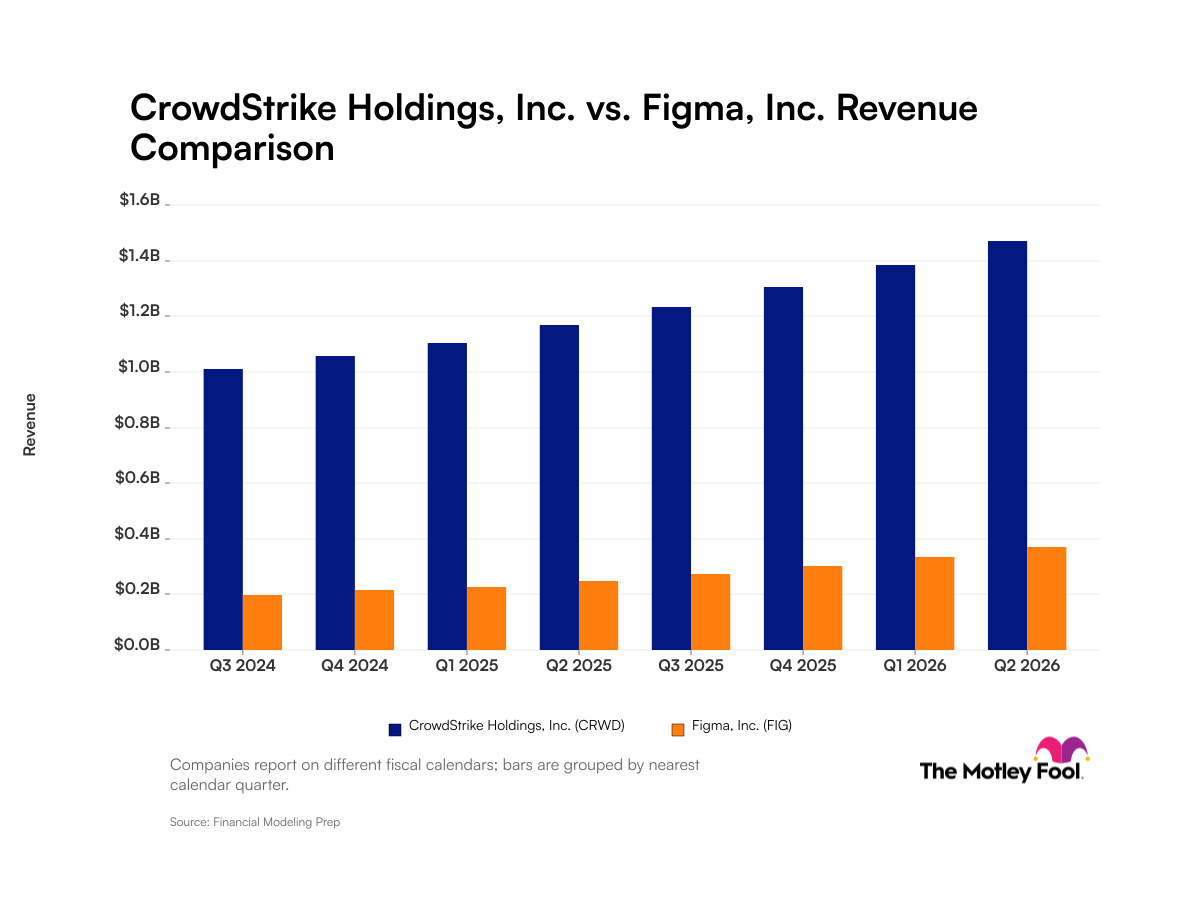
- Revenue -- $333 million, up 46% year over year, with growth accelerating for two consecutive quarters.
- Net dollar retention rate -- Reached 139%, a 3 percentage point increase from the prior quarter, the highest in over two years.
- International revenue growth -- International business revenue grew 48% year over year, outpacing overall company growth.
- Operating margin -- Non-GAAP operating margin stood at 16%, with operating income of $52 million.
- Free cash flow -- $89 million in free cash flow and a margin of 27%; Q1 margin was reduced by a $56 million annual bonus payout, which had a 17 percentage point impact.
- Paid customer base -- Expanded to approximately 690,000, increasing 54% year over year.
- Large customer segments -- Paid customers with more than $10,000 in ARR grew 37%, while those over $100,000 grew 48%, both reflecting acceleration.
- AI credit monetization -- AI credit monetization began March 18; over 75% of Org and Enterprise plan users who exceeded previous limits continued to consume credits, and more than 95% of those users remained active by end of April.
- AI-driven usage and expansion -- Among customers with more than $100,000 in ARR, weekly usage of Make reached 60%, up from just over 50% last quarter.
- MCP adoption -- Customers with more than $100,000 in ARR that used MCP grew full seats approximately 70% faster over the quarter than those not using MCP.
- Guidance update -- Full-year revenue guidance was raised by $55 million to a range of $1.422 billion-$1.428 billion, implying 35% growth at midpoint; non-GAAP operating income guidance raised by $25 million to $125 million-$135 million.
- Cash position -- Ended the quarter with $1.6 billion in cash, cash equivalents, and marketable securities.
- Product metrics -- In Q1, 60% of Figma’s largest customers used Make weekly, and over 80% of Make users on Full Seats continued using Figma Design.
- AI-driven Pro team conversions -- Pro team conversions to paid plans increased over 150% year over year, led by adoption of AI capabilities.
Summary
Figma (FIG -2.40%) reported accelerating revenue growth, significant expansion in its paid customer base, and early success in monetizing AI features across its platform. New credit monetization initiatives are showing strong engagement, particularly among enterprise and organizational users who continue to purchase additional credits after enforcement. The company emphasized unique competitive positioning through platform differentiation and ongoing product expansions, while its raised full-year guidance reflects confidence in broad-based seat growth, retention, and continued AI-driven upsell. Figma’s updated bonus accrual structure will continue to impact quarterly free cash flow margins moving forward.
- A major international hyperscaler unified over 35,000 paid seats under a single agreement, representing one of the largest deals in company history.
- Field said, "Adoption of Weave at NBBJ is expected to triple in the next 3 months," highlighting growing traction with AI-enabled products beyond traditional software design.
- Melwani noted, "Pro teams that purchase AI credit add-ons had more seats per team and an average annualized spend of over 3x than that of teams that haven't purchased add-ons."
- The launch of full seat AI credit limits now ties revenue directly to increasing AI usage on the platform, establishing a new monetization milestone.
Industry glossary
- Make: Figma’s AI-powered collaborative design tool enabling code, prototyping, and workflow automation within the platform.
- MCP: Multi-Context Platform, Figma’s architecture that allows AI agents and developers to interact directly with design files and workflows.
- AI credit monetization: Revenue model where users consume prepaid units (“credits”) for AI-powered features, introducing usage-based billing for advanced capabilities.
- Full Seat: Highest license tier in Figma, providing comprehensive access to all features including AI tools, prototyping, and admin controls.
Full Conference Call Transcript
Dylan Field: Hello, everyone, and thank you for joining. I'm looking forward to sharing the results of another incredible quarter at Figma. First though, let me tell you how I'm thinking about the opportunity ahead. Anyone building software today knows that we are living through an extraordinary time because with AI, what used to take months can now ship in sometimes an afternoon. Code is more plentiful, easier to write and the distance between an idea and its implementation is collapsing. You've heard me say it many times in the past. When execution is cheap, design and creativity are the edge. And now it's not only me saying it, the entire world sees it too.
The bottleneck has shifted away from can we build it and toward can we imagine something that's worth building. More design tools are launching, more people are creating, more software is now being built than ever before. And in this world where bits are abundant, what's scarce is human creativity, actual point of view, care and craft and judgment. This is what makes a product, a company, a campaign cut through the noise. Designers, builders and creatives, they all need tools that let them explore without limits and express their vision exactly as they imagined it. And that is what Figma has always been built for. Our Q1 numbers reflect this momentum. Here are a few highlights.
In Q1 2026, revenue grew 46% year-over-year to $333 million, accelerating from 40% last quarter and 38% in Q3. Growth came from across our business, seat expansion, retention, enterprise adoption, new users and of course, AI through Figma Weave, our broader AI capabilities and early traction from AI credit monetization, which started on March 18. Net dollar retention rate also increased to 139%, our highest rate in over 2 years. This is up 3 percentage points from last quarter. We also continued to generate strong cash flow. Non-GAAP operating margin was 16% in the quarter. Free cash flow was 27%, and we ended Q1 with $1.6 billion in cash, cash equivalents and marketable securities.
Thank you to the Figma team for your focus and for your execution. I'm also especially proud of how our team is adapting to new ways of working with AI during this time of exponential change. The momentum we've built gives us the confidence to raise our revenue and non-GAAP operating profit guidance for the year. Praveer will share more details on that in just a moment. But the story of our quarter, of course, goes far beyond the numbers. We're seeing our customers go bigger and deeper with Figma. So let me share a few examples. First, Google. Google is a longtime Figma customer. Many of their most iconic products have been designed and built on our platform.
As they build the next generation of AI native products, they're doubling down on Figma. The team designing agenetic Gemini experiences for millions of enterprise customers uses Figma end-to-end as their single source of truth from the earliest concept work all the way through to shipping. In their words, they can only "get to a level of detail that we want in Figma, that's not possible with vibe coding." Lufthansa is another example of a customer going deeper with Figma to drive real innovation. Their Lido navigation product design team used Figma Make to prototype Lido mPilot, an integrated iOS charting app that streamlines flight navigation for commercial pilots.
They did it with a level of fidelity that goes well beyond traditional prototypes, though. By connecting Figma make to their in-house API, the team could prototype dynamic, interactive map features. That way pilots could test real gestures before any production code was written. As they put it, pilots could really imagine what we were trying to show them. We validated our concepts before touching implementation. That's the goal of every product team, and we actually did it. Teams aren't just going deeper at Figma. We're seeing broader adoption across the organization as well. Rocket Mortgage, for example, serves 1 in 6 American homeowners, unifying multiple brands and technology stacks into a single homeownership platform.
To help scale that vision, the team built their design system directly into Figma Make as a shared template infrastructure for their entire org, accelerating adoption well beyond the design team. As design engineering lead, Will Hobick, describes it: "We're seeing adoption across the organization. Teams across Rocket are now using Figma Make to rapidly build dashboards, craft presentations and explore new customer experiences, all built on top of our shared design system and brand foundations." Design Director, Emily Strobl, had this to say on why it's resonating. "We've all experienced AI tools that just don't quite hit the mark or reflect our brand standards.
Embedding our design system into Figma Make has fundamentally changed that." In some cases, expansion goes even further beyond product development altogether. At NBBJ, one of the world's leaning architecture firms, Figma Weave, formerly known as Weavy, is changing how they win business. NBBJ's architects are subject matter experts in the industries that they design for. Their work is about understanding how a space needs to function, not just how it looks. So pitching a client used to mean commissioning photo realistic renders from an external studio. And that process took days and returned only 1 or 2 versions with little room for refinement. And now architects at NBBJ can just do it themselves.
Figma Weave lets them translate their 3D models into precise, photorealistic renderings. They're able to generate and refine in real time, pushing until the result meets the exact bar that their work demands, dialing in time-of-day lighting, grounding a design in actual urban context, and getting the materiality just right. Figures placed at human scale make a ceiling height or entry sequence immediately legible to clients. The result is a faster pitch, a stronger presentation in full creative control from start to finish. Adoption of Weave at NBBJ is expected to triple in the next 3 months. Across these customers and countless others, Figma remains the place where teams with the highest bar come to do their best work.
Teams that know that creativity and craft are what we'll set them apart, they need tools that can match that ambition. Tools that let them explore freely and expressed their vision without limits. That's who Figma is built for. Our platform is where creativity lives and compounds, where teams can move quickly on their first idea and push further, questioning, refining, iterating with the best of AI, code and direct manipulation until the work is unmistakably theirs. We see this in how our customers actually work. As of Q1, around 60% of our largest customers used Figma Make on a weekly basis.
And over 80% of Make users on Full Seats continued using Figma Design for visual editing and broader exploration alongside Make. We love seeing how the ambition of our users and our community is always growing, and we are moving faster than ever to meet it. In the last few months, we shipped major updates to Figma Make that let users bring their own context into every prompt and give them more control over every decision as they build. We introduced new MCP capabilities that let agents read and write directly to Figma files so that teams can stay in control. In Q1, MCP weekly active users in Design grew 5x quarter-over-quarter.
And we shipped updates to Figma Weave, including a timeline editor for refining AI-generated video. Figma Make has driven the most AI usage so far, but MCP, Figma Weave and our AI assistant, which is currently in Alpha are meaningfully expanding the surface for AI consumption in Figma. All of this builds on what has made Figma the choice for the world's best teams building the world's best software. First, a performant enterprise-grade multiplayer canvas and platform, where humans and agents can work side by side with no silos, no handoffs, just the best ideas rising to the top. Second, deep product context that makes AI actually useful.
The institutional taste, the historical decisions, the accumulated understanding of how your product should work and feel. And third, full creative control, the ability to prompt, code and manipulate visually all in one place, unlocking the full power of AI without giving up intent or the full range of what you can imagine. Because in a world of abundant software, all of this together is what it takes to build products that stand out. And the companies that figure out how to harness human creativity alongside AI, those companies will define what the next era of software and creativity looks like. having spent over a decade building for the most creative community on the Internet, this is our moment.
I cannot wait for you all to see what we're shipping over the next weeks and months, including at Config, our annual user conference in June. With that, I'll pass it to Praveer.
Praveer Melwani: Thanks, Dylan. Dylan shared some of the headlines and why we believe Figma is outperforming. I'll share a bit more detail on what we're seeing in our outlook for the rest of the year. AI continues to be an incredible tailwind for our business. Total revenue in the first quarter was $333 million, representing 46% year-over-year growth and exceeding the high end of our guidance. This marks our second consecutive quarter of acceleration in our year-over-year revenue growth. Our outperformance resulted from stronger-than-expected seat expansion across entire organizations driven by design's growing importance and adoption of our AI products, including Figma Make, MCP and Figma Weave. Our international business also contributed to our results with revenue growing 48% year-over-year.
We also saw increased demand for our governance plus add-on and advisory services. Our Q1 results are a testament to the team's relentless work building, shipping, iterating and listening to feedback from our customers. Retention and expansion metrics continued to strengthen in Q1. Our net dollar retention rate for paid customers spending more than $10,000 in ARR reached 139%, up 3 percentage points from the prior quarter and our highest level in over 2 years. Our outperformance in NDR was driven by strength in seat expansion and growth in our non-seat-based offerings, including AI add-ons. We also saw acceleration in our customer cohorts.
Paid customers spending more than $10,000 in ARR grew 37% year-over-year in Q1, a 5 percentage point acceleration relative to Q4 last year. Paid customers spending more than $100,000 in ARR, grew 48% year-over-year in Q1, a 2 percentage point acceleration relative to Q4 of last year. And our overall customer base grew to approximately 690,000 paid customers from approximately 450,000 in Q1 of last year, growing 54% year-over-year. As AI gets better, Figma is accelerating and customer usage and workflows on our platform are deepening. Our platform and AI products drove faster growth for both new customer acquisition and expansion within existing accounts. Across all tiers, we're seeing customers grow seats and expand into new functions and teams.
Within our larger enterprise customers, approximately 60% of customers with more than $100,000 in ARR were using Make weekly in Q1, up from over 50% just last quarter. In the long tail, we're also seeing continued acceleration in adoption of our AI features with new Pro team conversions which we view as a leading indicator for future growth up over 150% compared to Q1 of last year, demonstrating our ability to both expand TAM and convert existing users to paid plans.
A few of our notable customer wins from the last quarter include one of the world's largest hyperscalers running thousands of product and engineering teams across dozens of business units, unified its fragmented Figma usage across the enterprise into a single agreement with over 35,000 paid seats, one of the largest deals in Figma's history. A top global media and entertainment company that started with organic Make usage ended up with a full company-wide rollout. As teams adopted Make, every developer upgraded to a full seat. That growth happened organically, driven by how the product is actually being used, not by a top-down mandate. We also saw some incredible wins in Q1 internationally.
In India, one of the country's largest IT services firms signed our largest ever deal in the region, consolidating design and engineering teams on to Figma. And in Europe, one of the world's largest industrial automation companies with over half of its R&D workforce focused on digital development, more than doubled their dev seats on platform. Engineers at the company now outnumber designers on Figma, the team is now leaning into Figma's MCP to connect design directly into their development environment. The themes across our customers are clear. They're deepening their usage of our products, expanding their seats with Figma and finding even more value in their user experiences with AI products.
In fact, in Q1, over 60% of paid customers with more than $10,000 in ARR added full seats compared to their prior renewal, consistent with what we observed last year and at equivalent expansion rates. I want to take a minute to highlight the strong early signal we are seeing on AI credit monetization. We are at an exciting inflection point. On March 18, we began implementing AI credit limits for all of our seats and have been very encouraged by the usage trends we've seen since then.
As of the end of April, over 75% of users on our Org and Enterprise plans who were previously over their credit limit continued to use credits and over 95% of those same users remain active on the platform. Early enterprise customers who have committed are doing so at scale. For example, one of the world's largest enterprise technology companies in the middle of a company-wide push to become an AI-native organization after standardizing on Make, they are now purchasing additional credits to expand AI capabilities across product, engineering and PM teams spanning 7 business units.
One of the world's largest professional services firms expanded their Figma investment after a company-wide Figma AI training drove a step change in adoption and embedded AI capabilities at the center of how they design, prototype and deliver client work across every major industry. Additionally, as of the end of Q1, Pro teams that purchase AI credit add-ons had more seats per team and an average annualized spend of over 3x than that of teams that haven't purchased add-ons. Importantly, the surface area for credit consumption continues to expand.
While today's credit usage is driven by products like Figma Make and our advanced image editing features, new capabilities currently in our early access program like our AI assistant, which enables new AI native creative workflows directly in the Figma Design canvas are expected to begin drawing on credits in the near future as well. Our MCP enables developers and AI agents to build and interact with Figma directly within their workflows. We are seeing more teams convert to paid plans and upgrade seat types to access higher rate limits for our MCP.
Among customers with more than $100,000 in ARR, those that were using our MCP grew full seats approximately 70% faster over the quarter than customers who are not using our MCP server. We expect this to evolve into a usage-based offering, but is currently available for free during the beta period. Q2 will be our first full quarter of credit monetization. We have been investing in more features to improve the customer experience including expanded admin controls, pay-as-you-go for Pro customers and more flexible contracting structures for enterprises. Our goal remains the same for our monetization model to support adoption rather than constrain it. Lots more to come here in the quarters ahead.
Now turning to some key income statement results. Unless otherwise noted, all metrics are non-GAAP. We've provided a reconciliation of GAAP to non-GAAP financials in our earnings release which is posted to our website. Gross profit in Q1 was $275 million, representing a gross margin of 82%. During the quarter, we saw a broader and deeper adoption of our AI features with our users benefiting from access to higher capability models, which in turn increased engagement and improved retention. With full seat AI credit limits now live, growing AI usage and adoption now translates into revenue, a key monetization milestone.
We expect to continue to capture efficiency gains where available and have a clear set of levers to manage inference costs as adoption scales. This includes routing queries across models based on task complexity and leveraging our model-agnostic architecture to optimize across providers. We are also investing in first-party models trained on Figma's design corpus to improve performance on design specific tasks while reducing cost. As we've reaccelerated our business, we've also delivered $52 million in operating income, representing an operating margin of 16%. Across the business, we've taken a first principles approach to rebuilding how we work across engineering, go-to-market and operations with AI tooling at the center.
It's been energizing to see the creativity of our team in tangible wins and productivity across the board. We continue to evaluate our hiring needs to make sure we're operating efficiently. We believe the future calls for flatter organizational structures and more smaller, high agency teams that can move even faster, which gives us more capacity to invest and retool how we work. Our Q1 free cash flow was $89 million, representing a free cash flow margin of 27%. We ended the quarter with $1.6 billion in cash, cash equivalents and marketable securities.
As we previewed, we introduced an annual corporate bonus program in 2025, which was accrued for during 2025 and paid out for the first time in Q1 this year. This was a $56 million cash outflow and had a 17 percentage point impact on our Q1 free cash flow margin. Going forward, we expect to continue to accrue for the annual bonus each quarter and pay out in Q1 of each year. We remain confident in the long-term cash-generating profile of the business. We also remain committed to managing dilution responsibly.
As our pre-IPO equity grants amortize, we expect that strong revenue growth, disciplined hiring and expanding operating leverage from AI will continue to drive improvement in stock-based compensation as a percentage of revenue. Now turning to our outlook. A reminder on our guidance philosophy. We're providing a snapshot of our current view of the business based on recent trends. We include what we have a high degree of confidence in and where our visibility is more limited we look to observe sustained trends in the data before we fully incorporate the benefit in our guidance. For the second quarter of 2026, we expect revenue in the range of $348 million to $350 million implying 40% year-over-year growth at the midpoint.
For the full year, we expect revenue in the range of $1.422 billion, to $1.428 billion, implying 35% growth at the midpoint and a raise of $55 million relative to our prior outlook. Our raise for the full year is driven by 3 things: first, increased paid conversion across our customer base, fueled by the depth and breadth of AI across our platform; second, sustained broad-based seat expansion across every tier with teams and organizations opting for more dev and full seats to access our AI products and credits; and third, outperformance versus our expectations across credit utilization, retention and add-on purchases since implementing credit limits.
On operating income for the full year, we expect non-GAAP operating income in the range of $125 million to $135 million, representing a non-GAAP operating margin of 9% at the midpoint. This represents a raise of $25 million relative to our prior outlook. Our increase in operating income is driven by our revenue increase for the full year, operational efficiencies and continued optimizations we have made in our AI implementations. Additionally, while we are not issuing quarterly operating income guidance, we would note that Q2 operating income and free cash flow are historically impacted by Config, our annual user conference. We anticipate a similar effect in 2026. In closing, Q1 was an exceptional quarter across multiple dimensions.
Year-over-year revenue growth has now accelerated for 2 consecutive quarters. Net dollar retention rate reached its highest level in over 2 years, and the early signs from AI credit monetization give us tremendous confidence in the road ahead. As Dylan shared, design has never mattered more and Figma is built for this moment. With that, I'll hand it over to the operator for Q&A.
Operator: [Operator Instructions] We will take the first question from Michael Turrin, Wells Fargo.
Richard Poland: This is Richard Poland on for Michael Turrin. So first one for me is just with respect to the AI credit monetization. I know it's been only 2 weeks in the quarter and I think somewhere around 6 to 8 weeks since that officially went through. But how should we think about that starting to ramp and show up in the model into the Q2 and second half?
Dylan Field: Yes. I appreciate the question here. So I think as where we stand, we're ahead of our expectations, and it's giving us confidence in the raise -- in our ability to raise our guide for the full year. We felt the momentum across big and small. Our paid customer base grew 54% year-over-year with the long tail of Pro teams there -- Pro team conversions rather, up over 150% in Q1 compared to the same quarter last year.
In Q1, we're now up to approximately 60% of our customers over $100,000 in ARR using Make weekly and actually have seen over 75% of our org and enterprise users who were previously over the limit prior to credit enforcement continue to consume credits in April. And so as we sit here at the end of Q1, teams that are purchasing AI credit add-ons on Pro have an average ARR of over 3x more than teams that had not purchased add-ons. And the part I'm candidly most excited about is all the amazing work that our team has still coming, which will increase the surface area for teams and organizations to experience the magic of our AI features.
So when you think about the rest of the year for us, we very much believe that we've got a tailwind here from our credit monetization. And it's both going to be through the consumption that teams are actually seeing while also helping us drive continued seat upgrades on -- help us drive continued to seat upgrades for users and teams in the months ahead.
Praveer Melwani: I'll also add that we're excited about the different surfaces that you'll see AI consumed on. For example, Weave is something that we're very excited about, and we really believe in the paradigm of node-base editing and the ways that you can create workflows where agents and models are working on the same canvas and you can move between the outputs of the various surfaces.
Operator: Your next question is Arjun Bhatia from William Blair.
Arjun Bhatia: Congrats on a great start to the year. Dylan, maybe I'm curious for you. It's been almost a year now or maybe we're a few months away since Make has been in GA. And I'm wondering what sort of change or evolution you've seen in the way customers and users are using Make. And it sounds like in your prepared remarks, you mentioned some enhancements that you had made around context and MCP. So I'd be curious how those new capabilities are resonating with customers and maybe enhancing the value of that solution.
Dylan Field: Absolutely. And thank you for the question. And I think it's definitely the case that we'll continue to see, just like we've seen in the last year, paradigms evolve and expectations of our users evolve. Like we said in the prepared remarks, our users are incredibly ambitious. And we always intend to meet their ambition to make it so they can take full advantage of the Figma platform to create what's in their head. And when it comes to Make, we've been really impressed by the way that our users have stretched the platform to create everything from tools to prototypes to beautiful website designs to actual ship software.
And some of them have just really done an incredible job of leveraging the platform to its fullest capabilities. And at the same time, we believe there's so much more that we can bring to Make. And as we do the look back, some of the early technical decisions that we made did constrain us in ways that are obvious in hindsight, but we were not obvious then. We've corrected those. If you haven't tried Make recently, please try it again. It is already so much better. And in the weeks and months to come, I think you'll be amazed by the progress and so please check it out.
Operator: Up next is Keith Weiss from Morgan Stanley.
Keith Weiss: Congratulations on a really awesome start to the year, both in terms of what we're seeing in the customer base growth as well as your ability to monetize against that. Dylan, kind of digging into that sort of exponential change that you're talking about and the improvements that you're seeing in Make. I think the question a lot of us have is how these pricing models and the value proposition is going to evolve as we understand how customers are utilizing the tooling, whether it be Make or an MCP server or whatnot.
Any initial kind of learnings that you could talk to us about in terms of how well the pricing model today is capturing that value proposition and how it might evolve going forward? And then for Praveer, we saw some degradation in gross margins as AI picked up. You talked about monetization starting to kick in against some of that usage. Is there any kind of guardrails you could give us on where gross margins may be going forward? Like do you have any indication of what type of gross margin business is like AI activity is?
And anything that could help us understand sort of the lower limits or whatnot of where those gross margins may come as AI becomes a bigger and bigger component of what you guys are serving your customers?
Dylan Field: Thank you for the question. I would say that, first of all, I firmly believe, as I've talked with customers that the value prop and how it relates to pricing, what matters most is that we are providing the most value that we can to our customers, and we're solving their problems. And in this era, at least of where we're at with AI and pricing, that is what customers are looking for first and foremost. How it evolves going forward, I think we might see change where people become more discriminating on how much they're spending on tokens. And in fact, I think we're already seeing that with some of our customers.
If the first chapter was, oh, gosh, we have to use AI and the second chapter was, okay, leader boards for token usage. Well, the third chapter seems to be, let's put some limits on this because this is real spend. And some of the things we're doing around MCP, for example, and Code Connect actually do translate to more efficiency for our customers. And of course, we'll try to make sure that as we think about Make and other aspects of our platform that we're striking the right balance on efficiencies that our customers can use our product. I'll pass to Praveer to answer the rest of the question.
Praveer Melwani: Yes. I appreciate the question, Keith. I think the spirit and sentiment that we get from customers is that they're looking to have more control. They want to have the ability to have governance on who gets access to what set of credits across teams, which we're really fast to address. And we've expanded admin controls. We've been exploring pay-as-you-go models for our Pro customers and more flexible contracting structures generally for enterprises. But to the broader question, I think we're seeing really encouraging signals and signs and early results on our AI monetization and we've got a number of early champions that are looking to continue to invest and work with us here.
And then to the spirit of your question on gross margin, I think in large part, it's hard to predict with precision where things will ultimately land. We've been completely focused around optimizing gross profit dollars. With full seat AI credit limits now live, any growing AI usage and adoption now translates into revenue, a much more natural offset to the growing use and customer value we're providing. In Q4, we previously demonstrated an ability to drive efficiency while also continuing to drive adoption and use. And our expectation is that we'll continue to have levers to pull in the future.
That includes things like routing queries across models based on task complexity, leveraging our model-agnostic architecture to optimize across providers and investing in first-party models trained on Figma's design corpus to improve performance on design-specific tasks while reducing cost. But the core focus for us right now, drive growth, ubiquity of our solutions, and we have every intention to ship and ship extremely quickly.
Operator: Gabriela Borges from Goldman Sachs has the next question.
Gabriela Borges: Dylan, I really appreciated your case study in the prepared remarks on Google's usage. I'd love for you to talk a little bit about some of these new tools that are coming out from the LLM providers like Google Stitch and code design. I'm curious how you think about the impact those tools will have on the industry. And it sounds like there may be some underappreciated synergies between how Figma could potentially work with those tools as part of a bigger design cycle. So I would love to hear your thoughts broadly on that.
Dylan Field: Absolutely, and thank you for the question. Well, I mean, first off, I just think that this is such an extraordinary time to build and as code becomes more commoditized and easier to write, design is clearly the layer above code and visual thinkers outnumber those who are comfortable in a terminal or an IDE. And so we expect this space to continue to heat up and to be the battleground for how software gets built. We also expect that tools around visual communication and creative design for purposes of marketing and advertising are going to be essential for breaking through the noise in a very crowded information environment online.
And I think that's why we're going to see more and more tools come out. And to your point, many of them will be tools that we can integrate with and will actually be complementary and something that we can work with in our ecosystem. Others will be more direct competitors. And so we, I think, try to understand that context by direct communication and conversation whenever possible and by having close relationships with our partners.
And I think that overall, we have to focus on what we know best, which is for 14 years now almost, we've been deeply in the details of designers, designer workflows, and we have a team that is just absolutely incredible that cares so much about craft, about quality and about designing products with a strong point of view. And we're shipping faster than ever right now. So as I said in my remarks, I think that's what's going to take to win in this era along with that partnership and making sure that we're working with our ecosystem.
Operator: Your next question is from Alex Zukin from Wolfe Research.
Aleksandr Zukin: I guess maybe first, this was your largest beat being public. And I appreciate that you guys had some really stellar new customer additions and a couple of really inspired key metrics. But maybe like what surprised you the most in the quarter that drove the outsized beat? And then Praveer, maybe just, again, the quality of the beat is so high. I think it would be really helpful if you could help maybe set some guardrails around the low end of where -- how should we think about gross margins, particularly exiting the year? Like is this something that stays above 80% because of all the commentary and technical innovations that you guys are doing?
Or do we pierce that 80% level at some point?
Praveer Melwani: Yes. Maybe I'll take the spirit of the last part of your question there on gross margin. Like I was sharing with Keith, our focus right now is to drive gross profit dollars and really focus on growth. And so that is the key metric for us versus thinking that there's a specific floor that we want peers through. We want to make sure that we're driving ubiquity of our solutions. We're investing and investing deeply, and we feel like we have the best product and team behind -- team that's working behind it in order for us to win.
And then I think in the spirit of your first question, the beat and the core makeup of the quarter for us came from all different directions. Our product portfolio today looks extremely different than a year ago. And with each new surface and feature that we've introduced, we've made it that much more compelling to hold a paid seat. It's a consistent trend we've seen with users upgrading the full seats for access to higher rate limits on our MCP or access to products like Make.
And so when you put that all together, all the components that helped us orchestrate a strength in our net dollar retention rate, TAM expansion, seat expansion, product expansion, tier expansion as well as pricing, we're all kind of kicking into high gear there. And you called it out there on Q1, we saw paid customer count growth overall, up 54% year-over-year, 10,000-plus customer cohort growth continued to signal strength and showcasing that they're continuing to add full seats across their teams at renewals. Our international business is humming. We're deepening our investments in some of -- in stuff like our Governance+ add-on as well as advisory services.
And it's early, but we are obviously seeing strong signal on AI monetization start to kick in. So as our pricing tailwinds from last year start to wane, we really get the benefit of some of these newer levers, and I'm excited about what the teams got cooking because I think it gives us confidence in the rest of the year here.
Dylan Field: I'll just add on to the first part of the question around that floor. Well, plus one what Praveer said and also just stress that we always are working to be extremely rigorous about our short-term and long-term thinking. I think there are many aspects around delivering and playing for the big prizes when it comes to these new markets around AI where short-term thinking might create spend, but it's only -- you only engage in that if you believe in the long-term TAM and profile of the business that you're entering. And so we will continue to like apply that thinking and framework to the decisions we make and be very selective about the opportunities we go after.
Operator: The next question is Billy Fitzsimmons from Piper Sandler.
William Fitzsimmons: So Dylan, maybe for you. I want to expand on one of the earlier questions on kind of the evolving competitive landscape. I guess since last quarter, one of the cloud hyperscalers announced a seemingly similar product to make at the end of the first quarter. And then one of the frontier labs subsequently announced a design tool. And it feels like there's both coopetition with those vendors. But given kind of competition and how rapidly things are moving come up in investor conversations, first, Dylan, I know you just reported really strong growth, and there are a few application software companies in that ballpark. But just help investors think about Figma's differentiation in kind of this rapidly changing landscape.
I know you've talked about that before. And then second, anything from a numbers perspective in the second quarter, either from top of funnel, new logo usage standpoint, that investors should be aware of that suggests a change in competition. It really doesn't seem like it based on the strong guide for 40% growth, but anything worth calling out?
Dylan Field: Yes. Thanks for the question. Obviously, this is a call about the first quarter, not the second quarter, so we'll stick to first quarter. And in terms of the competition or perceived competition, again, I think you have to look at each player individually. To speak directly, I'm very, very thankful for our partnership with Google. And we are big fans of the Gemini series of models. And we think that they're doing a lot of really interesting work, and there's a lot of opportunity to collaborate. And their labs product is not something that we're seen us gain the way of that nor do we see the effect as far as I can tell in a substantial way.
I think when it comes to Anthropic, obviously, we can't dismiss them. And I said that earlier, I'll say it again. They have the ability to train in first-party models and couple those with their own products if they choose to. And so we have to pay attention to that. And also, they're doing a lot of things, and we'll see what remains their focus. In terms of differentiators, I think there are many, a few that I'll mention today. Performant multiplayer canvas, I think, is something that people underestimate how hard it is to get those mechanics right and to really execute with quality on.
This is something that has been a deep area of expertise for us for years. And I think there's a misconception that it only pertains to design. It pertains to many representations, including design, but also can pertain to code in the future. Deep product context, I think, is another main differentiator that we have in terms of the context we can build from workflows, but also the context that our team has on serving our users.
And finally, this ability to bring the best of AI and design and code and freeform direct manipulation together, all in one place, in one platform, that is what I think will ultimately create flow for people doing design work and serving their users. And I believe it will be our ultimate differentiator is the ability to go between these modalities rapidly.
Praveer Melwani: Yes. And just to be explicitly clear there, we're confident in our guide for Q2. The numbers that we reported this quarter and the strength that we've shown in NDR and make usage for our largest customers growing from 50% as of the end of Q4 up to 60% as of the end of Q1. Pro team conversions up 150% year-over-year over the course of the quarter. The bottom line is customers are going bigger. They're going broader with Figma than ever before. You heard about Google, Lufthansa, Rocket Mortgage and countless others. And we're moving fast. And we have every history here of showing that we can meet the moment, and we're going to continue to out-execute there.
Operator: Next up from Stifel is Parker Lane.
J. Lane: If you look at the last few months since the enforcement of the credit limits here, I was wondering if you could talk about the split of those customers who have exceeded their limits buying more credits versus upgrading into full seats. And as you look out to '26 and these tools continue to improve, do you expect that split to be roughly similar? Or do you think there's going to be more of a likelihood that people choose one path or the other here?
Praveer Melwani: I think customers are going to get both, right? It's a little bit too early to comment on the long-term mix, but we expect consumption to be an upside driver for the year. Our goal remains the same over here for our monetization model to support adoption rather than constrain it. And as we reinvest in the business, there's an opportunity for us to encourage use of our new products and features as we roll them out. And we get excited about the opportunity for our customers, for our users to experience all the magic of the products and features that we've got coming. So we've got an opportunity to both go deep with organizations as well as broad.
As we go deep, we'll drive more consumption, cross-platform use. purchases of add-ons like our Governance+ and advisory services. And then going broad, we'll license more of the team. And as they go broad in that way, they'll be able to unlock more features and use and potentially drive more consumption as well. And so we've got early signal right now, but we've been very excited by the usage trends we've been seeing since implementing credit limits on March 18 there. And I'd just remind you that as of the end of April, the majority of -- or rather 75% of the organ enterprise users who were previously over their credit limits, they continue to consume credits.
They continue to consume credits over the month of April. And so when you think about it, the right model here is the one that meets the needs for our customers. And today, we believe that it's -- we're going to consistently see a mix of the 2 models, both seats as well as AI consumption.
Dylan Field: And in terms of the product aspect of your question around when does a user choose inference versus when do they choose doing direct editing. This is something that I believe we really need to bring together and make -- it's a flexible approach where customers can choose the right thing at the right time, the right tool at the right time. And the more we can do that, the more customers can save on inference should they need to and also they can get the benefits of AI when that is applicable. There are some workflows in Figma Design that are 10 or 100x faster than AI.
There are some workflows with AI that are way faster than if you're going to do it manually and really try to do like some bulk editing task. As we move to a world where Assistant expands in the alpha and ultimately comes out of alpha, more of our customers will be able to get those benefits in Figma as well.
Operator: Nick Altmann from BTIG has the next question.
Nicholas Altmann: Awesome. I kind of had a higher-level question, but this notion of code to canvas or canvas to code, it creates a bidirectional or maybe a round-trip workflow. And so Dylan, can you just talk about what you're hearing or what you're seeing from customers in regards to this workflow change? And then the follow-up is you've talked about how design being the differentiator gets accentuated in this new era. So if we look out over the next couple of years, like how much do you think your customers will adopt more of a code-to-canvas workflow approach? And does that potentially foster more users to adopt full seats rather than dev seats or collab seats?
Dylan Field: Absolutely. Thank you for the question. I would say that First of all, just to frame up where I see us in the time line right now, we're in the early innings still of the product interfaces around models and inference. And so I don't think that anyone would tell you that an IDE or a terminal is where people are going to gravitate towards long term, if given the choice. It is instead, I think, the way that they can access these workflows today.
And as that abstraction barrier goes up and they can instead access AI workflows, model capabilities through richer interfaces that are more accustomed to the task that they're trying to complete, I believe very strongly customer workflows will shift in that direction. That said, it's where we're at today. And whether you're building an IDE, you're building in a terminal or you're building in Figma, we -- or you're doing both and going back and forth, it's really important to help our customers connect those dots and make sure that they're efficient with their token spend, but also the time that they spend translating between these surfaces. And that's why we do that.
And we've been glad to see the usage of use Figma on the right side from models to and code to the canvas. And also on the MCP side, you heard it earlier, that's growing tremendously and people are getting real value out of that in terms of implementing designs and doing that in a much faster way, and there's still so much more we can do there. So we're excited about the round trip and has applications on our platform, too, even within the walls of Figma.
Operator: And everyone, at this time, there are no further questions. I'll hand back to our speakers for any additional or closing remarks.
Praveer Melwani: Thank you all for joining. We are exceptionally proud of the quarter, and we look forward to speaking to you guys soon.
Dylan Field: I'll also just finish off by thanking the team. Our team has been doing an incredible job executing with such strength and working extremely hard to meet the moment, and we have so much gratitude for everything they're doing, and I'm excited to see -- excited for all of you to see some of the stuff that we're working on in the weeks and months ahead. Tune to Config, our annual user conference in June and excited for you to see what we're shipping there and also to hear your feedback. Thank you.
Operator: Once again, everyone, that does conclude today's conference. We would like to thank you all for your participation. You may now disconnect.