Investors can't seem to stop talking about artificial intelligence lately, and for good reason. Leading tech companies spend billions creating this technology, which will have a massive impact on future earnings, although the hype will probably wane soon. Microsoft (MSFT +0.20%) appears to be in the catbird seat with its multi-billion dollar investment in ChatGPT maker OpenAI.
What makes ChatGPT different from other chatbots? It is a generative language learning model (LLM) application. Many of us are familiar with chatbots, often through customer service applications. These can handle limited queries and have a handful of canned responses. Want to raise your credit card limit? They can help.
But if you have something more complicated, you probably need a person. Generative LLM models like ChatGPT or Alphabet's generative chatbot "Bard" change that. They can handle complex queries or tasks, converse, and generate original responses, rather than just canned replies. The possibilities are staggering.
Amazon (AMZN -0.10%) is quietly making moves in AI as well, and its stock offers much better long-term upside potential. With that said, here's a look at what makes it the more attractive AI stock now.
Microsoft stock soars
Microsoft Cloud is a beneficiary of companies emphasizing data and cloud applications. Companies are ditching expensive on-site servers for cloud-based Microsoft Azure, and tech like AI will increase demand. Manufacturers, retailers, and even accounting firms use data to power efficiency. This is why Microsoft's server products and cloud services segment grew another 17% last quarter to $22 billion in revenue (42% of the company's total). Cloud services and Azure grew a whopping 27% -- despite the immensely challenging economy. Investors were duly impressed, and the stock shot up more than 10% to a new 52-week high, as shown below.
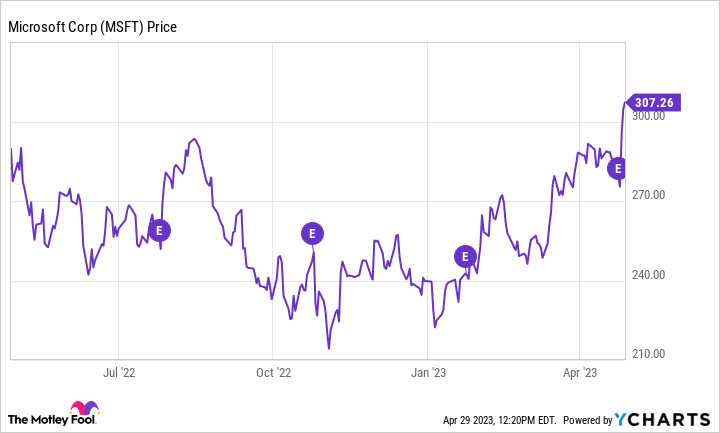
Microsoft is one of the globe's most successful and well-run companies, and the stock price reflects this. The price-to-earnings (P/E) ratio of 33 is more than its average since January 1, 2019, and the highest since the stimulus-driven tech bubble that followed the March 2020 crash. While a tremendous company and a quality investment, Microsoft investors' upside may be limited at this price.
Amazon stock has massive upside
The only cloud services provider with more market share than Microsoft Azure (23%) is Amazon Web Services (AWS) at 32%. Revenue in the AWS segment has grown more than 85% since 2020. Breaking it down a bit further, it generated $45 billion in 2020 and is on pace to exceed $85 billion this year. Growth slowed in Q1 to just 16%, which is concerning. However, Amazon has proactively assisted its customers in lowering costs as the economy slows. The belief is that helping customers save money will hurt sales now but retain these customers for the long haul. This approach should be welcomed by long-term investors.
Amazon uses AI to optimize logistics and improve digital advertising, among other areas. Now its Amazon Bedrock service makes AI tools available to customers. Bedrock offers customers the use of "foundational models" (FMs) to build their own AI tools. FMs are base data networks that can be adapted to suit various needs. This is terrific for customers who want to experiment with text generation, chatbots, or other functions without large investments in digital infrastructure. And it all runs on AWS, of course.
The economy hasn't been kind to Amazon since the pandemic. It's no secret that inflation, labor costs, and other headaches have cratered retail margins. Amazon's stock has followed suit, and trades 27% off its 52-week high and 44% off its all-time high. Unlike Microsoft, P/E is not the best measure of Amazon's value, especially since profits are hard to come by right now. Instead, investors can look at the company's price-to-sales (P/S) ratio, which at just over 2 is the lowest it has traded since 2015. Amazon isn't out of the woods yet, as management cautions that AWS growth could keep slowing for a while. But investors beat the market by being ahead of the curve.
AMZN Amazon.com
NASDAQ · As of 4:00 PM ET 10/21/26

Remember that aside from AWS and AI, Amazon has over 200 million Prime members, a delivery infrastructure as extensive as that of UPS, and a digital advertising business that generated $39 billion in sales over the past twelve months. You may have heard the phrase "buy straw hats in the winter," meaning buy when the price is low. Well, it's "winter" for Amazon now, but the season will eventually change. When it does, Amazon's stock could make market-bearing gains.