As of this writing (Dec. 22), popular cryptocurrency Dogecoin (DOGE 1.42%) boasts a market capitalization of $22 billion. This makes Dogecoin the ninth-most valuable token in the crypto landscape -- more than Cardano, Chainlink, Stellar, Litecoin, and Avalanche.
But with its price down more than 60% this year, is Dogecoin a buy for around $0.12 as we head into 2026?
Why did Dogecoin rise and then fall in 2025?
Dogecoin began 2025 with meaningful momentum -- sporting a price of roughly $0.42. As investors can see, the token's rise was fleeting -- plummeting throughout the remainder of the year and now hovering near its lowest price since last summer.
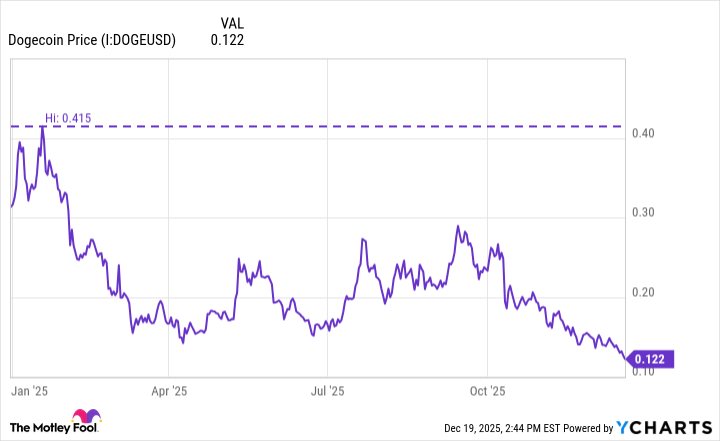
Dogecoin Price data by YCharts
Last November, then-candidate Donald Trump emerged victorious in the presidential election. One of President Trump's most vocal supporters on the campaign trail was Tesla CEO, Elon Musk.
Both Musk and Trump shared a common interest: reducing debt on the U.S. balance sheet. Shortly after winning the election, Trump announced that his administration would create a network called the Department of Government Efficiency (DOGE). The goal of DOGE was to perform thorough audits of each federal agency's budget and identify areas of wasteful spend. Fittingly, Musk was put in charge of this effort.
Dogecoin's supporters -- which mainly consist of retail investors -- speculated that Musk's involvement with DOGE might somehow benefit Dogecoin itself.
There were two reasons for this. First, the Department of Government Efficiency used the same acronym as Dogecoin's ticker. Second, and more importantly, Musk has been at the center of prior rallies around Dogecoin in years past as the entrepreneur has taken a liking to the meme coin.
As the sell-off makes clear, neither of these points had anything to do with wider adoption of Dogecoin in the real world or potentially enhanced its utility protocols. Hence, Dogecoin's hype narrative following Trump's election victory faded rather quickly.

Image source: Getty Images.
Could 2026 be a big year for Dogecoin?
Unlike Bitcoin or Ethereum, Dogecoin has very little utility in the world of decentralized finance (DeFi). The token is not widely used in peer-to-peer payments and for the most part, its user base is limited.
With only niche use cases at this time, it will take significant application improvements from Dogecoin's developer base to help improve its perception in the cryptocurrency market.
On top of that, with five billion new tokens entering its supply each year, it's structurally difficult for Dogecoin to sustain meaningful price appreciation.
Given its lack of utility and its inability to ever really become a store of value, I don't see the mechanics around Dogecoin suddenly changing next year.
Is Dogecoin a smart investment?
Broadly speaking, the cryptocurrency landscape exhibits outsized volatility relative to stocks or bonds. Dogecoin takes this idea to a whole new level, though. Ultimately, the token is a highly speculative investment opportunity in a still-evolving market.

CRYPTO: DOGE
Key Data Points
The underlying factor behind Dogecoin's volatility is the fact that it largely relies on internet-driven narratives from social media to influence its price. These dynamics are incredibly unpredictable relative to the price fluctuations investors may witness in stocks or more established cryptocurrencies during specific economic cycles.
While investors have made money in Dogecoin, the caveat is that profits hinged on perfectly timing your buys and sells. With this in mind, I don't see Dogecoin as a good opportunity for long-term investors seeking better results than day traders.
If you are an investor seeking to build durable wealth, your best bet is holding onto quality stocks and proven alternative assets such as gold or real estate over the course of a long time horizon. For those interested in dabbling in cryptocurrency, there are far superior options compared to Dogecoin.
As 2026 approaches, I see no smart reason to buy Dogecoin. Investors who currently own the token may be better off liquidating their position -- even if it's at a loss -- and rotating capital into higher-caliber investments.